Logo Title
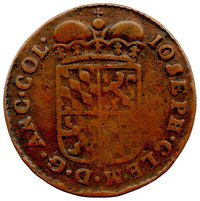
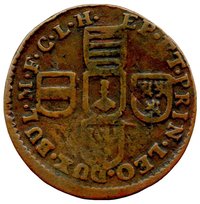
obverse
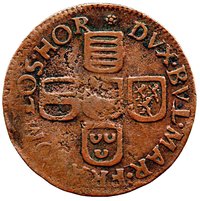
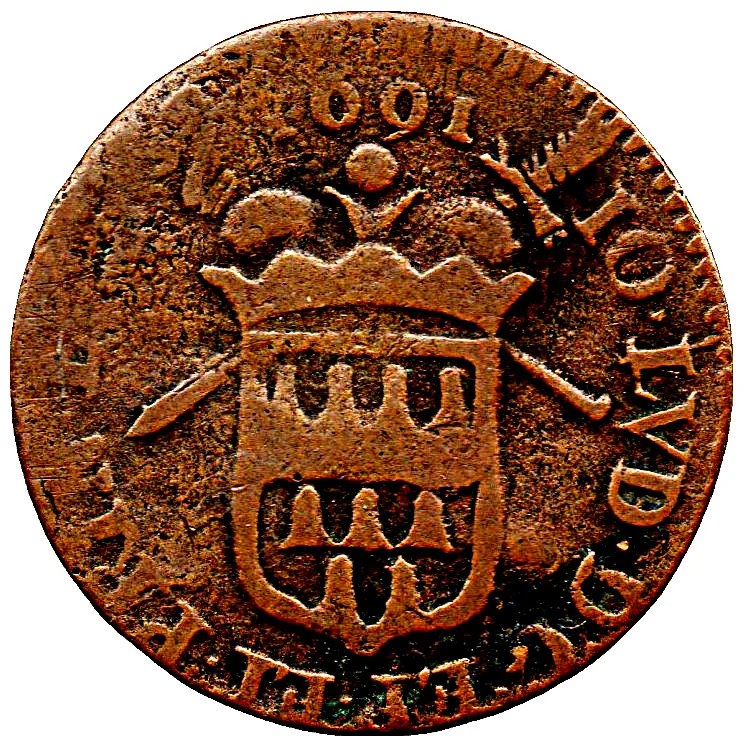
reverse
http://monnaiesliegeoises.over-blog.com/

1 Liard – Prince-bishopric of Liege

Belgium
Context
Years: 1691–1693
Country: Belgium Country flag
Currency:
(1650—1795)
Demonetized: Yes
Material
Diameter: 23 mm
Weight: 3.2 g
Shape: Round
Composition: Copper
Magnetic: No
Alignment: Coin alignment
Obverse
OBVERSE ↑
flip
Reverse
REVERSE ↓
References
KM: #Click to copy to clipboard97
Numista: #48973

Obverse

Description:
The prince's arms, with a crosier and sword in saltire behind, beneath an electoral cap.
Inscription:
IO·LVD·D·G·EP·ET·PRIN·LEO·1691
Script: Latin

Reverse

Description:
Five shields in cross: Hornes above, Looz below, Franchimont right, Bouillon left, Liège center.
Inscription:
DVX·BVL·MAR·FRA·COM·LOS·HOR
Script: Latin

Edge

Plain

Mintings

YearMint MarkMintageQualityCollection
1691
1692
1693

Historical background

In 1691, the Prince-Bishopric of Liège found itself in a precarious monetary situation, caught in the crosscurrents of a wider European currency crisis. The late 17th century was a period of intense warfare, most notably the Nine Years' War (1688-1697), which placed severe financial strain on all belligerents, including Liège's powerful neighbors, France and the Dutch Republic. These states engaged in competitive currency debasement—reducing the precious metal content in their coins—to finance their military campaigns. As a small, neutral territory with a highly developed economy based on arms manufacturing and trade, Liège was flooded with this increasingly inferior foreign coinage, which drove its own better-quality money out of circulation (Gresham's Law).

The local response was largely reactive and struggled to keep pace. The monetary system of the Prince-Bishopric was complex, with minting rights shared between the Prince-Bishop and the Cathedral Chapter, leading to fragmented authority. While official ordinances repeatedly forbade the circulation of debased foreign coins and attempted to fix exchange rates, these measures were largely ineffective in practice. The economic reality dictated that merchants and citizens had to accept the foreign coins for daily transactions, creating confusion, inflation in the prices of goods, and a loss of confidence in the monetary system. The integrity of Liège's own currency, particularly its patard and liard, was undermined.

Consequently, the year 1691 represents a point of acute stress within a longer period of monetary instability. The government of Prince-Bishop Jean-Louis d'Elderen was forced to engage in constant legislative action, issuing proclamations to adjust the legal value of the myriad coins in circulation in a futile attempt to stabilize the economy. This situation eroded princely revenues, disrupted commerce, and placed a burden on the population, highlighting the vulnerability of the Prince-Bishopric's monetary sovereignty amidst the turbulent financial policies of its warring neighbors.
💎 Extremely Rare