


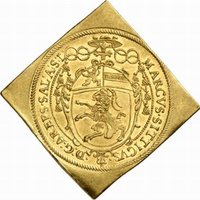
Obverse
Description:
Oval shield under a cross and cardinal's hat. Top: arms of Salzburg. Bottom: arms of Hohenems. Legend around (starts 2h).
Inscription:
MARCVS SITTICVS D G AREPS SAL AP SE L
Script: Latin
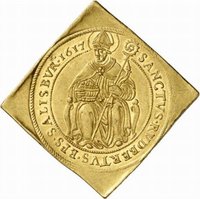
Reverse
Description:
St. Rupert seated left, holding crozier and salt box. Legend encircles, starting at 1 o'clock, with date at its end.
Inscription:
SANCTVS RVDBERTVS EPS SALISBVRG 1617
Script: Latin
Edge
Mintings
| Year | Mint Mark | Mintage | Quality | Collection |
|---|---|---|---|---|
| 1617 | — | — |
Historical background
In 1617, the Bishopric of Salzburg, a wealthy and independent ecclesiastical principality within the Holy Roman Empire, operated within a complex and fragmented monetary landscape. Like most German territories, it did not possess exclusive minting rights but participated in regional monetary unions, primarily the Reichsmünzordnung (Imperial Coinage Ordinance). The intent of these ordinances was to standardize silver coinage across the Empire, but in practice, local princes and bishops, including the Prince-Archbishop of Salzburg, often struck their own coins according to these broad standards. Salzburg's currency in circulation would have been a mix of its own issued coins—such as silver Gulden, Kreuzer, and Pfennige—and a plethora of foreign coins from neighboring states and trade partners, leading to constant challenges of valuation and exchange.
The economic stability of Salzburg's currency was heavily dependent on the famed silver and salt mines it controlled, which provided the bullion reserves necessary for minting. However, the early 17th century was a period of significant monetary tension across Europe due to the influx of cheaper silver from the New World, which caused inflation and debasement. While Salzburg, under the prudent rule of Archbishop Markus Sittikus von Hohenems (1612-1619), was relatively more stable than many territories, it was not immune to these pressures. The bishopric had to vigilantly manage its coinage to maintain its value and credibility, both for internal trade and for its extensive economic dealings across the Alps with Italy and to the north.
This monetary environment existed on the precipice of major conflict. The year 1617 directly preceded the outbreak of the Thirty Years' War (1618-1648), a conflict that would soon unleash catastrophic economic and monetary chaos across the German lands. While Salzburg itself was not a primary battlefield in the initial stages, the impending war threatened the trade routes and bullion flows that were essential for a stable currency. Thus, the currency situation in 1617, while functionally orderly on the surface, was underpinned by the structural frailties of the Imperial monetary system and the looming threat of a war that would severely test the bishopric's financial resilience.
The economic stability of Salzburg's currency was heavily dependent on the famed silver and salt mines it controlled, which provided the bullion reserves necessary for minting. However, the early 17th century was a period of significant monetary tension across Europe due to the influx of cheaper silver from the New World, which caused inflation and debasement. While Salzburg, under the prudent rule of Archbishop Markus Sittikus von Hohenems (1612-1619), was relatively more stable than many territories, it was not immune to these pressures. The bishopric had to vigilantly manage its coinage to maintain its value and credibility, both for internal trade and for its extensive economic dealings across the Alps with Italy and to the north.
This monetary environment existed on the precipice of major conflict. The year 1617 directly preceded the outbreak of the Thirty Years' War (1618-1648), a conflict that would soon unleash catastrophic economic and monetary chaos across the German lands. While Salzburg itself was not a primary battlefield in the initial stages, the impending war threatened the trade routes and bullion flows that were essential for a stable currency. Thus, the currency situation in 1617, while functionally orderly on the surface, was underpinned by the structural frailties of the Imperial monetary system and the looming threat of a war that would severely test the bishopric's financial resilience.

✨ Legendary