

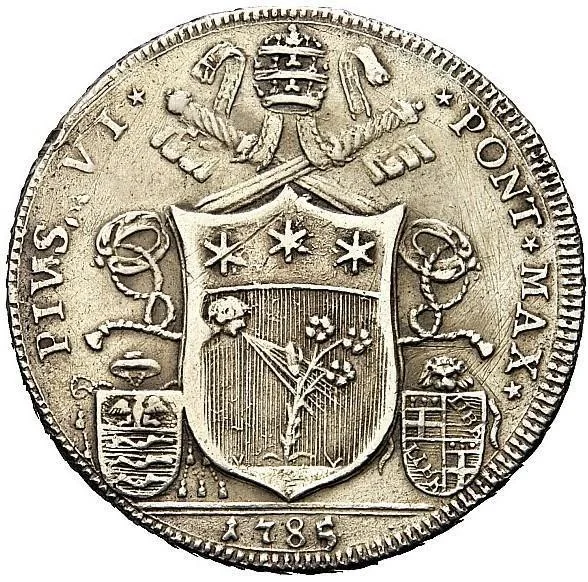

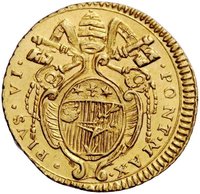
Obverse
Description:
Papal arms with two shields and date.
Inscription:
PIVS VI · ·PONT·MAX·
1785
1785
Script: Latin
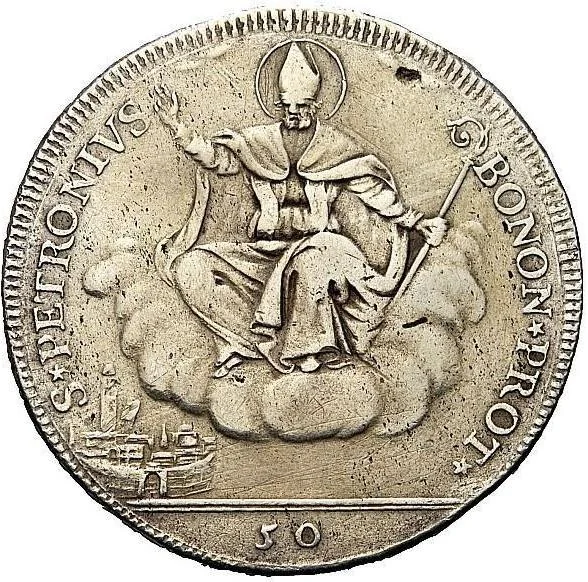
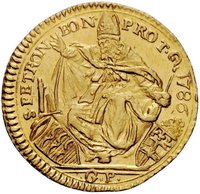
Reverse
Description:
St. Peter seated on clouds, value beneath.
Inscription:
S·PETRONIVS BONON·PROT·
50
50
Script: Latin
Edge
Categories
| Symbols> Coat of Arms |
| Person> Religious figure |
| Symbol> Crown |
| Geography> Town |
| Religion> Religious objects |
Mintings
| Year | Mint Mark | Mintage | Quality | Collection |
|---|---|---|---|---|
| 1785 | — | — |
Historical background
In 1785, Bologna's currency situation was a complex tapestry reflecting its political status within the Papal States. While the city was under the sovereignty of Pope Pius VI, it retained some historic fiscal autonomy. The official monetary system was based on the Papal scudo, divided into 100 baiochi, each of 5 quattrini. However, this official currency circulated alongside a multitude of older, local coins from Bologna's past as an independent commune, as well as foreign specie from neighboring Italian and European states, creating a daily challenge for commerce.
This monetary plurality led to practical difficulties. Merchants and money-changers (banchi) had to constantly assess the weight, purity, and exchange rates of various coins, from the Papal giulio and grosso to lingering Bolognini. The value of these coins was not solely dictated by papal decree but also by their intrinsic silver content and market demand. This environment necessitated a thriving profession of money-changers, whose tables were a common sight, but it also introduced uncertainty and potential for fraud in everyday transactions.
The situation was symptomatic of the broader economic pressures of the time. Bologna's economy, while still featuring significant textile and agricultural markets, was constrained by papal fiscal policies and the fragmented Italian monetary landscape. The circulation of so many coin types indicated both a lingering local identity and an inefficient system that hampered trade. This complexity would persist until the Napoleonic invasions a decade later, which swept away the old papal monetary structures and imposed a more uniform, decimal-based system.
This monetary plurality led to practical difficulties. Merchants and money-changers (banchi) had to constantly assess the weight, purity, and exchange rates of various coins, from the Papal giulio and grosso to lingering Bolognini. The value of these coins was not solely dictated by papal decree but also by their intrinsic silver content and market demand. This environment necessitated a thriving profession of money-changers, whose tables were a common sight, but it also introduced uncertainty and potential for fraud in everyday transactions.
The situation was symptomatic of the broader economic pressures of the time. Bologna's economy, while still featuring significant textile and agricultural markets, was constrained by papal fiscal policies and the fragmented Italian monetary landscape. The circulation of so many coin types indicated both a lingering local identity and an inefficient system that hampered trade. This complexity would persist until the Napoleonic invasions a decade later, which swept away the old papal monetary structures and imposed a more uniform, decimal-based system.
✨ Legendary