Logo Title
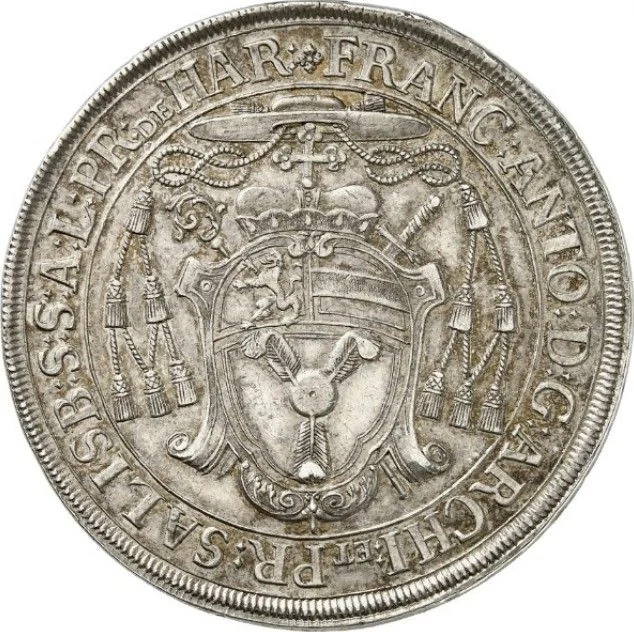
obverse
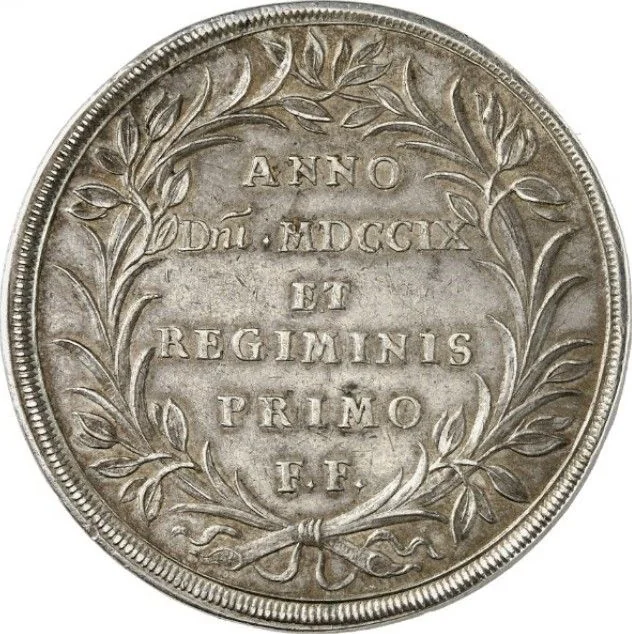
reverse
Fritz Rudolf Künker GmbH & Co. KG, Osnabrück and Lübke & Wiedemann KG, Leonberg

1 Thaler - 1 Guldiner – Bishopric of Salzburg

Non-circulating coins
Commemoration: From the intronization
Context
Year: 1709
Currency:
Demonetized: Yes
Material
Diameter: 42 mm
Weight: 29.5 g
Silver weight: 29.50 g
Shape: Round
Composition: Silver
Magnetic: No
References
KM: #Click to copy to clipboard295
Numista: #479588
Value
Bullion value: $82.77

Obverse

Description:
Cardinal's hat above a baroque shield with Salzburg's arms, over a sword and crozier. Circular legend.
Inscription:
FRANC ANTO D G ARCHI ET PR SALISB S S A L PR DE HAR
Script: Latin

Reverse

Description:
Legend in laurel crown.
Inscription:
ANNO

Dni MDCCIX

ET

REGIMINIS

PRIMO

F.F.
Script: Latin

Edge

Mintings

YearMint MarkMintageQualityCollection
1709

Historical background

In 1709, the Bishopric of Salzburg, a wealthy and independent ecclesiastical principality within the Holy Roman Empire, faced significant monetary instability, a common challenge across German lands in this period. The primary issue stemmed from the widespread debasement of coinage, where ruling authorities reduced the precious metal content in coins to generate short-term profit from seigniorage. This practice, engaged in by numerous states, led to a flood of low-quality coins circulating alongside older, higher-value pieces, causing confusion, inflation, and a loss of public trust in the currency system. For a trade-oriented state like Salzburg, whose wealth derived from salt mines, transit trade, and banking, such monetary chaos disrupted commerce and financial predictability.

The situation was exacerbated by the pressures of the War of the Spanish Succession (1701-1714). While not a primary battlefield, Salzburg, under Prince-Archbishop Franz Anton von Harrach, faced immense financial strain from imperial war taxes and the need to maintain its own defenses. Debasement offered a tempting, if destructive, way to meet these sudden fiscal demands. Consequently, the local currency—primarily Gulden, Kreuzer, and Pfennig—saw its value become highly unstable against the benchmark Reichsthaler. The market became flooded with inferior coins from neighboring territories, further complicating transactions and disadvantaging Salzburg's merchants and populace.

In response to this crisis, Archbishop von Harrach pursued a policy of monetary stabilization. His administration worked to recall debased coinage and issue new, properly valued money, aligning Salzburg's currency more closely with imperial standards. This effort was part of a broader, though often fragmented, movement within the Empire to restore monetary order. The 1709 reforms aimed to protect Salzburg's economic integrity, ensure the reliability of its renowned banking houses, and reassert princely control over finance, highlighting the constant struggle between short-term fiscal necessity and long-term economic health in the early modern state.
Legendary