

1 Quattrino – Papal States
Vatican City
Context
Years: 1635–1636
Country: Vatican City 
Issuer: Papal States
Ruler: Urban VIII
Currency:
(1534—1835)
Demonetized: Yes
Material
References
KM: #Click to copy to clipboard186
Numista: #463546
Obverse
Description:
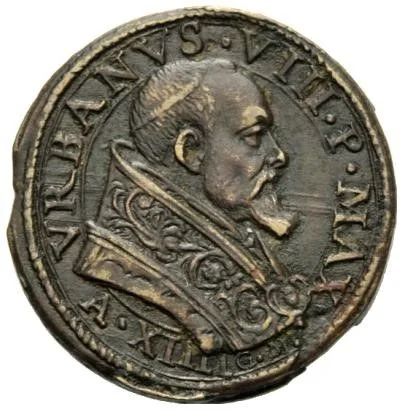
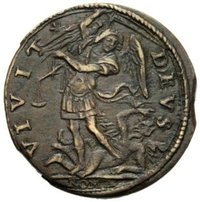
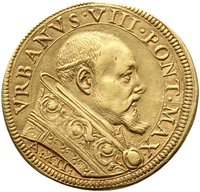
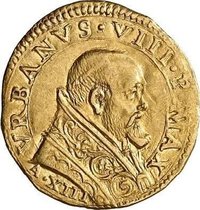
Bust right. Pontifical year and initials below.
Inscription:
VRBANVS · · VIII · P · MAX ·
A · XIIII · G · M ·
A · XIIII · G · M ·
Script: Latin
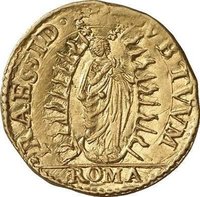
Reverse
Description:
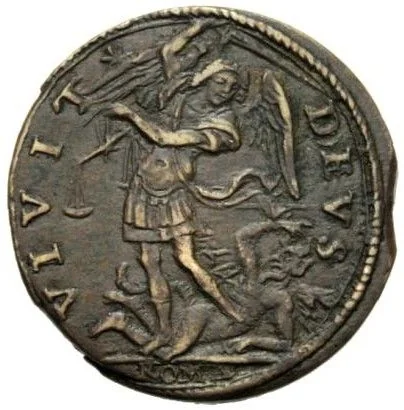
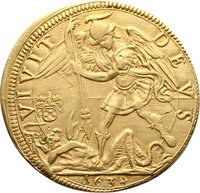
Saint Michael stands on Satan, wielding a sword in his right hand and scales in his left. Mint name below.
Inscription:
DEVS VIVIT
ROMA
ROMA
Script: Latin
Edge
Categories
| Person> Religious figure |
| Symbols> Coat of Arms |
| Object> Cold weapons |
Mints
| Name | Mark |
|---|---|
| Rome | — |
Mintings
| Year | Mint Mark | Mintage | Quality | Collection |
|---|---|---|---|---|
| — | — | — | ||
| — | — | — | BU |
Historical background
In 1635, the Papal States existed within a complex and strained monetary system typical of early modern Italy. The primary unit of account was the scudo, a silver coin, but the reality of daily transactions was a chaotic jumble of circulating specie. Alongside Papal-issued scudi, giuli, and baiocchi, there was a flood of foreign coins from other Italian states, Spain, and the Ottoman Empire, each with fluctuating intrinsic metal values. This proliferation created constant challenges for commerce, as merchants and officials had to navigate varying exchange rates and widespread debasement, where coins were minted with less precious metal than their face value declared.
The financial pressures on the Papacy under Pope Urban VIII (Barberini) were severe, heavily driven by military costs. The War of Castro (1641-44) was looming, and the Papacy was deeply involved in the Thirty Years' War, requiring vast sums to support the Catholic League. To raise revenue, the Papal treasury increasingly resorted to fiscal instruments like the sale of public offices (venal offices) and annuities (monti), but also to currency manipulation. Debasement and the issuance of overvalued copper piccioli small coinage became a tempting short-term solution to fund deficits, though this eroded public trust and sparked inflation, particularly burdening the poor who used copper for everyday purchases.
Consequently, the year 1635 represents a point of growing monetary instability within a broader fiscal crisis. The Papal Mint struggled to maintain the standard of its silver currency while economic pressures pushed it toward debasement. This environment of multiple circulating media, inflationary pressures from copper, and the state's reliance on seigniorage (profit from minting) created a fragile and inefficient financial system. It was a system on the brink, foreshadowing the more acute monetary disorders and popular discontent that would manifest later in Urban VIII's pontificate, especially during the costly War of Castro.
The financial pressures on the Papacy under Pope Urban VIII (Barberini) were severe, heavily driven by military costs. The War of Castro (1641-44) was looming, and the Papacy was deeply involved in the Thirty Years' War, requiring vast sums to support the Catholic League. To raise revenue, the Papal treasury increasingly resorted to fiscal instruments like the sale of public offices (venal offices) and annuities (monti), but also to currency manipulation. Debasement and the issuance of overvalued copper piccioli small coinage became a tempting short-term solution to fund deficits, though this eroded public trust and sparked inflation, particularly burdening the poor who used copper for everyday purchases.
Consequently, the year 1635 represents a point of growing monetary instability within a broader fiscal crisis. The Papal Mint struggled to maintain the standard of its silver currency while economic pressures pushed it toward debasement. This environment of multiple circulating media, inflationary pressures from copper, and the state's reliance on seigniorage (profit from minting) created a fragile and inefficient financial system. It was a system on the brink, foreshadowing the more acute monetary disorders and popular discontent that would manifest later in Urban VIII's pontificate, especially during the costly War of Castro.
✨ Legendary