Logo Title
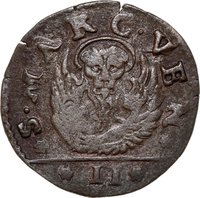
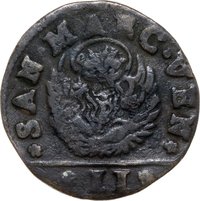
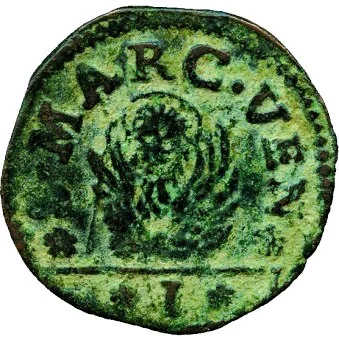
obverse
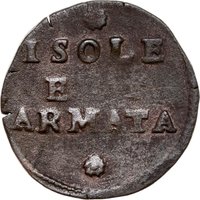
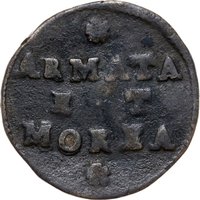
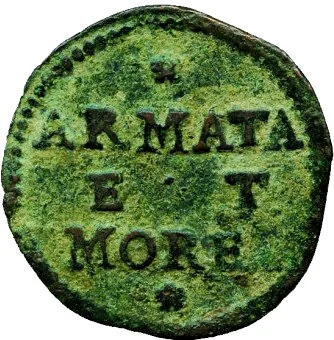
reverse
A. H. Baldwin & Sons Ltd

1 Soldo – Kingdom of the Morea

Greece
Context
Years: 1688–1691
Country: Greece Country flag
Period:
(1684—1699)
Currency:
(1688—1715)
Demonetized: Yes
Material
Diameter: 24 mm
Composition: Copper
Magnetic: No
References
KM: #Click to copy to clipboard1
Numista: #115968

Obverse

Description:
St. Mark's Lion, 'I' below.
Inscription:
S·MARC·VEN·

*I*
Script: Latin

Reverse

Description:
3-line inscription with rosettes above and below.
Inscription:
ARMATA

E · T

MOREA
Script: Latin

Edge

Categories

Animal> Feline

Mintings

YearMint MarkMintageQualityCollection

Historical background

In 1688, the currency situation in the Kingdom of the Morea was a complex and unstable system directly resulting from its creation by the Republic of Venice following the Ottoman-Venetian War (1684-1699). Venice had conquered the Peloponnese (Morea) from the Ottomans in 1687 and established a nominally feudal kingdom. The new administration inherited a monetary vacuum, as Ottoman coinage had largely fled the territory and Venetian trade coins like the zecchino (ducat) and lira were not produced in sufficient quantities for local daily use.

To address this, Venetian authorities implemented a pragmatic but problematic dual-currency system. Official transactions, military pay, and long-distance trade were conducted in Venetian silver reali and gold zecchini. However, for the local Greek population's everyday economy, the government was forced to officially recognize and regulate the continued circulation of debased Ottoman copper coins, the mangır (or pare). This created a fixed, arbitrary exchange rate between the high-value Venetian silver and the low-value Ottoman copper, a rate that did not reflect market realities and was prone to manipulation.

Consequently, the monetary environment was marked by scarcity, confusion, and inherent weakness. The shortage of small-denomination Venetian coinage stifled local trade, while the reliance on a foreign, base-metal currency undermined the state's fiscal authority. This fragile system reflected the kingdom's tenuous position—a Venetian colonial project built on recently conquered land, struggling to impose a new economic order on a persistent Ottoman monetary substrate, all while the war with the Ottoman Empire continued. This instability would persist until the Ottoman reconquest of the region in 1715.
💎 Extremely Rare