

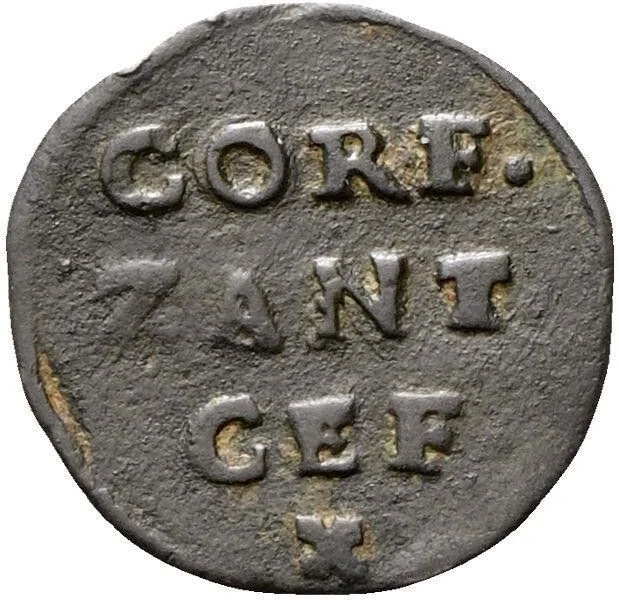
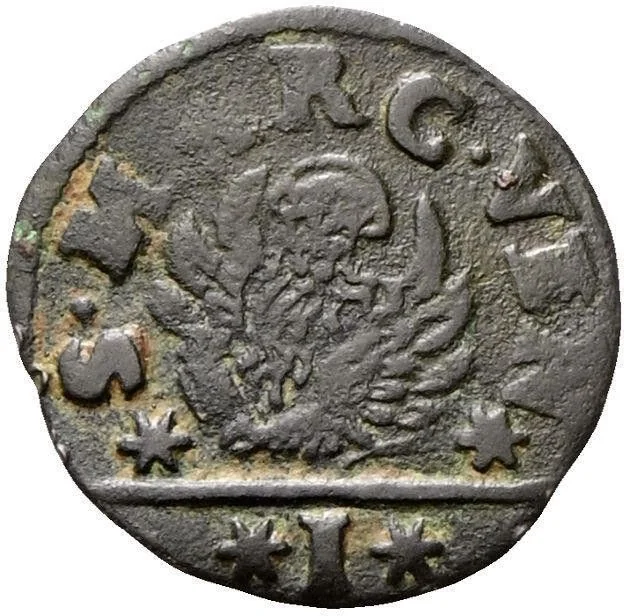
1 soldo – Venetian rule in the Ionian Islands
Add to wishlist
Greece
Context
Material
Diameter: 21 mm
Weight: 2.44 g
Shape: Irregular round
Composition: Copper
Magnetic: No
Alignment: Coin alignment
flip
References
KM: #
Numista: #459124
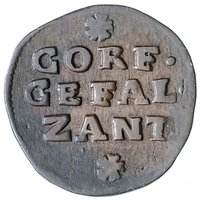
Obverse
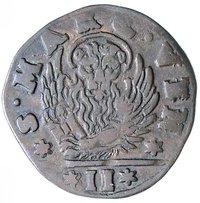
Reverse
Description:
Lion of St. Mark holding book; value in exergue in Roman numerals.
Inscription:
🞹 S · MARC · VEN 🞹
🞹 I 🞹
🞹 I 🞹
Script: Latin
Edge
Mints
| Name | Mark |
|---|---|
| Venice | — |
Mintings
| Year | Mint Mark | Mintage | Quality | Collection |
|---|---|---|---|---|
| — | — | — |
Historical background
In 1710, the Ionian Islands (principally Corfu, Cephalonia, Zante, and Lefkada) existed in a complex monetary environment under Venetian rule, a situation reflecting both their strategic importance and their economic role within the Republic’s maritime empire. Officially, the Venetian monetary system was in force, with the silver lira as the primary unit of account, subdivided into 20 soldi or 240 denari. High-value transactions, especially in international trade, were conducted using gold zecchini and large silver ducato coins. However, the reality in the islands' ports was one of significant currency plurality due to their position at the crossroads of Mediterranean commerce.
The local economy was inundated with a wide variety of foreign coins, a direct result of the islands' role as entrepôts. Spanish reales (pieces of eight), Ottoman piastres, French écus, and other European and Levantine currencies circulated freely alongside Venetian issues. This created constant challenges for merchants and authorities, requiring sophisticated exchange rate lists and the expertise of money-changers. The value of these coins was determined by their intrinsic metal content (gold or silver weight and purity), leading to frequent fluctuations and arbitrage.
For the Venetian administration in 1710, managing this currency mosaic was a persistent struggle aimed at maintaining fiscal control and ensuring that taxes and official transactions were settled in reliable Venetian specie. Decrees periodically attempted to fix exchange rates or ban certain foreign coins, but these were often ineffective against market forces. Consequently, the monetary landscape was one of de facto hybridity, where the official Venetian system provided a framework for accounting and state revenue, while a diverse pool of foreign silver and gold coins fueled the vibrant and essential daily trade of the islands.
The local economy was inundated with a wide variety of foreign coins, a direct result of the islands' role as entrepôts. Spanish reales (pieces of eight), Ottoman piastres, French écus, and other European and Levantine currencies circulated freely alongside Venetian issues. This created constant challenges for merchants and authorities, requiring sophisticated exchange rate lists and the expertise of money-changers. The value of these coins was determined by their intrinsic metal content (gold or silver weight and purity), leading to frequent fluctuations and arbitrage.
For the Venetian administration in 1710, managing this currency mosaic was a persistent struggle aimed at maintaining fiscal control and ensuring that taxes and official transactions were settled in reliable Venetian specie. Decrees periodically attempted to fix exchange rates or ban certain foreign coins, but these were often ineffective against market forces. Consequently, the monetary landscape was one of de facto hybridity, where the official Venetian system provided a framework for accounting and state revenue, while a diverse pool of foreign silver and gold coins fueled the vibrant and essential daily trade of the islands.
✨ Legendary