

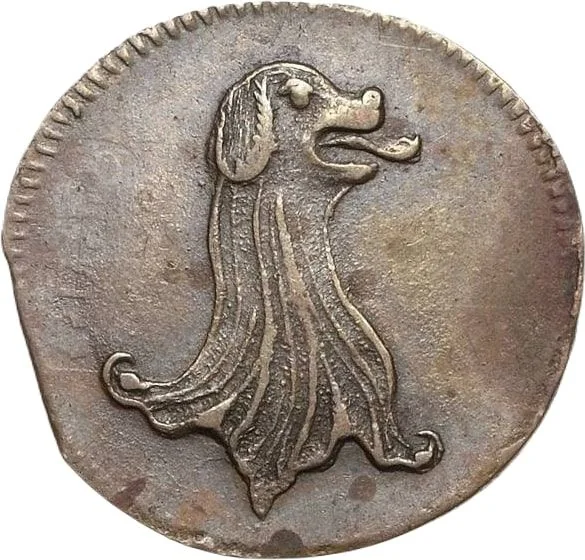
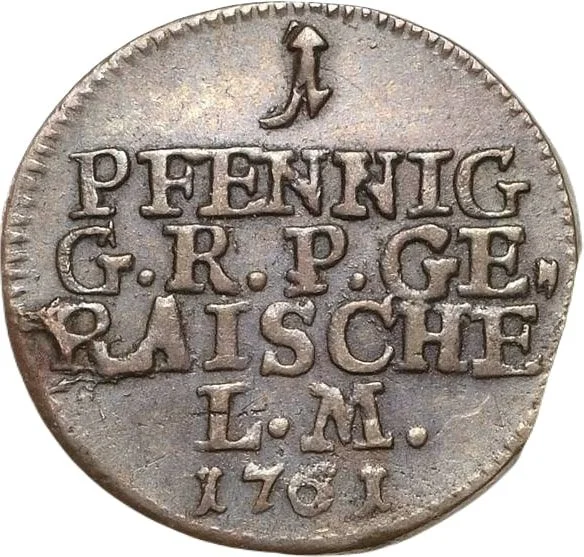
1 Pfennig – Reuss-Gera
Germany

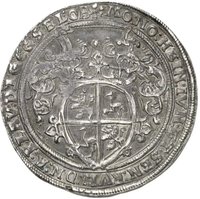
Obverse
Description:
Dog facing right.
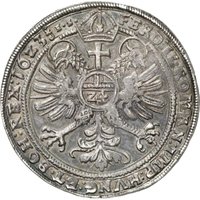
Reverse
Description:
Denomination and date on six lines.
Inscription:
I
PFENNIG
G.R.P.GE.
RAISCHE
L.M.
1761
PFENNIG
G.R.P.GE.
RAISCHE
L.M.
1761
Script: Latin
Edge
Mints
| Name | Mark |
|---|---|
| Saalfeld | — |
Mintings
| Year | Mint Mark | Mintage | Quality | Collection |
|---|---|---|---|---|
| 1761 | — | — |
Historical background
In 1761, the currency situation in the small Thuringian principality of Reuss-Gera was complex and challenging, reflecting the fragmented political and economic landscape of the Holy Roman Empire. The state, like its many neighbors, issued its own coinage—primarily Groschen and Kreuzers—but these circulated alongside a multitude of foreign coins from other German states, Austrian thalers, and even French and Dutch money. This created a chaotic monetary environment where exchange rates fluctuated constantly, and the value of coinage was heavily dependent on its precious metal content, which rulers often debased to finance their expenditures.
The immediate pressure in 1761 was the financial strain of the ongoing Seven Years' War (1756-1763). Although not a primary battlefield, Reuss-Gera, like all German territories, was caught in the wider conflict and faced immense fiscal demands. The ruling Count, Heinrich XXV, was almost certainly compelled to extract every possible resource to pay for troop levies, war contributions to larger powers, and general state maintenance. This often led to the issuance of inferior coinage or the clipping of existing coins, a practice that further eroded public trust in the currency and spurred inflation, harming local trade and the peasant economy.
Consequently, daily commerce in Gera and its surrounding lands operated under a cloud of uncertainty. Merchants and citizens had to be expert assayers, constantly evaluating the real value of mixed coinage in their purses. The lack of a uniform, trusted currency hindered economic development and integrated the principality into a precarious regional system. The situation in 1761 was thus one of monetary instability, directly tied to the wartime fiscal desperation of a small state navigating survival within the Empire's intricate and competitive monetary web.
The immediate pressure in 1761 was the financial strain of the ongoing Seven Years' War (1756-1763). Although not a primary battlefield, Reuss-Gera, like all German territories, was caught in the wider conflict and faced immense fiscal demands. The ruling Count, Heinrich XXV, was almost certainly compelled to extract every possible resource to pay for troop levies, war contributions to larger powers, and general state maintenance. This often led to the issuance of inferior coinage or the clipping of existing coins, a practice that further eroded public trust in the currency and spurred inflation, harming local trade and the peasant economy.
Consequently, daily commerce in Gera and its surrounding lands operated under a cloud of uncertainty. Merchants and citizens had to be expert assayers, constantly evaluating the real value of mixed coinage in their purses. The lack of a uniform, trusted currency hindered economic development and integrated the principality into a precarious regional system. The situation in 1761 was thus one of monetary instability, directly tied to the wartime fiscal desperation of a small state navigating survival within the Empire's intricate and competitive monetary web.

✨ Legendary