

20 scudi – Malta
Add to wishlist
Malta
Obverse
Description:
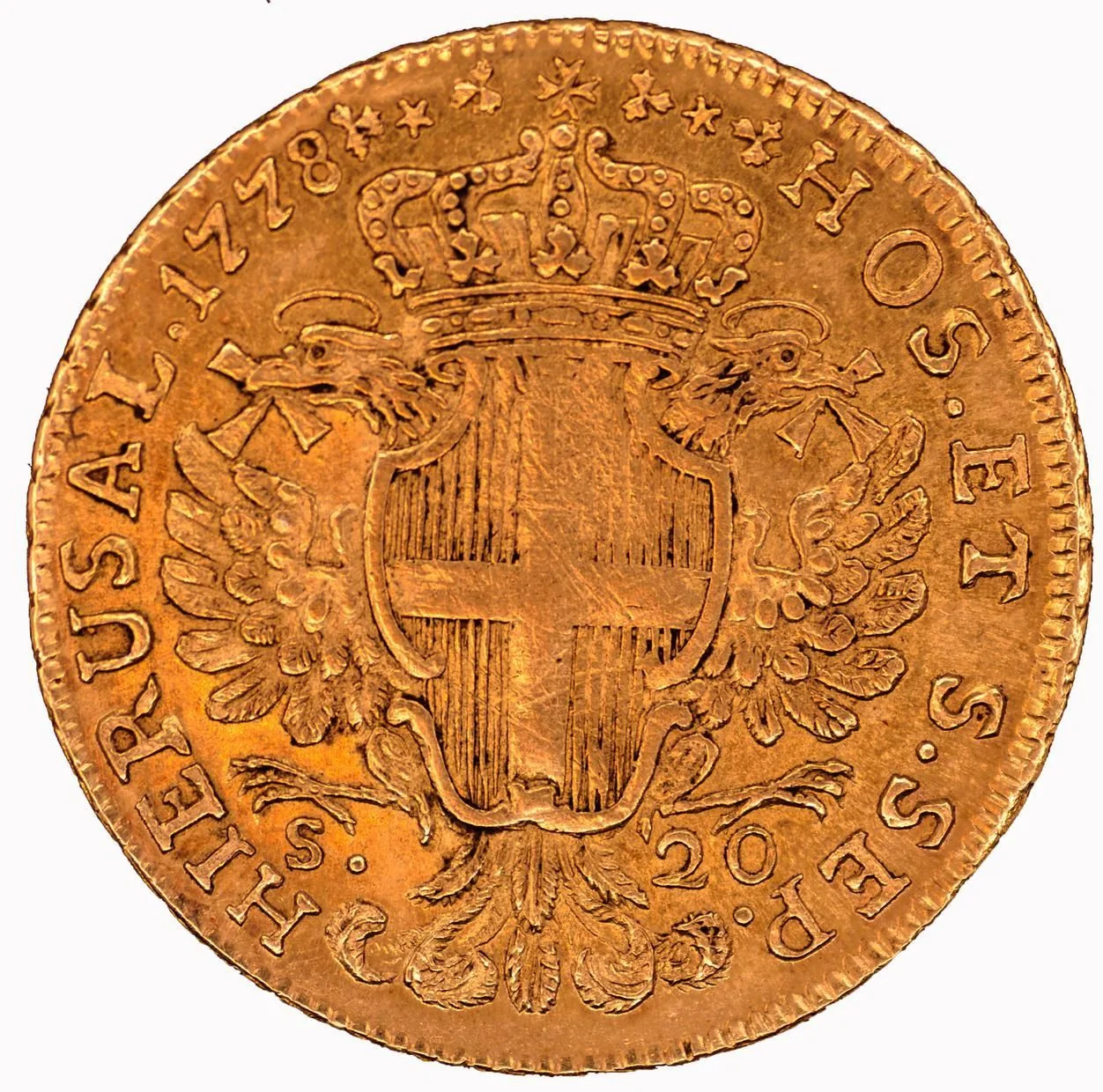
Imperial eagle with crowned arms.
Inscription:
HOS ET S SEP HIERUSAL 1778
Script: Latin
Reverse
Edge
Mintings
| Year | Mint Mark | Mintage | Quality | Collection |
|---|---|---|---|---|
| 1798 | — | — |
Historical background
In 1798, the currency situation in Malta was one of profound instability and transition, directly resulting from the islands' sudden change in sovereignty. For over 250 years, Malta had been governed by the Order of Saint John, which operated its own monetary system. The principal circulating coin was the Maltese scudo, alongside a complex system of tari, grani, and piccioli. The Order's coinage, minted at the Zecca in Valletta, was respected and stable, but the economy also relied heavily on a diverse mix of foreign coins, particularly Spanish dollars and Sicilian pieces, reflecting the island's pivotal role in Mediterranean trade.
This stability was shattered in June 1798 when Napoleon Bonaparte's French forces expelled the Knights with little resistance. The French occupation, though brief, had an immediate and catastrophic financial impact. As per revolutionary practice, the French authorities looted the Treasury of the Order, seizing precious metals and valuables from churches and palaces to fund their ongoing campaign, notably the expedition to Egypt. This drained the island of its bullion reserves, which underpinned the monetary system. To cover their administrative costs, the French then issued a new, forced paper currency, mandating its use for all transactions.
The Maltese population, already resentful of French anti-clerical reforms, rejected this unbacked paper money, leading to a rapid collapse in trust and a severe liquidity crisis. With the Order's specie looted or hoarded and the French paper notes worthless, commerce ground to a halt, exacerbating widespread hardship. This financial chaos, coupled with oppressive French rule, was a primary catalyst for the popular uprising that began in September 1798. By the time the Maltese rebels successfully called for British assistance and established a blockade, the islands' currency system was in complete disarray, a situation the subsequent British protectorate would spend years rectifying.
This stability was shattered in June 1798 when Napoleon Bonaparte's French forces expelled the Knights with little resistance. The French occupation, though brief, had an immediate and catastrophic financial impact. As per revolutionary practice, the French authorities looted the Treasury of the Order, seizing precious metals and valuables from churches and palaces to fund their ongoing campaign, notably the expedition to Egypt. This drained the island of its bullion reserves, which underpinned the monetary system. To cover their administrative costs, the French then issued a new, forced paper currency, mandating its use for all transactions.
The Maltese population, already resentful of French anti-clerical reforms, rejected this unbacked paper money, leading to a rapid collapse in trust and a severe liquidity crisis. With the Order's specie looted or hoarded and the French paper notes worthless, commerce ground to a halt, exacerbating widespread hardship. This financial chaos, coupled with oppressive French rule, was a primary catalyst for the popular uprising that began in September 1798. By the time the Maltese rebels successfully called for British assistance and established a blockade, the islands' currency system was in complete disarray, a situation the subsequent British protectorate would spend years rectifying.
Navigation Non-circulating coins of Malta
✨ Legendary