

30 Kreuzers – Landgraviate of Hesse-Darmstadt
Context
Year: 1759
Issuer: Landgraviate of Hesse-Darmstadt
Ruler: Louis VIII
Currency:
(1568—1805)
Demonetized: Yes
References
KM: #Click to copy to clipboard194
Numista: #447315
Value
Bullion value: $19.12
Obverse
Description:
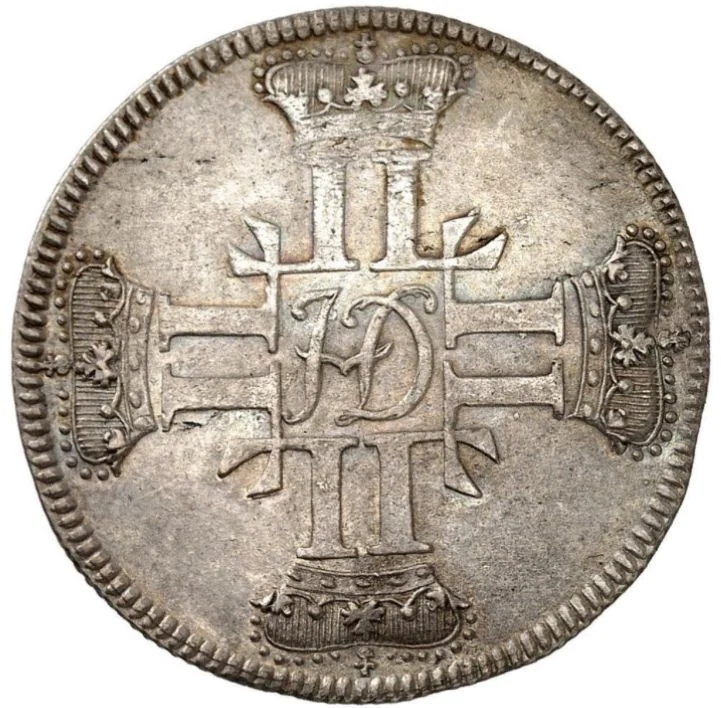
Four monograms crowned in a cross.
Inscription:
LL LL LL LL
HD
HD
Scripts: Latin, Latin (cursive)
Reverse
Description:
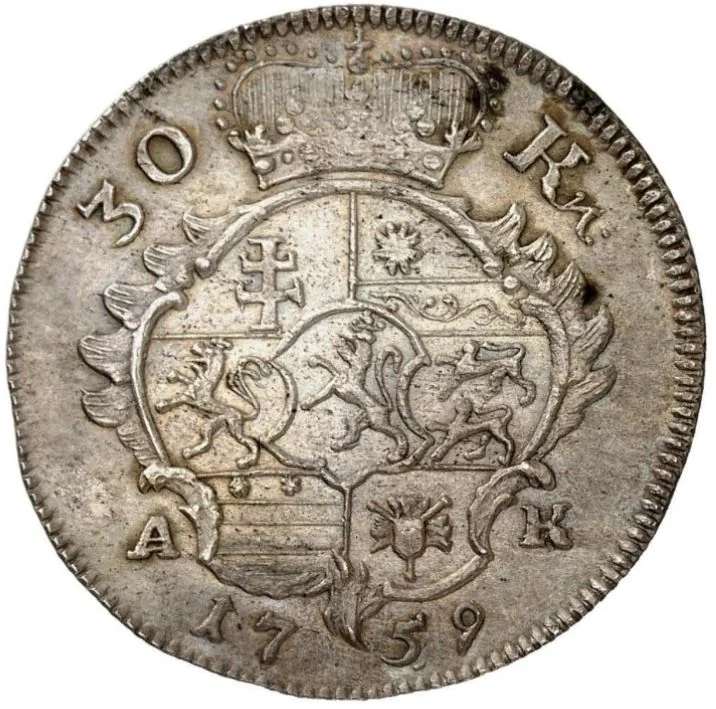
Crowned arms in cartouche divides value, with mint official's initials at sides and date below.
Inscription:
30 Kr.
A K
1759
A K
1759
Script: Latin
Edge
Mints
| Name | Mark |
|---|---|
| Darmstadt | — |
Mintings
| Year | Mint Mark | Mintage | Quality | Collection |
|---|---|---|---|---|
| 1759 | — | — |
Historical background
In 1759, the Landgraviate of Hesse-Darmstadt, under Landgrave Ludwig VIII, was deeply entangled in the global conflict of the Seven Years' War (1756-1763). While not a primary belligerent like its northern neighbor Hesse-Kassel, Hesse-Darmstadt faced severe financial strain due to military mobilization and the economic disruptions of war. The landgraviate maintained a contingent of troops in allied service, and the costs of sustaining this force, coupled with the passage of foreign armies through its territory, placed a heavy burden on its treasury. This fiscal pressure was the primary catalyst for the currency manipulations of the period.
The response to this crisis was a deliberate debasement of the coinage. The state mint, seeking to extract immediate profit, began issuing inferior coins—particularly the Gute Groschen—with the same face value but reduced silver content. This practice, akin to printing money, created a short-term influx of funds for the war effort but triggered inflation and a loss of public confidence. Consequently, older, purer coins were hoarded or melted down (Gresham's Law), leaving circulation dominated by the new, debased currency and leading to a complex system where multiple coinages with varying intrinsic values existed side-by-side, disrupting trade and daily commerce.
This situation was not isolated but part of a wider "Kipper- und Wipperzeit" (clipping and waving time) across the Holy Roman Empire, where numerous states engaged in competitive devaluation. For Hesse-Darmstadt, the consequences in 1759 were a severely weakened economy, rising prices for essential goods, and long-term damage to the credibility of its monetary authority. The landgraviate's currency would remain unstable for years, requiring eventual and difficult recoinage efforts to restore stability after the war's conclusion.
The response to this crisis was a deliberate debasement of the coinage. The state mint, seeking to extract immediate profit, began issuing inferior coins—particularly the Gute Groschen—with the same face value but reduced silver content. This practice, akin to printing money, created a short-term influx of funds for the war effort but triggered inflation and a loss of public confidence. Consequently, older, purer coins were hoarded or melted down (Gresham's Law), leaving circulation dominated by the new, debased currency and leading to a complex system where multiple coinages with varying intrinsic values existed side-by-side, disrupting trade and daily commerce.
This situation was not isolated but part of a wider "Kipper- und Wipperzeit" (clipping and waving time) across the Holy Roman Empire, where numerous states engaged in competitive devaluation. For Hesse-Darmstadt, the consequences in 1759 were a severely weakened economy, rising prices for essential goods, and long-term damage to the credibility of its monetary authority. The landgraviate's currency would remain unstable for years, requiring eventual and difficult recoinage efforts to restore stability after the war's conclusion.
✨ Legendary