

20 Kreuzers – Landgraviate of Hesse-Darmstadt
Context
Year: 1766
Issuer: Landgraviate of Hesse-Darmstadt
Ruler: Louis VIII
Currency:
(1568—1805)
Demonetized: Yes
References
KM: #Click to copy to clipboard222
Numista: #447175
Value
Bullion value: $18.58
Obverse
Description:
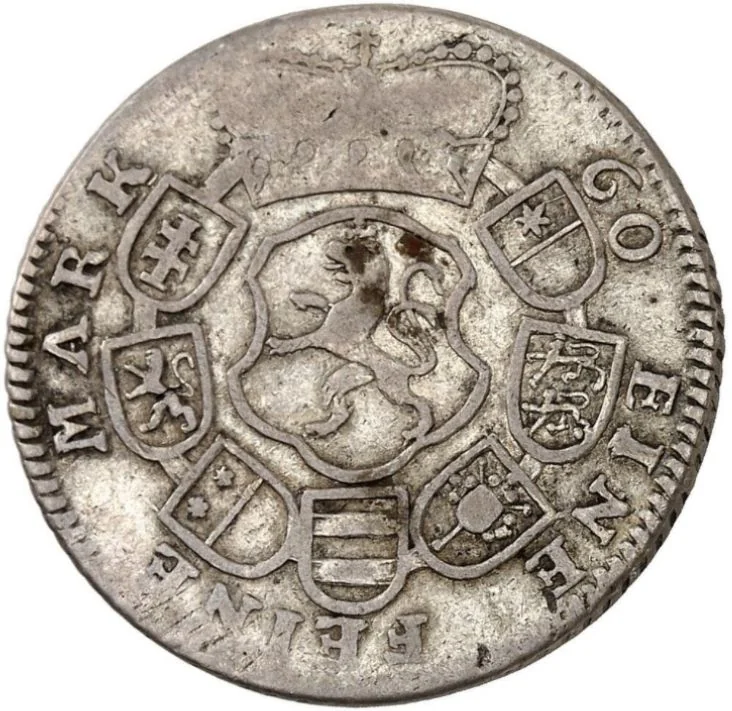
Crowned lion shield encircled by seven smaller shields, value around.
Inscription:
60 EINE FEINE MARK
Script: Latin
Reverse
Description:
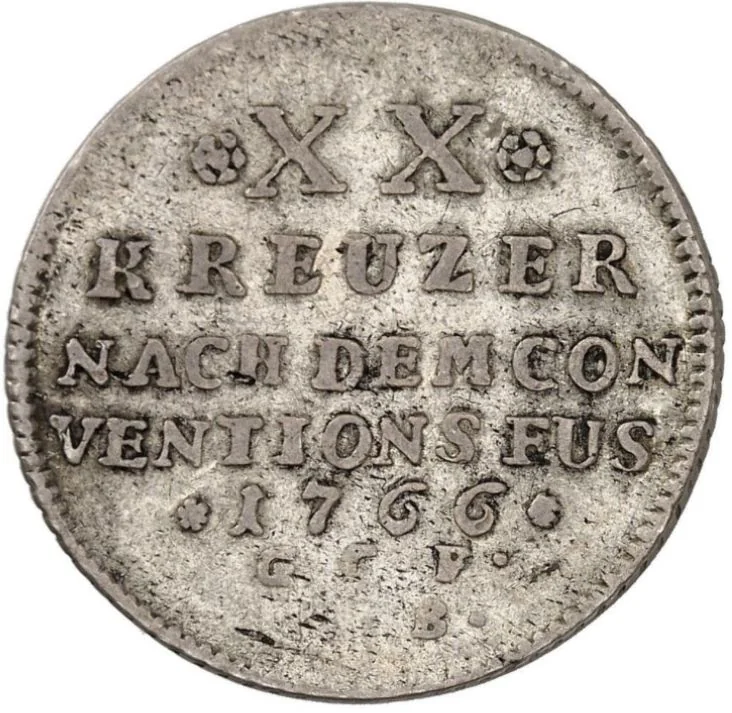
Value, date in Roman numerals, mint officials' marks below.
Inscription:
✿XX✿
KREUZER
NACH DEM CON
VENTIONS FUS
✿1766✿
GCF·
PB·
KREUZER
NACH DEM CON
VENTIONS FUS
✿1766✿
GCF·
PB·
Script: Latin
Edge
Mints
| Name | Mark |
|---|---|
| Darmstadt | — |
Mintings
| Year | Mint Mark | Mintage | Quality | Collection |
|---|---|---|---|---|
| 1766 | — | — |
Historical background
In 1766, the currency situation in the Landgraviate of Hesse-Darmstadt was characterized by significant fragmentation and instability, a common challenge within the Holy Roman Empire. The landgraviate did not have a unified, sovereign currency but operated within a complex monetary system where various silver Taler coins, regional Kreuzer, and Heller denominations circulated alongside the currencies of neighboring states. This proliferation of different coins, often with varying silver content and value, created chronic confusion for commerce and facilitated widespread debasement, where coins were minted with less precious metal than their face value claimed.
The primary monetary reference point was the Reichstaler, a theoretical standard set by imperial ordinances. However, the practical day-to-day currency was the Hessen-Darmstädtischer Kuranttaler, which was often minted in response to local fiscal needs, particularly to finance the state's administrative costs and the court of Landgrave Ludwig VIII. The need for revenue, especially after the costly Seven Years' War (1756-1763), placed constant pressure on the treasury, tempting the authorities to engage in debasement, thereby eroding public trust in the currency and causing inflationary pressures.
Consequently, 1766 fell within a period of ongoing monetary adjustment rather than reform. Transactions required careful evaluation of coins by weight and fineness, hindering economic development. While some neighboring territories were moving toward more standardized systems, Hesse-Darmstadt's monetary landscape remained a patchwork of old and new coins, a situation that would persist until more forceful standardization efforts emerged in the following decades under Landgrave Ludwig IX and, ultimately, the broader reforms of the Napoleonic era.
The primary monetary reference point was the Reichstaler, a theoretical standard set by imperial ordinances. However, the practical day-to-day currency was the Hessen-Darmstädtischer Kuranttaler, which was often minted in response to local fiscal needs, particularly to finance the state's administrative costs and the court of Landgrave Ludwig VIII. The need for revenue, especially after the costly Seven Years' War (1756-1763), placed constant pressure on the treasury, tempting the authorities to engage in debasement, thereby eroding public trust in the currency and causing inflationary pressures.
Consequently, 1766 fell within a period of ongoing monetary adjustment rather than reform. Transactions required careful evaluation of coins by weight and fineness, hindering economic development. While some neighboring territories were moving toward more standardized systems, Hesse-Darmstadt's monetary landscape remained a patchwork of old and new coins, a situation that would persist until more forceful standardization efforts emerged in the following decades under Landgrave Ludwig IX and, ultimately, the broader reforms of the Napoleonic era.

✨ Legendary