

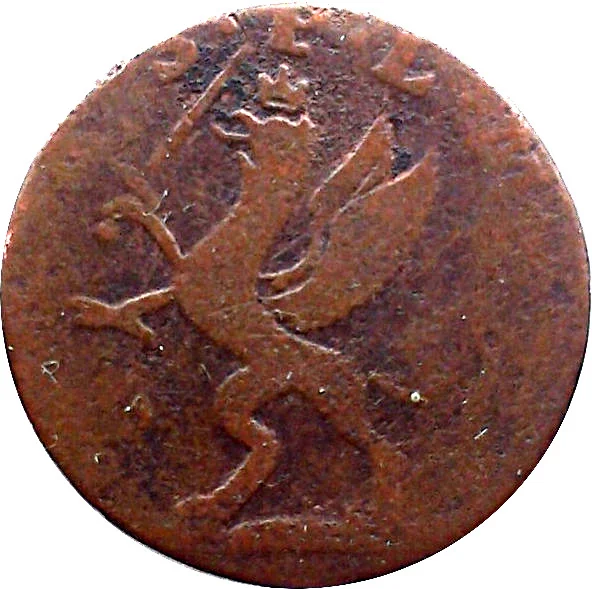
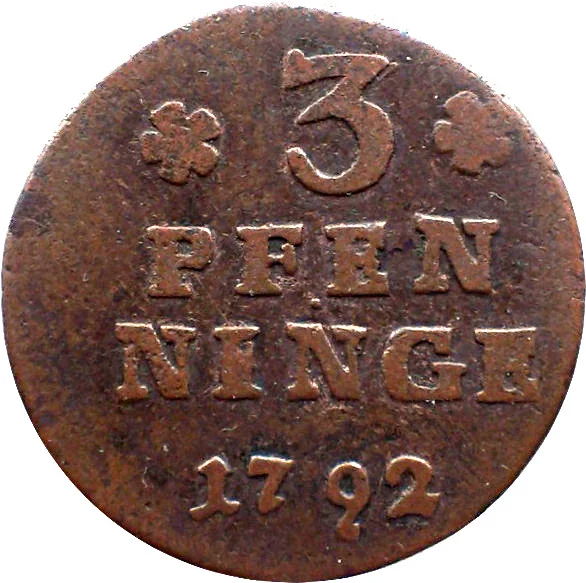
3 Pfennigs – Swedish dominion of Pomerania
Sweden
Context
Years: 1776–1808
Country: Sweden 
Issuer: Swedish dominion of Pomerania
Ruler: Gustav III
Currency:
(1630—1815)
Demonetized: Yes
Total mintage: 1,410,000
Material
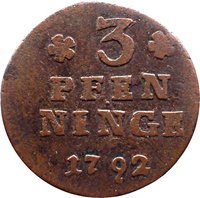
References
KM: #Click to copy to clipboard422
Numista: #43924
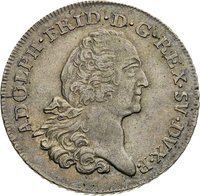
Obverse
Reverse
Edge
Plain
Mintings
| Year | Mint Mark | Mintage | Quality | Collection |
|---|---|---|---|---|
| 1776 | — | 384,000 | ||
| 1792 | — | 384,000 | ||
| 1806 | — | 384,000 | ||
| 1808 | — | 258,000 |
Historical background
In 1776, the currency situation in Swedish Pomerania was complex and strained, characterized by a dual system that created significant economic friction. The province officially used Swedish currency, with the Riksdaler divided into 48 skillings, as mandated by Stockholm. However, due to centuries of historical ties and far more extensive trade with its German neighbours, the widely preferred and de facto circulating currencies were the various German Reichsthaler and the local Pomeranian Pfund, the latter valued at 1/4 of a Reichsthaler. This created a persistent disconnect between official policy and commercial reality, requiring constant conversion and facilitating arbitrage.
The root of the problem lay in Sweden's mercantilist policies, which aimed to bind the province's economy to the Swedish realm but largely failed. Swedish coins were often scarce in Pomerania, while German and Dutch coins flowed abundantly across the borders. Consequently, merchants and the public conducted most daily transactions in Reichsthaler, while taxes and official state business had to be calculated in the Swedish system. This duality not only bred confusion but also encouraged the clipping and debasement of coins, as well as the circulation of a multitude of foreign specie, further destabilizing the local monetary environment.
By 1776, Swedish authorities had made limited attempts at reform, but any effective solution was hampered by Pomerania's geographical and economic reality. The province was a small, mainland exclave deeply integrated into the German economic sphere, making the enforcement of a foreign monetary standard impractical. The situation ultimately reflected the broader administrative challenge for Sweden: maintaining control over a distant territory whose natural economic orientation lay elsewhere, leading to a persistent and inefficient monetary duality that would persist until the end of Swedish rule in 1815.
The root of the problem lay in Sweden's mercantilist policies, which aimed to bind the province's economy to the Swedish realm but largely failed. Swedish coins were often scarce in Pomerania, while German and Dutch coins flowed abundantly across the borders. Consequently, merchants and the public conducted most daily transactions in Reichsthaler, while taxes and official state business had to be calculated in the Swedish system. This duality not only bred confusion but also encouraged the clipping and debasement of coins, as well as the circulation of a multitude of foreign specie, further destabilizing the local monetary environment.
By 1776, Swedish authorities had made limited attempts at reform, but any effective solution was hampered by Pomerania's geographical and economic reality. The province was a small, mainland exclave deeply integrated into the German economic sphere, making the enforcement of a foreign monetary standard impractical. The situation ultimately reflected the broader administrative challenge for Sweden: maintaining control over a distant territory whose natural economic orientation lay elsewhere, leading to a persistent and inefficient monetary duality that would persist until the end of Swedish rule in 1815.
⭐ Rare