

1 Liard – Prince-bishopric of Liege
Belgium
Context
Years: 1610–1612
Country: Belgium 
Issuer: Prince-bishopric of Liege
Ruler: Ernest of Bavaria
Currency:
(1545—1650)
Subdivision: 1 Liard = 1 Aidant
Demonetized: Yes
Material
Diameter: 25 mm
Weight: 3.2 g
Thickness: 1 mm
Shape: Irregular round
Composition: Copper
Magnetic: No
References
KM: #Click to copy to clipboard15
Numista: #42796
Obverse
Description:
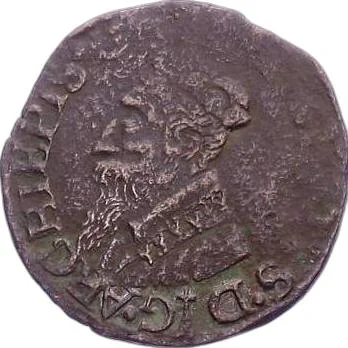
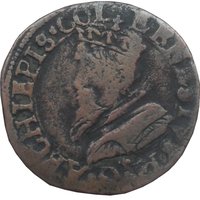
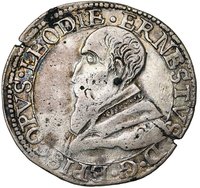
Bust left in cap. Legend divided by perron at 12:00 and 6:00.
Inscription:
ERNESTVS · D G · ARCHIEPS · COL
Script: Latin
Reverse
Description:
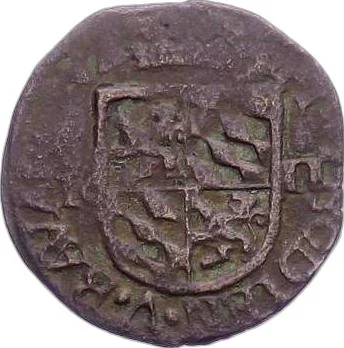
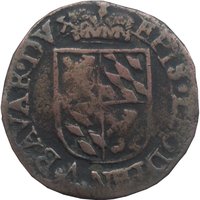
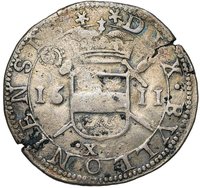
Bavaria-Palatinate arms flank date.
Inscription:
EPI · LEODIEN · V · BAVARI · DVX
Script: Latin
Edge
Mints
| Name | Mark |
|---|---|
| Liège | — |
Mintings
| Year | Mint Mark | Mintage | Quality | Collection |
|---|---|---|---|---|
| 1610 | — | — | ||
| — | — | — | ||
| 1611 | — | — | ||
| 1612 | — | — |
Historical background
In 1610, the Prince-Bishopric of Liège existed as a complex monetary zone, caught between the competing influences of its powerful neighbours. While nominally part of the Holy Roman Empire, its economy was deeply integrated with the Spanish Netherlands to the west and the Dutch Republic to the north. Consequently, a multitude of foreign coins—Spanish reales, Dutch leeuwendaalders (lion dollars), and German thalers—circulated freely alongside local issues, creating a chaotic and unstable exchange environment. The bishopric’s own mint struggled to maintain authority, as its silver patards and gold Florins often varied in weight and fineness, leading to widespread suspicion and discounting in daily trade.
This monetary confusion was exacerbated by the ongoing Eighty Years' War (1568-1648) raging on its borders. The conflict between Spain and the Dutch Republic turned Liège into a crossroads for war financing and troop movements, flooding the region with even more foreign specie, including often-debased coinage used to pay armies. Furthermore, the "Kipper und Wipper" period of currency debasement that would soon sweep the Empire was beginning to take hold, as princes and cities reduced the precious metal content of their coins to generate short-term profit. For Liège's merchants and populace, this meant constant uncertainty, as the real value of coins could change abruptly, harming commerce and sowing distrust.
The political context under Prince-Bishop Ernest of Bavaria (r. 1581-1612) did little to resolve the crisis. While Ernest was a capable administrator, his primary focus was on consolidating his family's power within the Empire and enforcing Counter-Reformation policies. Monetary reform was a secondary concern, requiring a level of centralised authority and economic isolation that Liège, as an open and politically fragmented state, could not achieve. Thus, in 1610, the bishopric remained a passive participant in a regional monetary disorder, lacking the sovereign power to impose a uniform currency and forced to adapt to the volatile flows of neighbouring economies at war.
This monetary confusion was exacerbated by the ongoing Eighty Years' War (1568-1648) raging on its borders. The conflict between Spain and the Dutch Republic turned Liège into a crossroads for war financing and troop movements, flooding the region with even more foreign specie, including often-debased coinage used to pay armies. Furthermore, the "Kipper und Wipper" period of currency debasement that would soon sweep the Empire was beginning to take hold, as princes and cities reduced the precious metal content of their coins to generate short-term profit. For Liège's merchants and populace, this meant constant uncertainty, as the real value of coins could change abruptly, harming commerce and sowing distrust.
The political context under Prince-Bishop Ernest of Bavaria (r. 1581-1612) did little to resolve the crisis. While Ernest was a capable administrator, his primary focus was on consolidating his family's power within the Empire and enforcing Counter-Reformation policies. Monetary reform was a secondary concern, requiring a level of centralised authority and economic isolation that Liège, as an open and politically fragmented state, could not achieve. Thus, in 1610, the bishopric remained a passive participant in a regional monetary disorder, lacking the sovereign power to impose a uniform currency and forced to adapt to the volatile flows of neighbouring economies at war.
💎 Extremely Rare