

3 Patards – Spanish Netherlands
Netherlands
Context
Years: 1616–1621
Country: Netherlands 
Issuer: Spanish Netherlands
Currency:
(1506—1713)
Demonetized: Yes
Material
Diameter: 27.5 mm
Weight: 2.63 g
Silver weight: 1.53 g
Shape: Irregular round
Composition: 58.3% Silver
Magnetic: No
Technique: Hammered
Alignment: Coin alignment
flip
References
KM: #Click to copy to clipboard45
Numista: #42635
Value
Bullion value: $4.45
Obverse
Description:
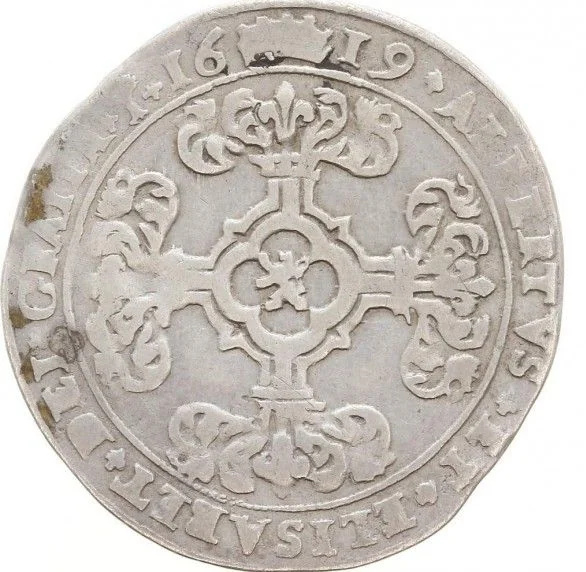
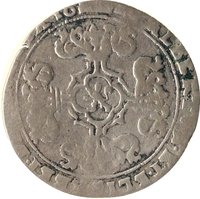
Flowered cross, lion in center. Crown above divides date.
Inscription:
+ ALBERTVS ET ELISABET DEI GRATIA
Script: Latin
Reverse
Description:
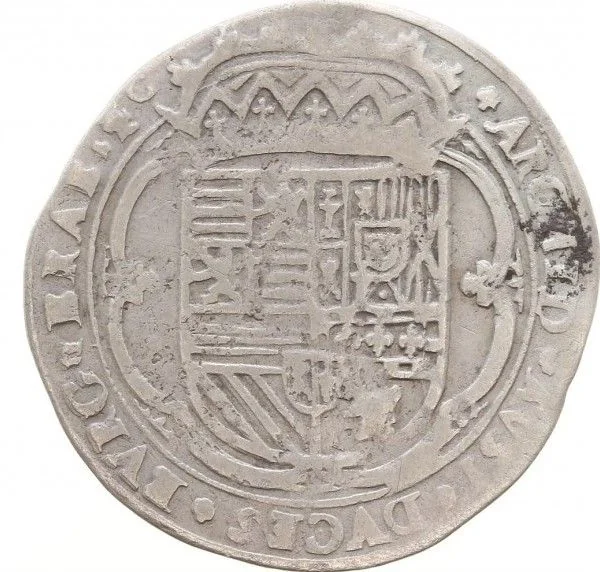
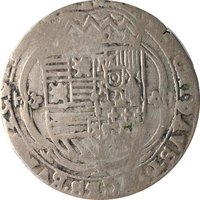
Eight-fold crowned arms in a polylobe.
Inscription:
+ ARCHID AVST DVCES BVR BRAB Z
Script: Latin
Edge
Mints
| Name | Mark |
|---|---|
| 's-Hertogenbosch | — |
| Antwerp | — |
| Royal Mint of Belgium | — |
Mintings
| Year | Mint Mark | Mintage | Quality | Collection |
|---|---|---|---|---|
| 1616 | arbre | — | ||
| 1616 | main | — | ||
| 1616 | téte | — | ||
| 1617 | arbre | — | ||
| 1617 | ètoile | — | ||
| 1617 | main | — | ||
| 1617 | téte | — | ||
| 1618 | arbre | — | ||
| 1618 | main | — | ||
| 1618 | téte | — | ||
| 1619 | arbre | — | ||
| 1619 | main | — | ||
| 1619 | téte | — | ||
| 1620 | arbre | — | ||
| 1620 | main | — | ||
| 1620 | téte | — | ||
| 1621 | arbre | — | ||
| 1621 | main | — | ||
| 1621 | téte | — |
Historical background
In 1616, the currency situation in the Spanish Netherlands was one of profound instability and complexity, a direct legacy of the ongoing Eighty Years' War (1568-1648). The region, a vital economic hub, was caught between the military and financial demands of the Spanish Crown and the disruptive economic warfare waged by the rebellious Dutch Republic to the north. This resulted in a chaotic monetary environment where officially minted coins (like the patagon or ducatón) circulated alongside a bewildering array of foreign, clipped, and debased coins, leading to frequent recoinage ordinances and failed attempts to fix exchange rates.
The core problem was a severe shortage of high-value silver coinage, driven by Gresham's Law ("bad money drives out good"). The government's own practices, including the deliberate debasement of coinage to fund the war effort, eroded public trust. Consequently, sound full-weight coins were hoarded or exported, while lightweight and adulterated coins flooded daily transactions. This created a crippling disparity between the official mint value of coins and their higher market currency value, paralyzing trade and credit.
Authorities in Brussels, under the Archdukes Albert and Isabella, responded with repeated but ineffective placcards (edicts). These attempted to dictate the value of countless coin types in circulation and impose harsh penalties for clipping or refusing official rates. However, these measures were largely unenforceable. The market's rejection of artificial valuations, combined with the relentless economic pressure from the war and competition from the financially robust Dutch Republic, meant that monetary confusion remained a defining feature of the economy in 1616, undermining recovery and stability.
The core problem was a severe shortage of high-value silver coinage, driven by Gresham's Law ("bad money drives out good"). The government's own practices, including the deliberate debasement of coinage to fund the war effort, eroded public trust. Consequently, sound full-weight coins were hoarded or exported, while lightweight and adulterated coins flooded daily transactions. This created a crippling disparity between the official mint value of coins and their higher market currency value, paralyzing trade and credit.
Authorities in Brussels, under the Archdukes Albert and Isabella, responded with repeated but ineffective placcards (edicts). These attempted to dictate the value of countless coin types in circulation and impose harsh penalties for clipping or refusing official rates. However, these measures were largely unenforceable. The market's rejection of artificial valuations, combined with the relentless economic pressure from the war and competition from the financially robust Dutch Republic, meant that monetary confusion remained a defining feature of the economy in 1616, undermining recovery and stability.
⭐ Rare