

Italy
Context

Material
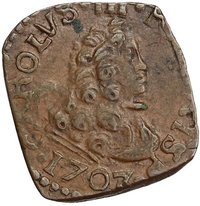
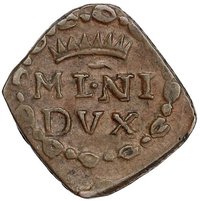
Diameter: 17 mm
Weight: 1.63 g
Shape: Irregular round
Composition: Copper
Magnetic: No
Alignment: Coin alignment
flip
References
KM: #Click to copy to clipboard100
Numista: #42535
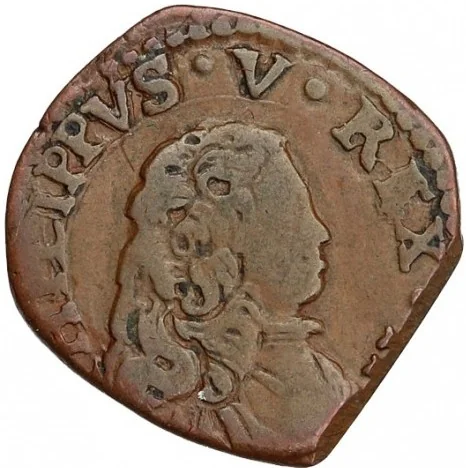
Obverse
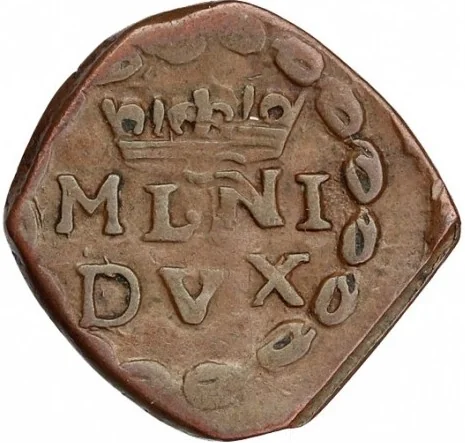
Reverse
Edge
Mints
| Name | Mark |
|---|---|
| Milan | — |
Mintings
| Year | Mint Mark | Mintage | Quality | Collection |
|---|---|---|---|---|
| — | — | — |
Historical background
In 1701, Milan found itself in a precarious monetary situation, caught in the turbulent aftermath of the War of the Spanish Succession. The Duchy of Milan, a strategic and wealthy possession, had just passed from Spanish Habsburg to Austrian Habsburg control as the conflict began. This political rupture caused immediate economic instability, disrupting established fiscal policies and trade networks. The new Austrian administration, led by Prince Eugene of Savoy, faced the urgent dual challenge of financing a large military garrison for the ongoing war and asserting authority over a complex local financial system. Confidence in the currency was low, as the population anticipated the new rulers would need to debase coinage or issue new money to cover immense wartime expenditures.
The circulating medium itself was a chaotic mix. The Spanish-era silver scudo remained a key reference, but the system was complicated by a proliferation of both domestic and foreign coins, including gold zecchini and various silver reali and lire. Crucially, the value of these coins was not fixed solely by their metal content but also by official "cries" or declarations (grida) that set their tariff in the accounting unit, the lira imperiale. This practice, common in early modern Europe, allowed authorities to manipulate values, often leading to a disconnect between face value and intrinsic metallic worth. By 1701, the pressure to fund the war made a devaluation via an official grida a constant threat, which would effectively tax holders of old coinage and disrupt all contracts and prices.
Consequently, merchants and bankers in Milan operated with great caution. Long-distance trade and credit, vital to the Lombard economy, were hampered by exchange rate uncertainty and the risk of sudden monetary decrees. The Austrian authorities, while needing to extract revenue, were also aware that excessive monetary manipulation would cripple the very economy they sought to tax. Thus, the currency situation in 1701 was one of tense limbo—a fragile system inherited from Spain, under immense strain from wartime demands, and awaiting the inevitable fiscal interventions of its new rulers, which would shape Milan's economic reality for decades to come.
The circulating medium itself was a chaotic mix. The Spanish-era silver scudo remained a key reference, but the system was complicated by a proliferation of both domestic and foreign coins, including gold zecchini and various silver reali and lire. Crucially, the value of these coins was not fixed solely by their metal content but also by official "cries" or declarations (grida) that set their tariff in the accounting unit, the lira imperiale. This practice, common in early modern Europe, allowed authorities to manipulate values, often leading to a disconnect between face value and intrinsic metallic worth. By 1701, the pressure to fund the war made a devaluation via an official grida a constant threat, which would effectively tax holders of old coinage and disrupt all contracts and prices.
Consequently, merchants and bankers in Milan operated with great caution. Long-distance trade and credit, vital to the Lombard economy, were hampered by exchange rate uncertainty and the risk of sudden monetary decrees. The Austrian authorities, while needing to extract revenue, were also aware that excessive monetary manipulation would cripple the very economy they sought to tax. Thus, the currency situation in 1701 was one of tense limbo—a fragile system inherited from Spain, under immense strain from wartime demands, and awaiting the inevitable fiscal interventions of its new rulers, which would shape Milan's economic reality for decades to come.
💎 Very Rare