

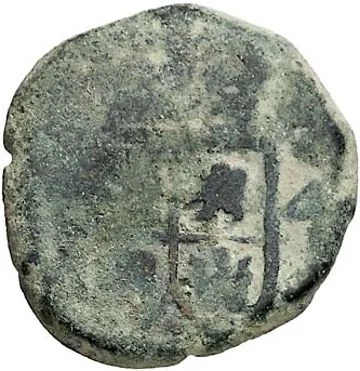
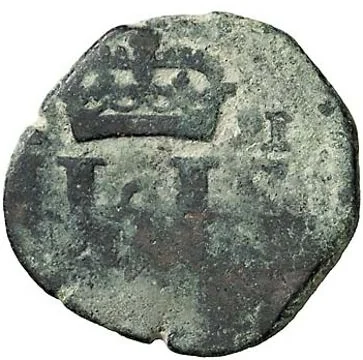
4 Maravedis – Spanish possession of Oran
Algeria
Context
Year: 1691
Country: Algeria 
Issuer: Spanish possession of Oran
Ruler: Charles II
Currency:
(1509—1708)
Demonetized: Yes
Material
References
KM: #Click to copy to clipboardL4
Numista: #114094
Obverse
Description:
Arms with castles and lions. Mintmark MD left, value 4 right.
Inscription:
MD 4
Script: Latin
Reverse
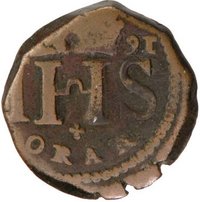
Description:
Christogram with crown above dividing date, legend below.
Inscription:
1691
IHS
ORAN
IHS
ORAN
Script: Latin
Edge
Categories
| Symbols> Coat of Arms |
| Symbol> Crown |
| Symbol> Christogram |
Mints
| Name | Mark |
|---|---|
| Royal Mint of Madrid | (M) |
Mintings
| Year | Mint Mark | Mintage | Quality | Collection |
|---|---|---|---|---|
| 1691 | MD | — |
Historical background
In 1691, the Spanish presidio of Oran on the North African coast existed in a state of perpetual economic and military strain, which was directly reflected in its complex currency situation. The garrison city, a costly strategic outhold, was financially dependent on irregular situados (subsidies) shipped from Spain, primarily from the royal coffers in Cadiz. These subsidies, often delayed or reduced due to the Crown's broader financial woes and priorities in European wars, were theoretically to be paid in strong Spanish silver reales. However, the actual money arriving was frequently insufficient, leading to chronic arrears in paying the garrison and local suppliers.
The daily monetary reality within Oran's walls was therefore one of extreme heterogeneity and devaluation. Alongside scarce Spanish coin, a multitude of foreign currencies circulated, most prominently French louis d'or and écus, Portuguese cruzados, and various Italian pieces. These entered via trade, the presence of foreign merchants and mercenaries, and through the ransom economy centered on Christian-Muslim captives. Most problematic was the widespread circulation of heavily debased local Algerian copper fals and silver mahbubs, used in small-scale transactions with the surrounding region. The Spanish authorities repeatedly issued proclamations against the use of these "Moors' coins," but economic necessity forced their acceptance, leading to confusion and loss in exchange.
This chaotic environment necessitated constant official intervention. The city's governors periodically issued pragmáticas (decrees) attempting to fix the exchange rates between the myriad coins, a largely futile effort to impose order. The result was a dual economy: official military accounts and large transactions struggled with a shortage of good Spanish silver, while the bustling local market operated on a unstable mix of low-value foreign and Algerian coinage. This monetary fragmentation underscored Oran's precarious position—a Spanish island financially adrift in a North African sea, its currency chaos mirroring its constant vulnerability to siege and its profound dependency on distant Madrid.
The daily monetary reality within Oran's walls was therefore one of extreme heterogeneity and devaluation. Alongside scarce Spanish coin, a multitude of foreign currencies circulated, most prominently French louis d'or and écus, Portuguese cruzados, and various Italian pieces. These entered via trade, the presence of foreign merchants and mercenaries, and through the ransom economy centered on Christian-Muslim captives. Most problematic was the widespread circulation of heavily debased local Algerian copper fals and silver mahbubs, used in small-scale transactions with the surrounding region. The Spanish authorities repeatedly issued proclamations against the use of these "Moors' coins," but economic necessity forced their acceptance, leading to confusion and loss in exchange.
This chaotic environment necessitated constant official intervention. The city's governors periodically issued pragmáticas (decrees) attempting to fix the exchange rates between the myriad coins, a largely futile effort to impose order. The result was a dual economy: official military accounts and large transactions struggled with a shortage of good Spanish silver, while the bustling local market operated on a unstable mix of low-value foreign and Algerian coinage. This monetary fragmentation underscored Oran's precarious position—a Spanish island financially adrift in a North African sea, its currency chaos mirroring its constant vulnerability to siege and its profound dependency on distant Madrid.
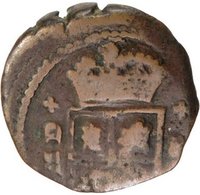
💎 Extremely Rare