

1 Giulio – Papal States
Circulating commemorative coins
Commemoration: Holy Year
Vatican City
Context
Year: 1675
Country: Vatican City 
Issuer: Papal States
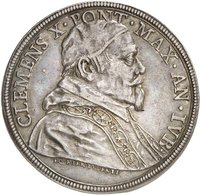
Ruler: Clement X
Currency:
(1534—1835)
Demonetized: Yes
Material
Weight: 3.07 g
Silver weight: 2.82 g
Shape: Round
Composition: 91.7% Silver
Standard: Gold tenth ounce
Magnetic: No
References
KM: #Click to copy to clipboard361
Numista: #113628
Value
Bullion value: $8.06
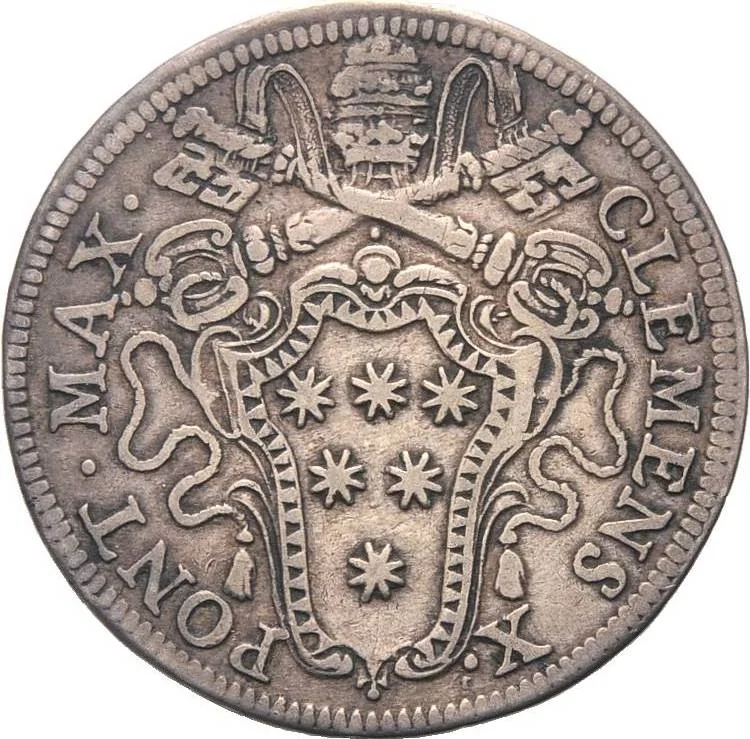
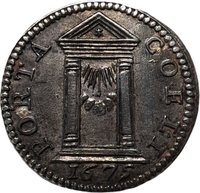
Obverse
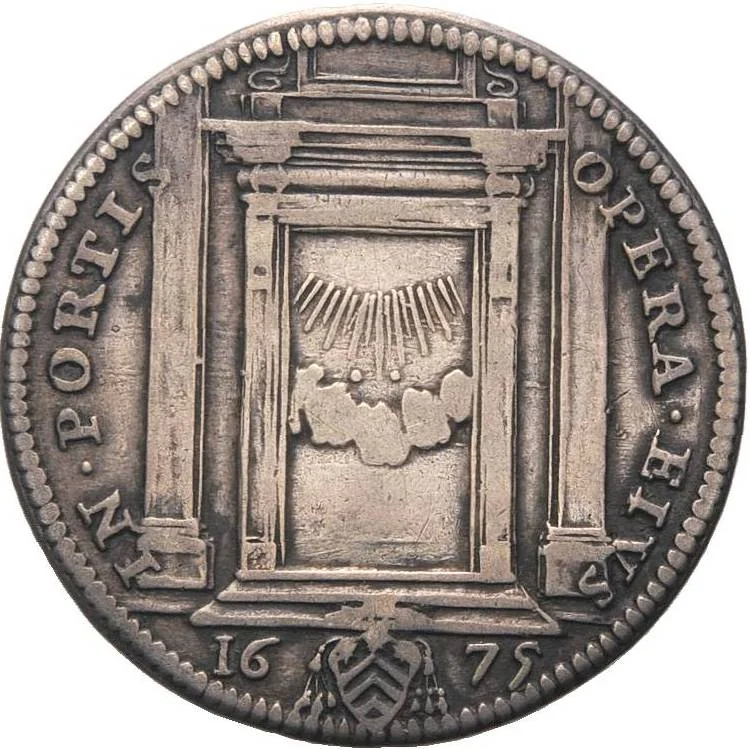
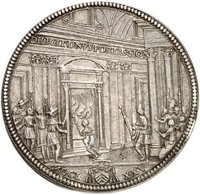
Reverse
Edge
Mintings
| Year | Mint Mark | Mintage | Quality | Collection |
|---|---|---|---|---|
| 1675 | — | — |
Historical background
In 1675, the Papal States' currency system was a complex and fragmented mosaic, reflecting the political and economic realities of the era. The central mint in Rome produced the primary silver scudo and the smaller giulio, alongside gold scudi and doppie. However, the value and purity of these coins were frequently manipulated to meet the pressing financial needs of the Holy See, often to fund military campaigns, monumental building projects, and the administrative costs of the Counter-Reformation. This practice of debasement—reducing the precious metal content—led to chronic inflation and a loss of public trust in the official currency.
Compounding this instability was the widespread circulation of a multitude of foreign coins. Due to the Papal States' position at the heart of the Italian peninsula and its role as an international religious centre, Spanish reales, Florentine florins, and Venetian ducats all circulated freely alongside papal issues. This created a chaotic exchange environment where merchants and money-changers had to constantly assess the metal content and prevailing exchange rates of dozens of different coins, hindering efficient trade and commerce within the state's borders.
Pope Clement X, reigning from 1670 to 1676, inherited these monetary troubles but his pontificate was marked by advanced age and a relatively quiet, administrative approach. While he made some efforts to stabilize finances through careful fiscal management rather than aggressive monetary reform, the fundamental structural problems persisted. Thus, in 1675, the currency situation remained one of inherent weakness: an official coinage prone to devaluation, a market dominated by more stable foreign specie, and an economy struggling under the weight of this inefficient and inflationary system.
Compounding this instability was the widespread circulation of a multitude of foreign coins. Due to the Papal States' position at the heart of the Italian peninsula and its role as an international religious centre, Spanish reales, Florentine florins, and Venetian ducats all circulated freely alongside papal issues. This created a chaotic exchange environment where merchants and money-changers had to constantly assess the metal content and prevailing exchange rates of dozens of different coins, hindering efficient trade and commerce within the state's borders.
Pope Clement X, reigning from 1670 to 1676, inherited these monetary troubles but his pontificate was marked by advanced age and a relatively quiet, administrative approach. While he made some efforts to stabilize finances through careful fiscal management rather than aggressive monetary reform, the fundamental structural problems persisted. Thus, in 1675, the currency situation remained one of inherent weakness: an official coinage prone to devaluation, a market dominated by more stable foreign specie, and an economy struggling under the weight of this inefficient and inflationary system.
✨ Legendary