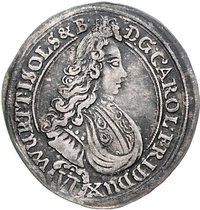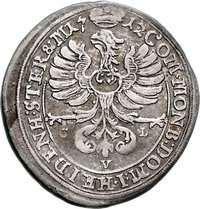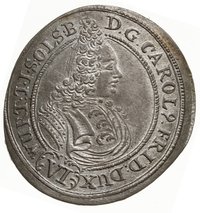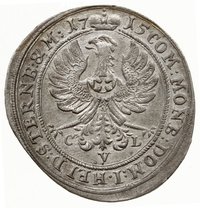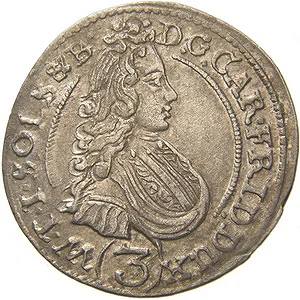
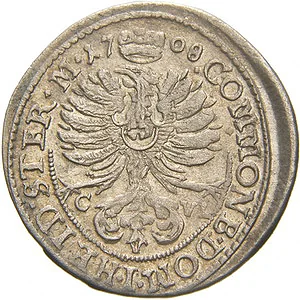
In 1708, the Duchy of Württemberg-Oels, a small Silesian territory ruled by a cadet branch of the House of Württemberg, faced a complex currency situation typical of the Holy Roman Empire's fragmented monetary landscape. The duchy did not possess its own independent minting rights (
Münzregal) but operated within the broader economic and monetary sphere of the Kingdom of Bohemia, to which Silesia belonged. Consequently, the circulating currency was predominantly the Bohemian (or Saxon)
Groschen and the
Taler, with their value and silver content subject to regional agreements and imperial regulations.
The period was one of significant monetary instability across the Empire, exacerbated by the War of the Spanish Succession (1701-1714). Rulers often debased coinage to finance military expenditures, leading to inflation and a flood of inferior coins. While specific records for Württemberg-Oels in 1708 are scarce, the duchy would have been acutely affected by these empire-wide trends. The circulation of underweight coins from neighboring states and the resulting confusion in exchange rates between different regional currencies would have posed a constant challenge for trade and public administration.
Therefore, the currency situation in Württemberg-Oels in 1708 was characterized by dependency and vulnerability. The duchy’s monetary system was not autonomous but was subject to the standards and fluctuations of larger regional powers and the destabilizing imperial-wide practice of coinage debasement. This created an environment of economic uncertainty for its populace, who had to navigate a daily reality of multiple coin types with varying and often unreliable intrinsic values.