

1 thaler – Württemberg-Oels-Juliusburg
Add to wishlist
Circulating commemorative coins
Commemoration: Death of Julius Sigismund
Germany
Context
Year: 1684
Country: Germany
Issuer: Württemberg-Oels-Juliusburg
Ruler: Julius Sigismund
Currency:
Demonetized: Yes
Material
References
KM: #
Numista: #41809
Value
Bullion value: $70.49
Obverse
Description:
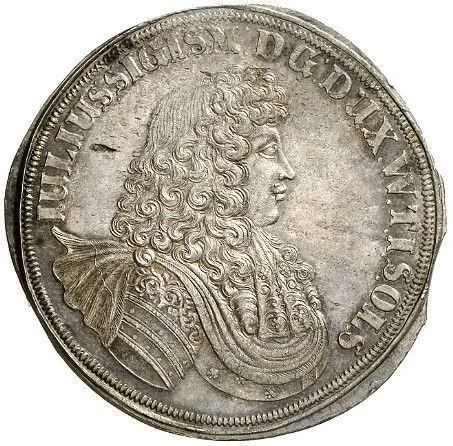
Julius Sigismund in right-facing profile.
Script: Latin
Reverse
Description:
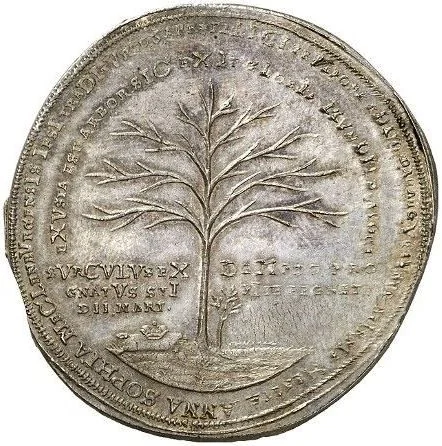
Tree-carved inscription.
Script: Latin
Edge
Mintings
| Year | Mint Mark | Mintage | Quality | Collection |
|---|---|---|---|---|
| 1684 | — | — |
Historical background
In 1684, the Duchy of Württemberg-Oels-Juliusburg, a small Silesian territory ruled by a cadet branch of the Württemberg dynasty, operated within the complex and fragmented monetary landscape of the Holy Roman Empire. The duchy itself did not possess a central minting authority strong enough to impose a uniform currency. Instead, its economy relied on a circulation of multiple coin types, primarily those issued by larger regional powers like the Emperor in Vienna, the Kingdom of Bohemia, and the nearby powerful city-states and bishoprics. This led to a chronic situation of multiple currencies in concurrent use, each with fluctuating values based on metal content and trust.
The practical monetary situation was governed by imperial regulations, particularly the Reichsmünzfuß (imperial minting standard), which aimed to bring order by specifying silver content for talers and smaller denominations. However, these standards were often ignored by the numerous minting authorities across the Empire. In daily trade, people in the duchy handled a mix of physical coins, including Reichstalers, Groschen, and Kreuzers. The value of these coins was not fixed by face value but by their actual weight and fineness of silver, requiring merchants and officials to constantly assess and convert between them.
This environment created significant challenges for commerce and administration in Württemberg-Oels-Juliusburg. Transaction costs were high due to the need for money changers and the risk of debased coins. Duke Sylvius Friedrich, ruling from 1664 to 1697, would have faced difficulties in stabilizing revenue and paying expenses, as the value of tax collections could be eroded by inferior coinage. The currency situation thus reflected the broader political weakness of small German principalities, which were subject to the economic currents of the Empire and the monetary policies of their more powerful neighbors.
The practical monetary situation was governed by imperial regulations, particularly the Reichsmünzfuß (imperial minting standard), which aimed to bring order by specifying silver content for talers and smaller denominations. However, these standards were often ignored by the numerous minting authorities across the Empire. In daily trade, people in the duchy handled a mix of physical coins, including Reichstalers, Groschen, and Kreuzers. The value of these coins was not fixed by face value but by their actual weight and fineness of silver, requiring merchants and officials to constantly assess and convert between them.
This environment created significant challenges for commerce and administration in Württemberg-Oels-Juliusburg. Transaction costs were high due to the need for money changers and the risk of debased coins. Duke Sylvius Friedrich, ruling from 1664 to 1697, would have faced difficulties in stabilizing revenue and paying expenses, as the value of tax collections could be eroded by inferior coinage. The currency situation thus reflected the broader political weakness of small German principalities, which were subject to the economic currents of the Empire and the monetary policies of their more powerful neighbors.
✨ Legendary