

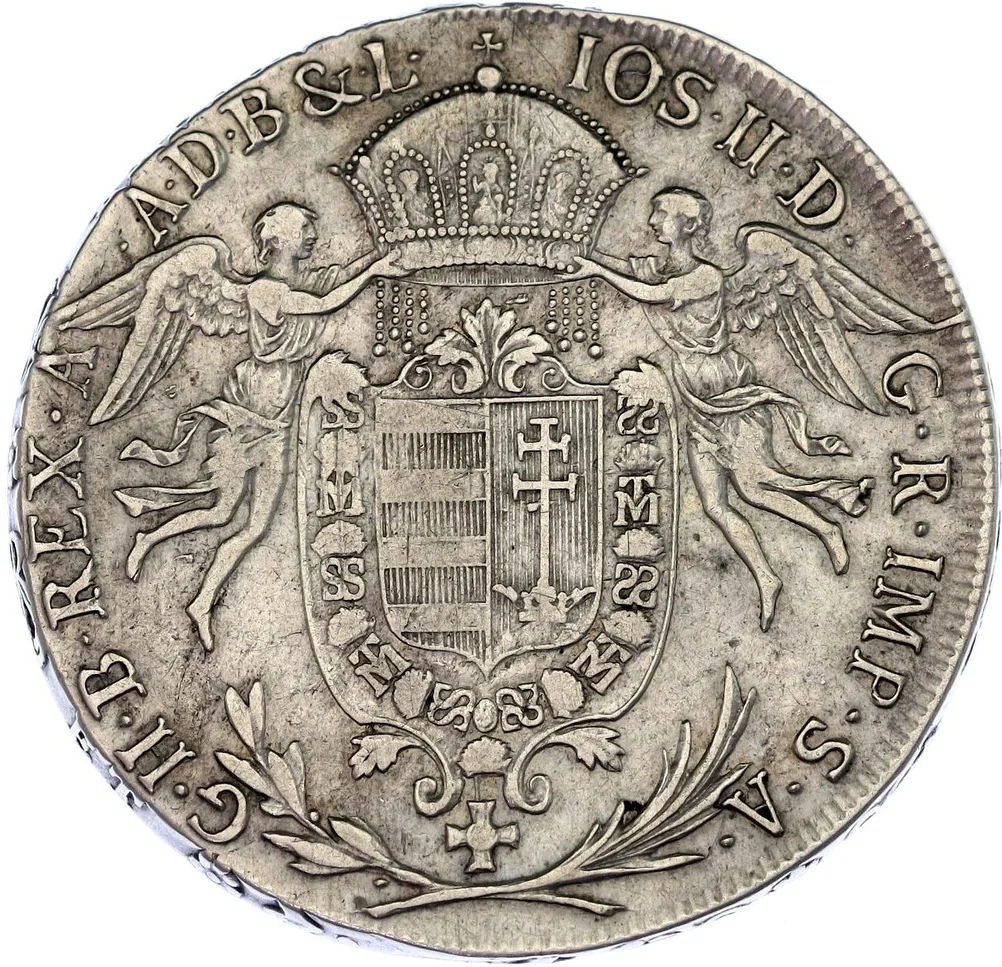
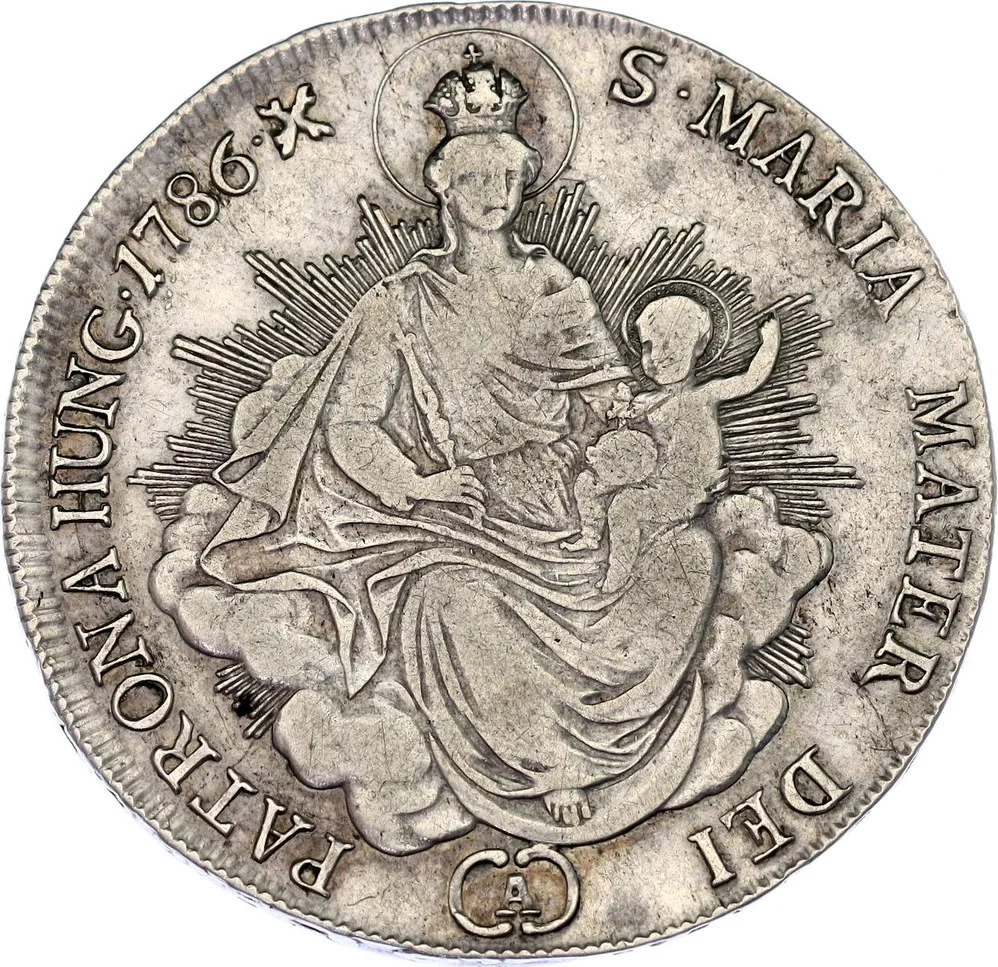

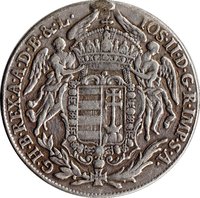
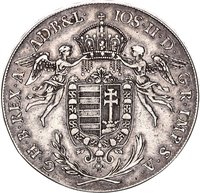
Obverse
Description:
Angels suspended midair, wings folded, holding a crowned double Hungarian shield in a cartouche.
Inscription:
IOS · II · D · G · R · IMP · S · A · G · H · B · REX · A-A · D · B & L
Script: Latin
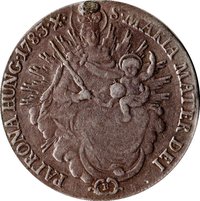
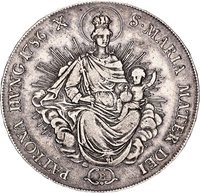
Reverse
Description:
Radiant crowned Madonna and Child seated on a crescent, mintmark in cartouche below.
Inscription:
S·MARIA MATER DEI PATRONA HVNG·1790·X
Script: Latin
Edge
VIRTVTI ET EXAMPLO
Legend:
VIRTVTE ET EXEMPLO
Mints
| Name | Mark |
|---|---|
| Münze Österreich | A |
| Kremnica | B |
Mintings
Historical background
In 1785, Hungary's currency situation was characterized by the complex monetary policies of the Habsburg Monarchy under the reformist Emperor Joseph II. The empire operated on a bimetallic standard, but the primary circulating currency in Hungary was the silver Gulden (or forint), subdivided into 60 Kreuzer (krajcár). However, the system was not uniform; alongside official coinage, older and foreign coins, particularly the Maria Theresa Thaler, also circulated widely, especially in international trade. This created a practical environment where exchange rates and values could be fluid and locally influenced.
The period was marked by significant economic challenges that strained the currency. Joseph II's centralizing reforms and costly foreign policies, including involvement in wars, placed a heavy financial burden on the state. To raise revenue, the government often resorted to increasing the minting of lower-quality coinage, a practice that risked inflation and undermined public confidence in the currency's value. Furthermore, Hungary's economy was still largely agrarian and manorial, with a relatively underdeveloped financial sector, meaning that barter and in-kind payments remained common in rural areas, reducing the practical reach of centralized monetary policy.
Ultimately, the currency situation reflected the broader tensions between the Habsburg central authority and the Hungarian estates. The nobility resisted Joseph II's attempts to standardize and control the economy as part of his broader agenda to diminish traditional privileges. The monetary system, therefore, was not just an economic issue but a political one, symbolizing the struggle between imperial modernization and Hungarian autonomy. This friction would contribute to the eventual withdrawal of many of Joseph's reforms after his death in 1790.
The period was marked by significant economic challenges that strained the currency. Joseph II's centralizing reforms and costly foreign policies, including involvement in wars, placed a heavy financial burden on the state. To raise revenue, the government often resorted to increasing the minting of lower-quality coinage, a practice that risked inflation and undermined public confidence in the currency's value. Furthermore, Hungary's economy was still largely agrarian and manorial, with a relatively underdeveloped financial sector, meaning that barter and in-kind payments remained common in rural areas, reducing the practical reach of centralized monetary policy.
Ultimately, the currency situation reflected the broader tensions between the Habsburg central authority and the Hungarian estates. The nobility resisted Joseph II's attempts to standardize and control the economy as part of his broader agenda to diminish traditional privileges. The monetary system, therefore, was not just an economic issue but a political one, symbolizing the struggle between imperial modernization and Hungarian autonomy. This friction would contribute to the eventual withdrawal of many of Joseph's reforms after his death in 1790.
💎 Very Rare