

1 riksdaler – Sweden
Add to wishlist
Circulating commemorative coins
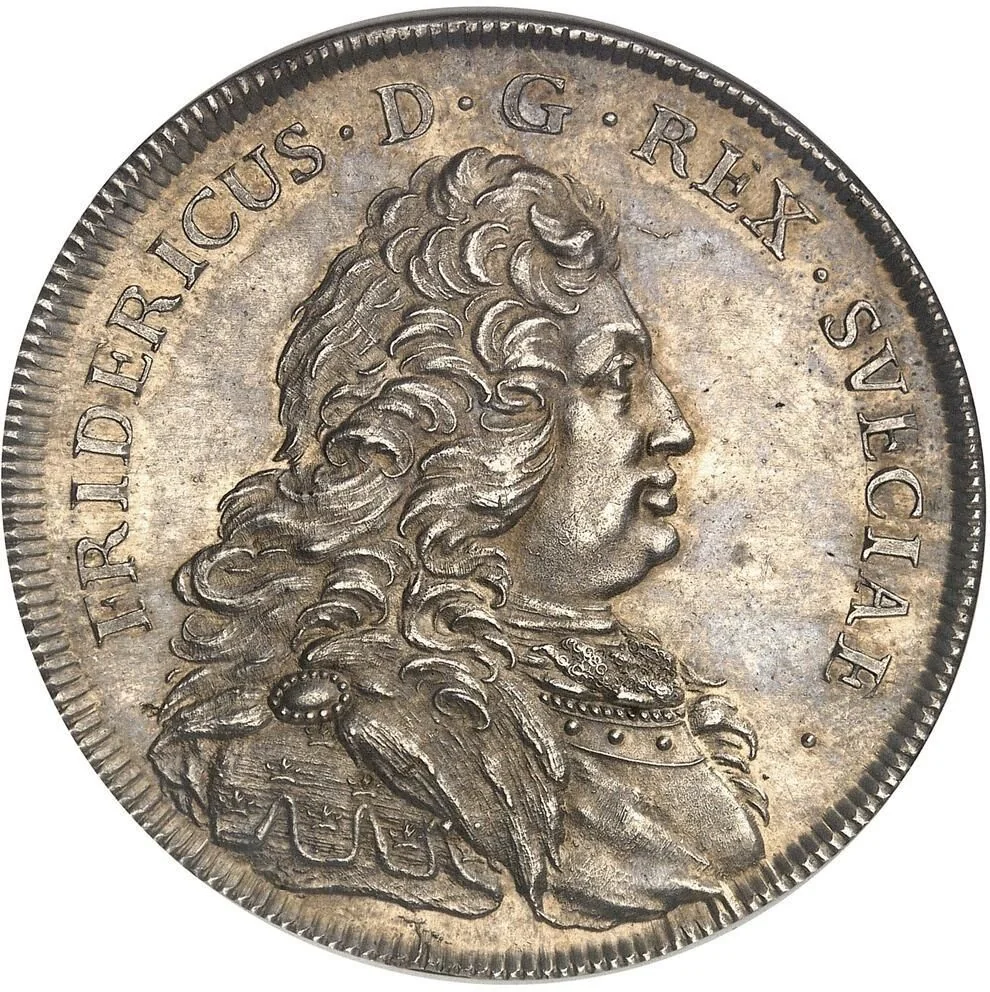
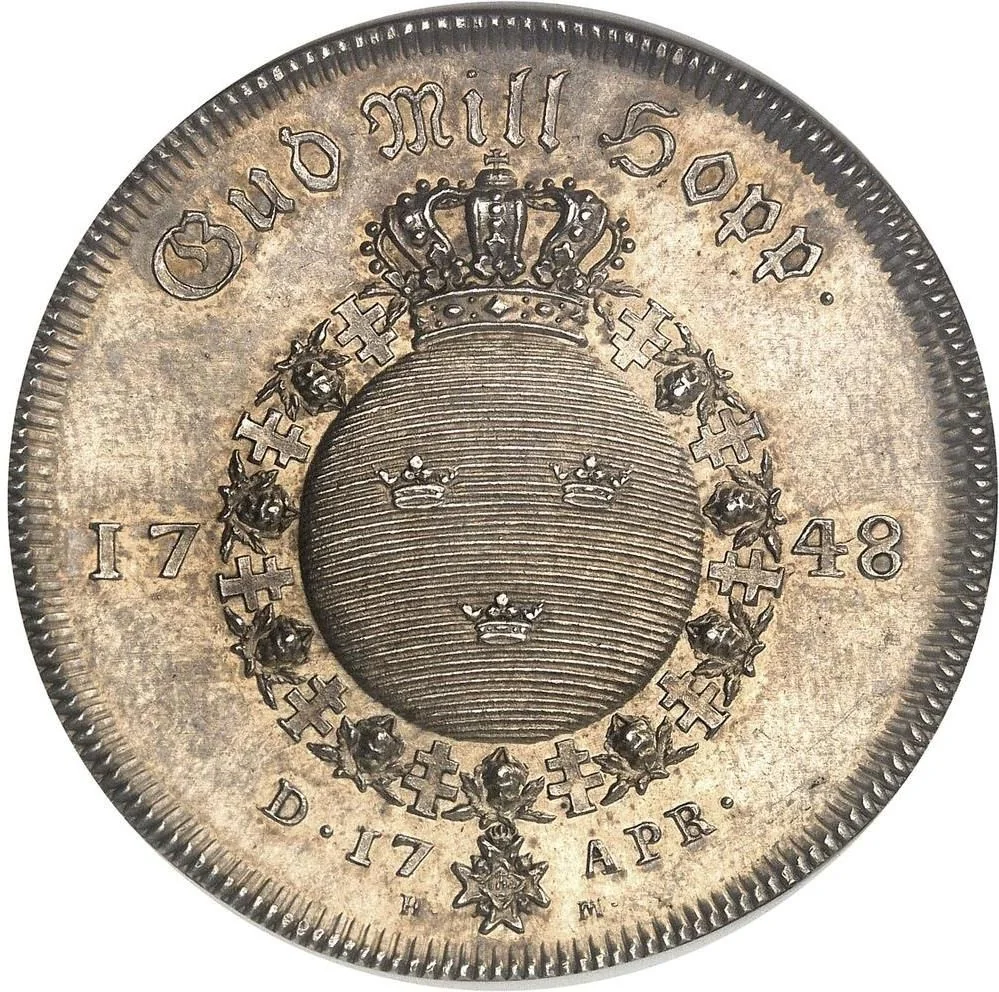
Commemoration: Commemorative coin celebrating the founding of the Royal Order of the Seraphim 17th April 1748.
Sweden
Context
Material
References
KM: #
Numista: #413025
Value
Bullion value: $73.52
Obverse
Description:
Bust of King Fredrik I in ornate armor, his long, curly hair framing the legend.
Inscription:
FRIDERICUS·D·G·REX·SVECIAE·
Reverse
Description:
Crowned Three Crowns on chain circle, date flanked by legend above and value below.
Inscription:
Gud Mitt Hopp.
17 48
D·17 APR·
H· M·
17 48
D·17 APR·
H· M·
Edge
Categories
| Symbols> Coat of Arms |
Mints
| Name | Mark |
|---|---|
| Stockholm | — |
Mintings
| Year | Mint Mark | Mintage | Quality | Collection |
|---|---|---|---|---|
| 1748 | — | — |
Historical background
In 1748, Sweden found itself in a precarious monetary situation, a direct legacy of the Great Northern War (1700–1721). To finance that prolonged and costly conflict, the state had resorted to massive coinage debasement and the issuance of paper money, known as transportsedlar. This created a dual-currency system where the rapidly depreciating paper money circulated alongside silver coins, leading to severe inflation, a collapse in public credit, and widespread economic uncertainty. By the 1740s, the paper money’s value had fallen to roughly one-third of its nominal silver parity, crippling trade and state finances.
Recognizing the crisis, the Swedish parliament, the Riksdag, embarked on a major monetary reform. The driving force behind this effort was the influential Hat Party, which controlled the government. Their solution, enacted in 1745, was to effectively abandon the silver standard that had been promised for the paper money and instead peg the riksdaler to a fixed value in copper. This "copper standard" was institutionalized in 1747, and by 1748, the system was in its early operational phase, managed by the newly established Riksens Ständers Bank (predecessor of the Riksbank).
Therefore, the currency situation in 1748 was one of fragile stabilization under an unconventional and experimental system. The immediate hyperinflation had been halted, and the value of the paper money was now legally tied to the nation’s abundant copper reserves. However, this was a managed fiat currency, not a true metallic standard, and its long-term viability was untested. The reform succeeded in providing short-term stability but entrenched a system that would later face new challenges, separating Sweden’s monetary base from international precious metal flows for several decades.
Recognizing the crisis, the Swedish parliament, the Riksdag, embarked on a major monetary reform. The driving force behind this effort was the influential Hat Party, which controlled the government. Their solution, enacted in 1745, was to effectively abandon the silver standard that had been promised for the paper money and instead peg the riksdaler to a fixed value in copper. This "copper standard" was institutionalized in 1747, and by 1748, the system was in its early operational phase, managed by the newly established Riksens Ständers Bank (predecessor of the Riksbank).
Therefore, the currency situation in 1748 was one of fragile stabilization under an unconventional and experimental system. The immediate hyperinflation had been halted, and the value of the paper money was now legally tied to the nation’s abundant copper reserves. However, this was a managed fiat currency, not a true metallic standard, and its long-term viability was untested. The reform succeeded in providing short-term stability but entrenched a system that would later face new challenges, separating Sweden’s monetary base from international precious metal flows for several decades.
✨ Legendary