

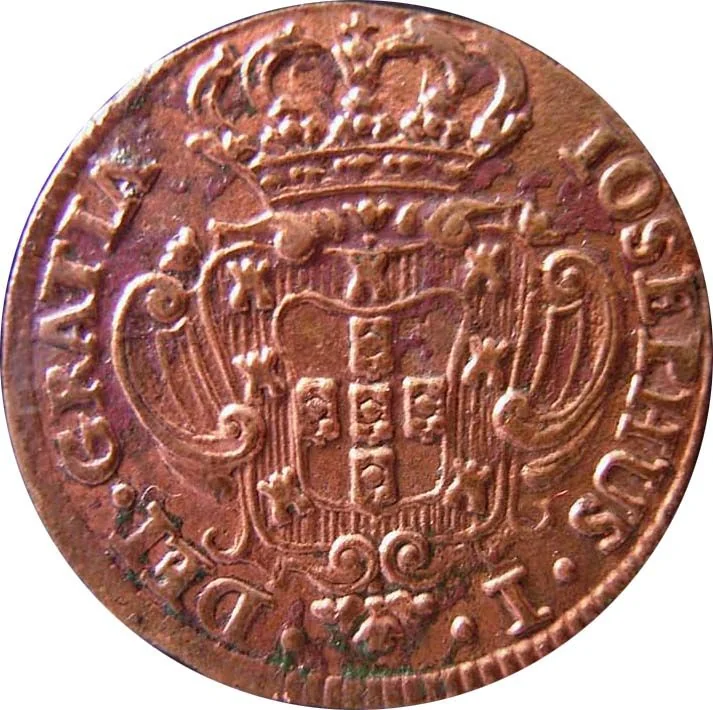
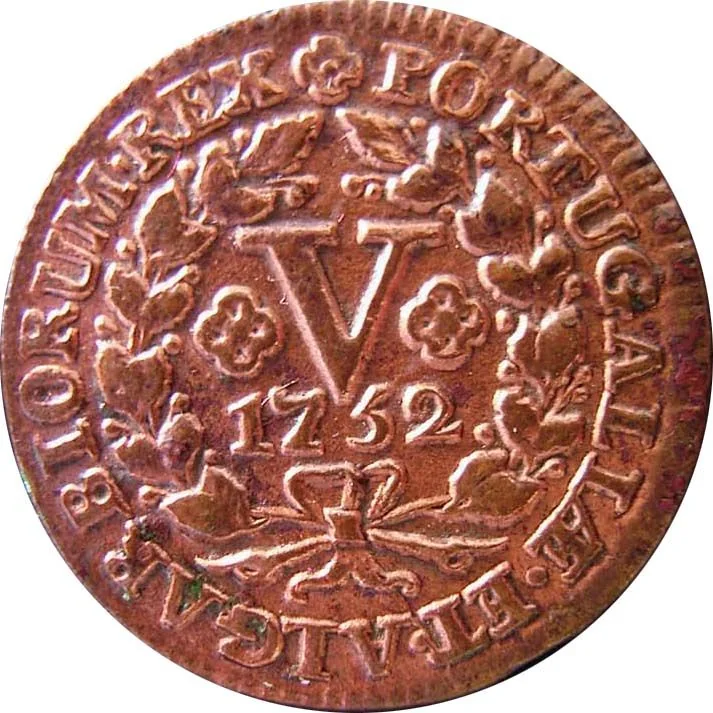

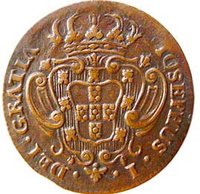
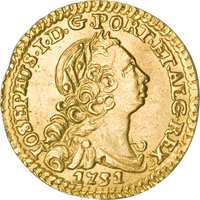
Obverse
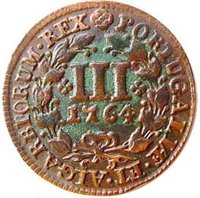
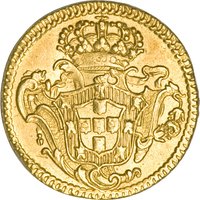
Reverse
Description:
Legend and wreath framing value and date.
Inscription:
PORTUGALLÆ·ET·ALGARBIORUM·REX
V
1764
V
1764
Script: Latin
Edge
Plain
Mints
| Name | Mark |
|---|---|
| Imprensa Nacional - Casa da Moeda | — |
Mintings
| Year | Mint Mark | Mintage | Quality | Collection |
|---|---|---|---|---|
| 1751 | — | 256,000 | ||
| 1752 | — | — | ||
| 1754 | — | — | ||
| 1756 | — | — | ||
| 1757 | — | 1,858,000 | ||
| 1759 | — | — | ||
| 1764 | — | 3,444,000 | ||
| 1766 | — | 669,000 | ||
| 1776 | — | 802,000 |
Historical background
In 1751, Portugal's currency situation was characterised by instability and complexity under the reign of King José I, with effective governance in the hands of his future chief minister, Sebastião José de Carvalho e Melo (the Marquis of Pombal). The monetary system was a bimetallic one, theoretically based on both gold and silver, but it suffered from severe practical problems. A critical issue was the widespread circulation of foreign coins, particularly gold Brazilian moedas and Spanish silver pieces of eight, which competed with and often overshadowed domestically minted currency. This created a disordered and unreliable medium of exchange for both daily commerce and state finance.
The root of this instability lay in Portugal's economic relationship with its colony, Brazil. The massive influx of gold from Brazilian mines during the first half of the 18th century had initially brought wealth but also triggered inflation and economic distortion. By 1751, while gold remittances were still significant, they were becoming less predictable. Furthermore, Portugal ran a chronic trade deficit with other European nations, especially Britain, which drained gold and silver abroad to pay for imports. This external drain, combined with internal hoarding, led to frequent shortages of specie (coined money), causing significant difficulties for domestic trade and state revenues.
Consequently, the currency realm in 1751 was one of transition and underlying tension. The existing system was inadequate for a modernising state, setting the stage for the decisive reforms that would follow. Just four years later, in 1755, Pombal would initiate a major monetary reorganisation, establishing the Real as a stable unit of account and creating the first true national mint (Casa da Moeda) to centralise and control the coinage, aiming to resolve the very crises that defined the monetary landscape of the early 1750s.
The root of this instability lay in Portugal's economic relationship with its colony, Brazil. The massive influx of gold from Brazilian mines during the first half of the 18th century had initially brought wealth but also triggered inflation and economic distortion. By 1751, while gold remittances were still significant, they were becoming less predictable. Furthermore, Portugal ran a chronic trade deficit with other European nations, especially Britain, which drained gold and silver abroad to pay for imports. This external drain, combined with internal hoarding, led to frequent shortages of specie (coined money), causing significant difficulties for domestic trade and state revenues.
Consequently, the currency realm in 1751 was one of transition and underlying tension. The existing system was inadequate for a modernising state, setting the stage for the decisive reforms that would follow. Just four years later, in 1755, Pombal would initiate a major monetary reorganisation, establishing the Real as a stable unit of account and creating the first true national mint (Casa da Moeda) to centralise and control the coinage, aiming to resolve the very crises that defined the monetary landscape of the early 1750s.
🌱 Fairly Common