

1 akce – Moldavia
Add to wishlist
Romania
Context
Material
Diameter: 25 mm
Weight: 7.88 g
Shape: Irregular round
Composition: Brass
Standard: Silver quarter ounce
Magnetic: No
Technique: Hammered
References
KM: #
Numista: #396752
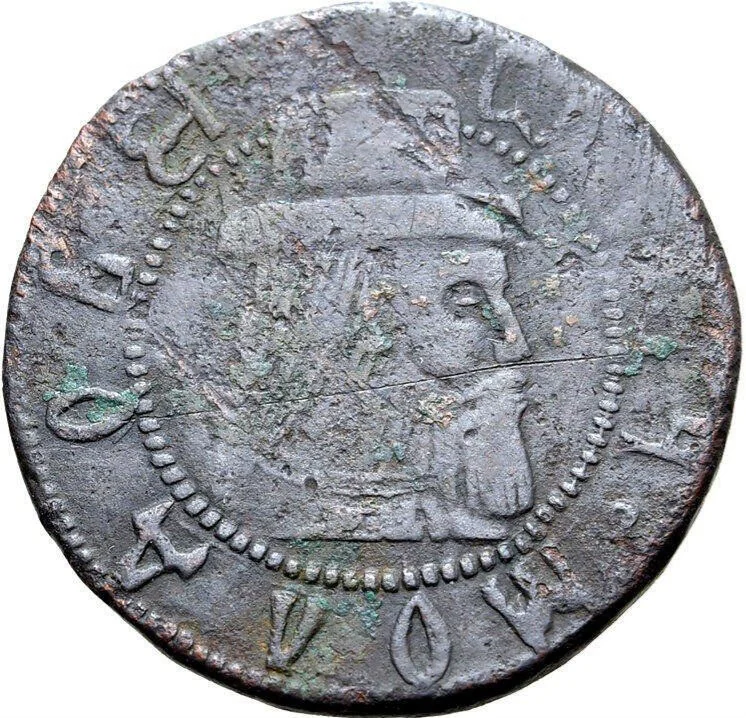
Obverse
Description:
Bearded man in hat, facing right.
Inscription:
ѠТЄЧ•MOЛДOBEI
Script: Cyrillic (medieval)
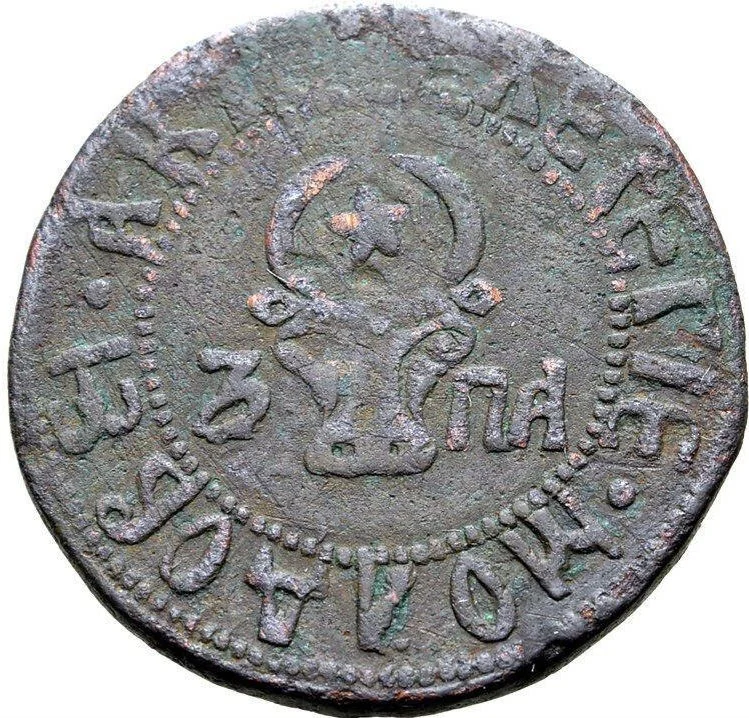
Reverse
Description:
Bull facing; star between horns, date in fields.
Inscription:
AKЧE•ГXEPEГIE•MOЛДOBEI
З ПA
З ПA
Script: Cyrillic (medieval)
Edge
Mintings
| Year | Mint Mark | Mintage | Quality | Collection |
|---|---|---|---|---|
| 1573 | — | — |
Historical background
In 1573, Moldavia (or the Principality of Moldavia) existed as a vassal state under the suzerainty of the Ottoman Empire, a political reality that fundamentally shaped its monetary situation. The Ottoman Porte demanded a heavy annual tribute (haraci), which drained the principality of precious metals and constrained its ability to mint its own high-value coinage. While local Moldavian mints, particularly at Suceava, did produce small-denomination coins like silver groși and copper bani for daily regional trade, the economy was increasingly dominated by foreign currency. This created a dual system where state finances were conducted in Ottoman gold, while local markets used a mix of local and imported coin.
The most prominent currencies in circulation were those of Moldavia’s powerful neighbours. Ottoman gold sultani and silver akçes were essential for international trade and tribute payments. Simultaneously, due to strong economic and cultural ties, Polish-Lithuanian coins (like the grosz and the złoty) and Hungarian gold ducats flowed freely across the border, especially in the northern and western regions. This proliferation of foreign coinage often led to monetary confusion, with exchange rates fluctuating and the value of the local coinage being undermined, a common problem in early modern tributary states.
Therefore, the monetary landscape of 1573 Moldavia was one of constrained sovereignty and complex circulation. Prince Petru Șchiopul (Peter the Lame), ruling during a period of intense internal and external pressure, had limited control over the broader monetary forces at play. The economy functioned through a fragile patchwork of local minting for everyday needs and a heavy reliance on stable foreign currencies for larger transactions and fulfilling the principality’s burdensome obligations to Istanbul, reflecting its precarious position between empires.
The most prominent currencies in circulation were those of Moldavia’s powerful neighbours. Ottoman gold sultani and silver akçes were essential for international trade and tribute payments. Simultaneously, due to strong economic and cultural ties, Polish-Lithuanian coins (like the grosz and the złoty) and Hungarian gold ducats flowed freely across the border, especially in the northern and western regions. This proliferation of foreign coinage often led to monetary confusion, with exchange rates fluctuating and the value of the local coinage being undermined, a common problem in early modern tributary states.
Therefore, the monetary landscape of 1573 Moldavia was one of constrained sovereignty and complex circulation. Prince Petru Șchiopul (Peter the Lame), ruling during a period of intense internal and external pressure, had limited control over the broader monetary forces at play. The economy functioned through a fragile patchwork of local minting for everyday needs and a heavy reliance on stable foreign currencies for larger transactions and fulfilling the principality’s burdensome obligations to Istanbul, reflecting its precarious position between empires.
✨ Legendary