

1 portugaløser – Norway
Add to wishlist
Norway
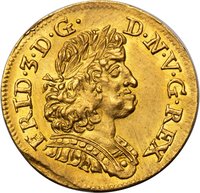
Obverse
Description:
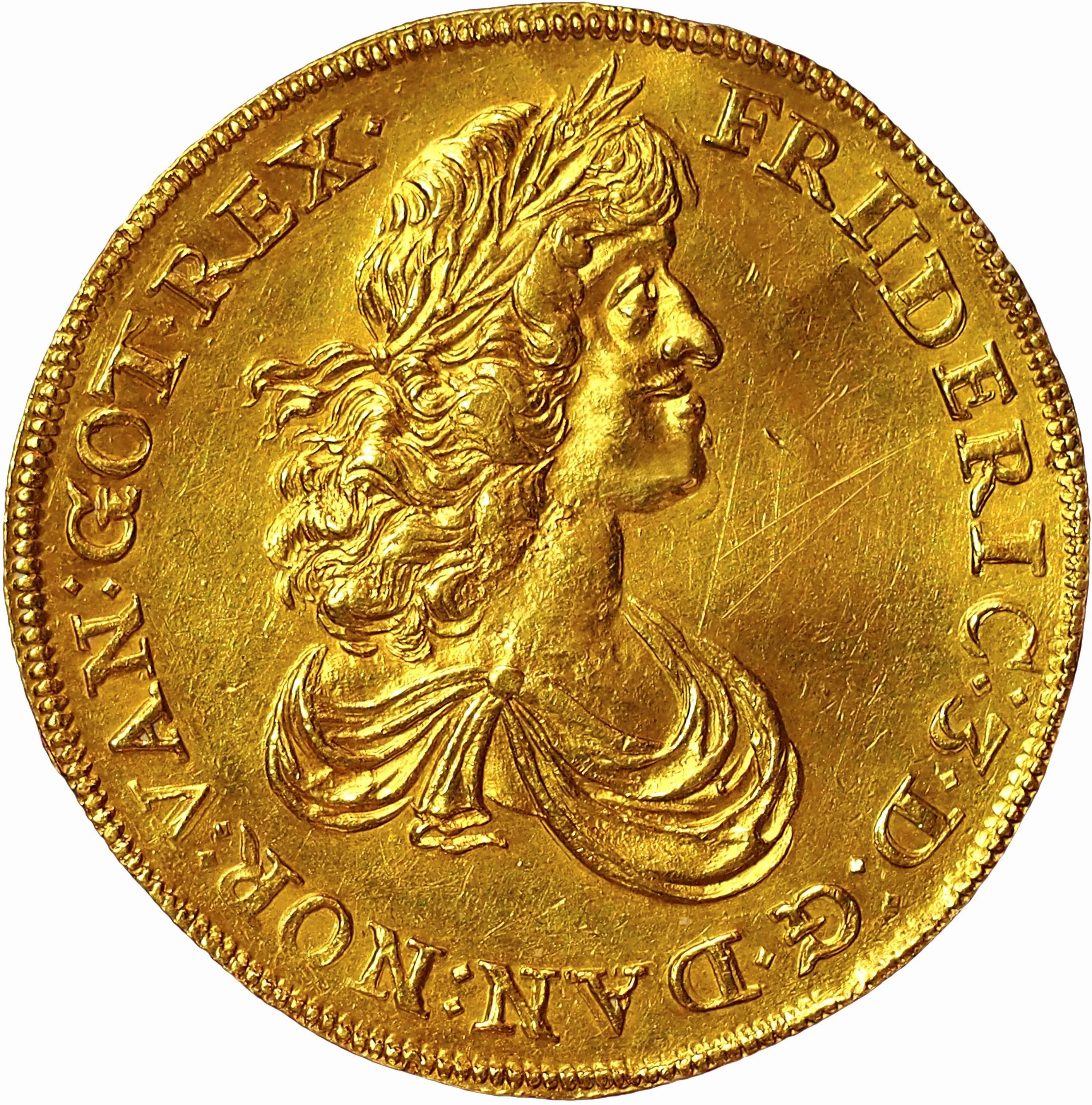
Bust of Frederik III with laurel wreath, facing right, within inscription and beaded rim.
Inscription:
FRIDERIC:3·D:G·DAN:NOR:VAN:GOT·REX·
Script: Latin
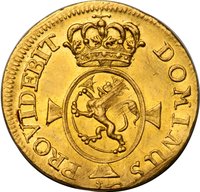
Reverse
Description:
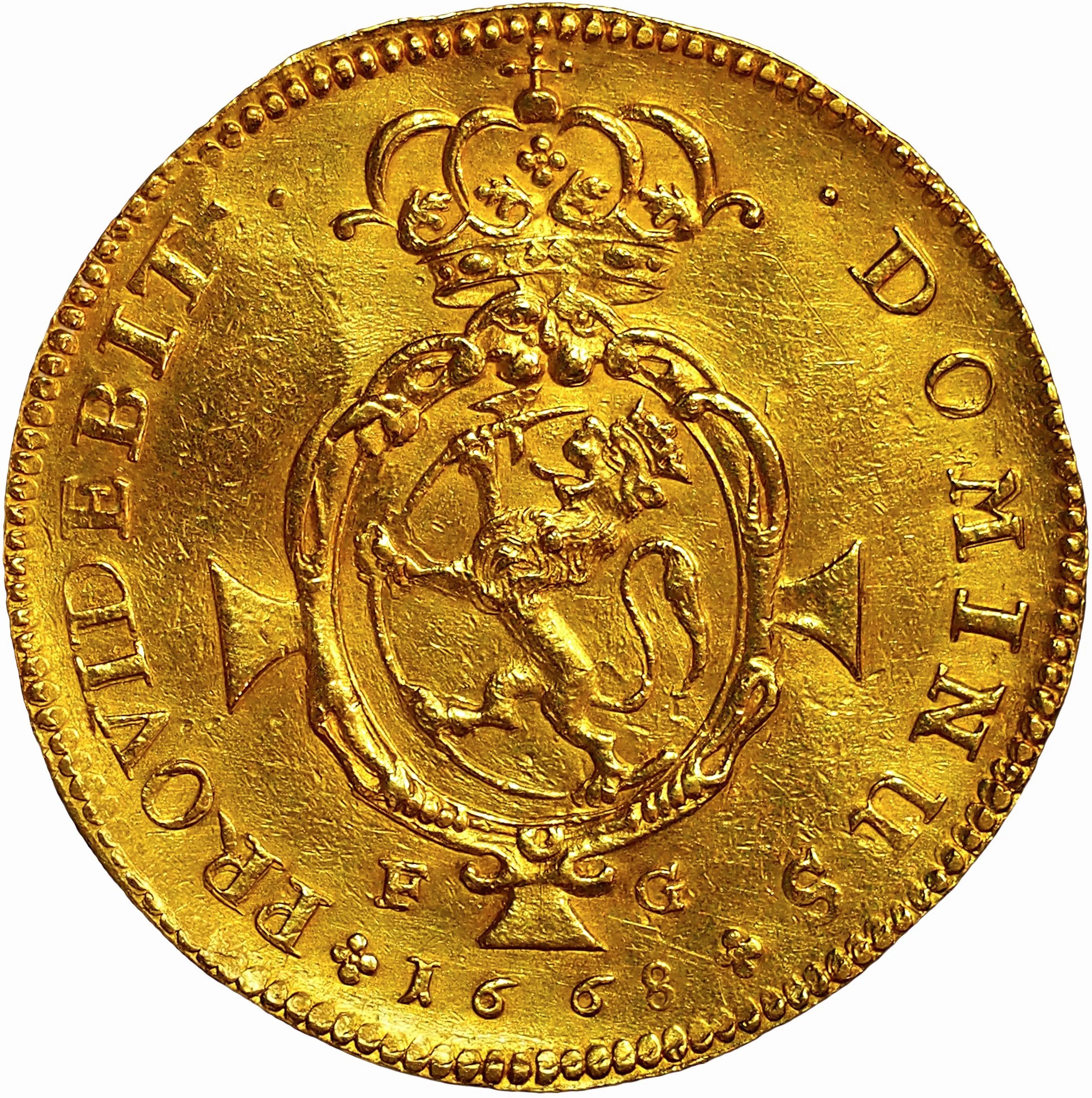
Norwegian lion with axe in crowned oval shield on a cross, flanked by initials, with date and inscription. Beaded rim.
Inscription:
·DOMINUS PROVIDEBIT·
F G
✤1668✤
F G
✤1668✤
Script: Latin
Edge
Plain.
Categories
| Animal |
| Symbols> Coat of Arms |
| Symbol> Cross |
| Object> Cold weapons |
| Person> Monarch |
| Symbol> Crown |
Mints
| Name | Mark |
|---|---|
| Christiania | — |
Mintings
| Year | Mint Mark | Mintage | Quality | Collection |
|---|---|---|---|---|
| 1668 | — | — |
Historical background
In 1668, Norway found itself in a complex monetary situation, deeply intertwined with its political union with Denmark. As part of the Danish-Norwegian dual monarchy, Norway did not control its own monetary policy; the currency system was dictated from Copenhagen. The primary circulating coin was the Danish rigsdaler, a large silver coin, but the reality was one of severe scarcity. Chronic shortages of official coinage, especially smaller denominations for everyday trade, plagued the Norwegian economy, leading to widespread inconvenience and hindering commerce.
To cope with this shortage, a problematic practice had become entrenched: the widespread use of fragmented coinage. Merchants and individuals would physically cut larger silver coins—most notably the rigsdaler and the speciedaler—into smaller pieces to make change. These clipped fragments, known as klippinger, circulated based on their estimated silver weight, but their irregular shapes led to constant disputes, fraud, and a deeply inefficient market. The monetary system was essentially a semi-barter economy reliant on a degraded and unreliable physical medium.
This chaotic situation prompted ongoing discussions in Copenhagen about reform. Just a few years prior, in 1665, a new silver mine was discovered at Kongsberg, offering a potential source of Norwegian silver for coinage. By 1668, plans were likely being formulated to address the crisis, which would culminate in the major monetary reform of 1671. This reform introduced a new, standardized coinage with proper subdivisions, aiming to replace the cut fragments and restore order, leveraging the newfound silver resources from Kongsberg to stabilize the union's currency.
To cope with this shortage, a problematic practice had become entrenched: the widespread use of fragmented coinage. Merchants and individuals would physically cut larger silver coins—most notably the rigsdaler and the speciedaler—into smaller pieces to make change. These clipped fragments, known as klippinger, circulated based on their estimated silver weight, but their irregular shapes led to constant disputes, fraud, and a deeply inefficient market. The monetary system was essentially a semi-barter economy reliant on a degraded and unreliable physical medium.
This chaotic situation prompted ongoing discussions in Copenhagen about reform. Just a few years prior, in 1665, a new silver mine was discovered at Kongsberg, offering a potential source of Norwegian silver for coinage. By 1668, plans were likely being formulated to address the crisis, which would culminate in the major monetary reform of 1671. This reform introduced a new, standardized coinage with proper subdivisions, aiming to replace the cut fragments and restore order, leveraging the newfound silver resources from Kongsberg to stabilize the union's currency.
✨ Legendary