

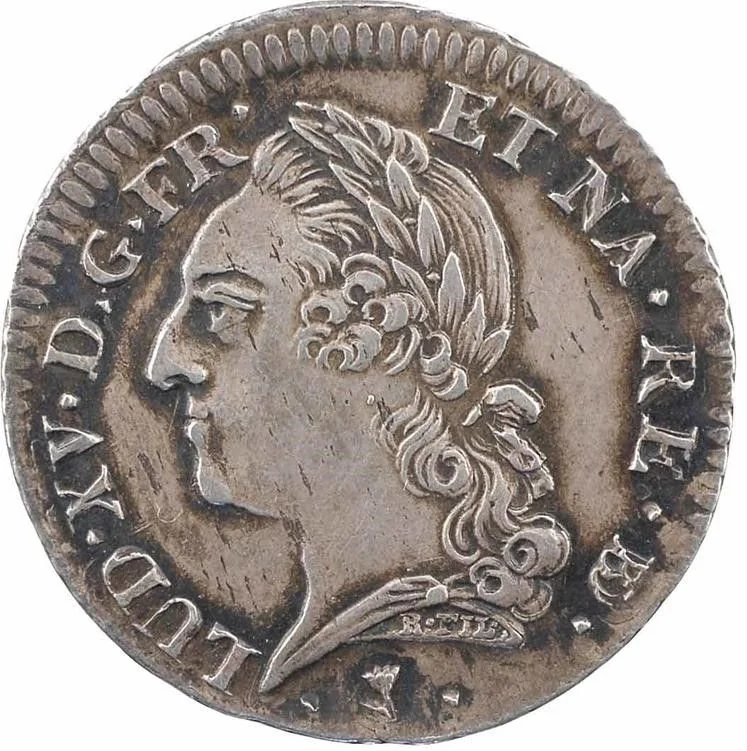
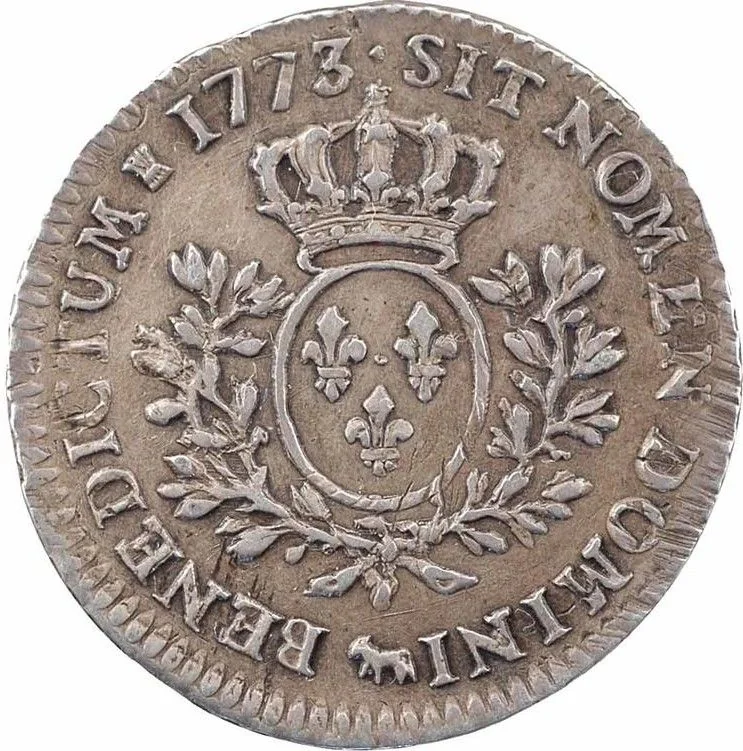
⅕ silver ecu – France
Add to wishlist
France
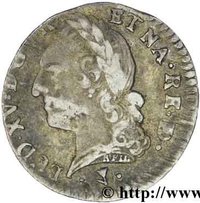
Obverse
Description:
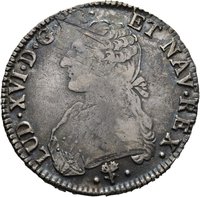
Louis XV, elderly, laureate, draped neck.
Inscription:
LUD•XV•D•G•FR• ET•NAV•REX•BD•
Script: Latin
Engraver: Joseph-Charles Röettiers
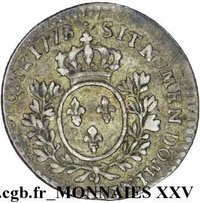
Reverse
Description:
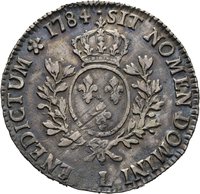
Crowned oval shield of France between olive branches; below, "atelier."
Inscription:
SIT NOMEN DOMINI 🐄 BENEDICTUM 1773
Script: Latin
Edge
Corded
Categories
| Person> Monarch |
| Symbol> Crown |
| Symbols> Coat of Arms |
| Symbol> Fleur-de-lis |
Mints
| Name | Mark |
|---|---|
| Pau | 🐄 |
Historical background
In 1773, France operated under a complex and strained monetary system that was a significant factor in the deepening fiscal crisis of the Ancien Régime. The official currency was the livre tournois, a unit of account, but actual circulation consisted of both metallic coinage and paper money. The coinage itself was a bimetallic system of gold louis d'or and silver écus, whose values were set by royal decree. However, the fixed ratio between gold and silver often failed to match fluctuating international market prices, leading to the frequent disappearance (through hoarding or export) of the undervalued metal, causing shortages and monetary instability.
The state’s finances were crippled by debt from decades of war, particularly the Seven Years' War (1756-1763), which had ended in a costly defeat. To manage this, the monarchy relied heavily on borrowing from a network of financiers and tax farmers, as attempts at direct tax reform were blocked by the privileged estates. A critical element of the crisis was the existence of paper instruments like billets de monnaie and, more problematically, billets de la Caisse d'Escompte (Discount Bank notes). While intended to stimulate commerce, these often circulated at a discount due to a lack of public confidence in the crown's ability to honor them with specie, reflecting a profound distrust in the government's solvency.
This fragile monetary environment was underpinned by a regressive and inefficient tax system that exempted the nobility and clergy, placing the burden on the Third Estate. By 1773, Controller General Anne Robert Jacques Turgot was attempting reforms to liberalize the grain trade and curb spending, but he faced fierce opposition from the privileged parlements and court factions. The currency situation thus was not an isolated issue but a symptom of a sclerotic political and economic structure, where monetary instability, massive sovereign debt, and social inequality were intertwining to create the preconditions for the upheaval that would erupt less than two decades later.
The state’s finances were crippled by debt from decades of war, particularly the Seven Years' War (1756-1763), which had ended in a costly defeat. To manage this, the monarchy relied heavily on borrowing from a network of financiers and tax farmers, as attempts at direct tax reform were blocked by the privileged estates. A critical element of the crisis was the existence of paper instruments like billets de monnaie and, more problematically, billets de la Caisse d'Escompte (Discount Bank notes). While intended to stimulate commerce, these often circulated at a discount due to a lack of public confidence in the crown's ability to honor them with specie, reflecting a profound distrust in the government's solvency.
This fragile monetary environment was underpinned by a regressive and inefficient tax system that exempted the nobility and clergy, placing the burden on the Third Estate. By 1773, Controller General Anne Robert Jacques Turgot was attempting reforms to liberalize the grain trade and curb spending, but he faced fierce opposition from the privileged parlements and court factions. The currency situation thus was not an isolated issue but a symptom of a sclerotic political and economic structure, where monetary instability, massive sovereign debt, and social inequality were intertwining to create the preconditions for the upheaval that would erupt less than two decades later.
✨ Legendary