

10 Cash – Danish India
India
Context
Years: 1768–1777
Country: India 
Issuer: Danish India
Ruler: Christian VII
Currency:
(1730—1818)
Demonetized: Yes
Material
References
KM: #Click to copy to clipboard164
Numista: #382117
Obverse
Description:
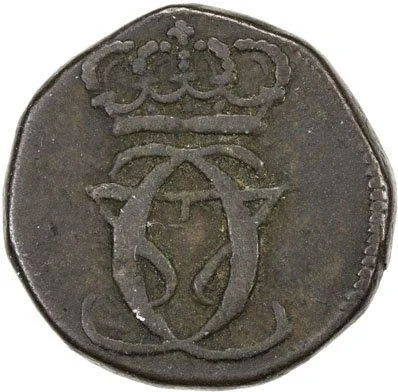
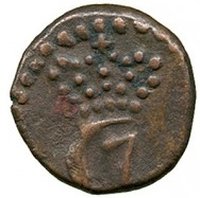
Crowned double C7 insignia
Script: Latin
Reverse
Description:
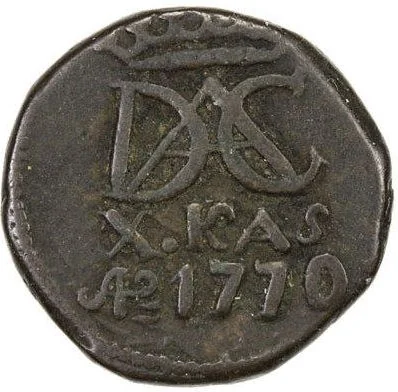
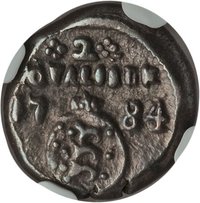
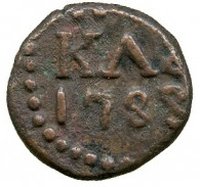
Crowned DAC monogram, denomination and date below.
Inscription:
DAC
X. KAS
1770
X. KAS
1770
Script: Latin
Edge
Plain
Mintings
| Year | Mint Mark | Mintage | Quality | Collection |
|---|---|---|---|---|
| 1768 | — | — | ||
| 1770 | — | — | ||
| 1777 | — | — |
Historical background
In 1768, the currency situation in Danish India, centered on the trading outposts of Tranquebar (Tharangambadi) and Serampore (Frederiksnagore), was complex and heavily influenced by its regional context. The Danish Asiatic Company did not issue a distinct local currency for exclusive use in its settlements. Instead, the economy operated on a multi-currency system dominated by various silver rupees from neighboring Indian powers and other European companies. The most important of these was the Arcot rupee, issued by the Nawab of the Carnatic, which served as the principal accounting unit and medium for larger commercial transactions. This reliance on external coinage reflected Denmark's minor commercial position and the pragmatic need for its trade to integrate seamlessly with the wider South Indian economy.
Daily transactions were facilitated by a proliferation of smaller copper coins, known as kās or cash, which filled the need for low-denomination currency. These coppers were minted by various local authorities and even by the Danish administration itself in Tranquebar, but they suffered from chronic instability. Their value was not fixed to silver but was subject to volatile exchange rates (batta) based on metal content, scarcity, and market demand. This created a two-tiered system: stable silver for large-scale trade and unreliable copper for the local bazaar, causing frequent inconvenience and loss for the common population.
The underlying problem for the Danes was a persistent shortage of specie (coin), exacerbated by their negative balance of trade. More silver flowed out to pay for Indian textiles and goods than flowed in from European exports. Consequently, Danish authorities often struggled to obtain enough acceptable coinage to pay for local goods, services, and troops, leading to occasional experiments with currency regulations and the issuance of lead tokens. Ultimately, the monetary landscape of 1768 was one of dependency and adaptation, where Danish commercial activity was conducted not on its own monetary terms, but through the heterogeneous and fluctuating currency systems of the Indian subcontinent.
Daily transactions were facilitated by a proliferation of smaller copper coins, known as kās or cash, which filled the need for low-denomination currency. These coppers were minted by various local authorities and even by the Danish administration itself in Tranquebar, but they suffered from chronic instability. Their value was not fixed to silver but was subject to volatile exchange rates (batta) based on metal content, scarcity, and market demand. This created a two-tiered system: stable silver for large-scale trade and unreliable copper for the local bazaar, causing frequent inconvenience and loss for the common population.
The underlying problem for the Danes was a persistent shortage of specie (coin), exacerbated by their negative balance of trade. More silver flowed out to pay for Indian textiles and goods than flowed in from European exports. Consequently, Danish authorities often struggled to obtain enough acceptable coinage to pay for local goods, services, and troops, leading to occasional experiments with currency regulations and the issuance of lead tokens. Ultimately, the monetary landscape of 1768 was one of dependency and adaptation, where Danish commercial activity was conducted not on its own monetary terms, but through the heterogeneous and fluctuating currency systems of the Indian subcontinent.
✨ Legendary