

1 quinzain – France
Add to wishlist
France
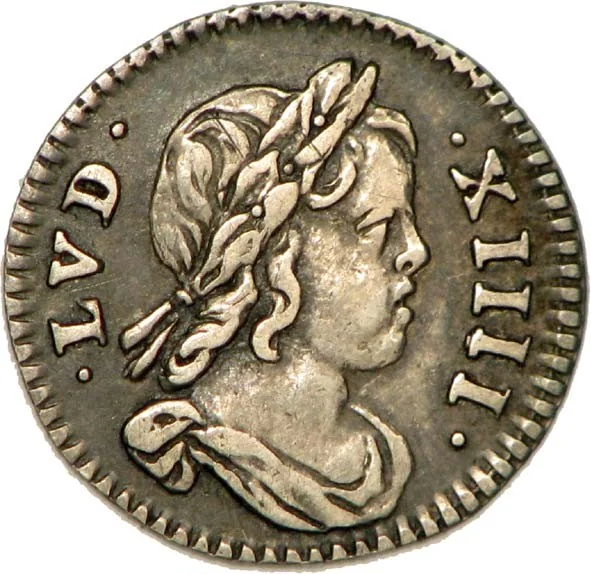
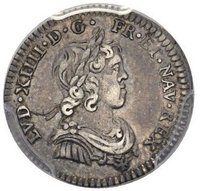
Obverse
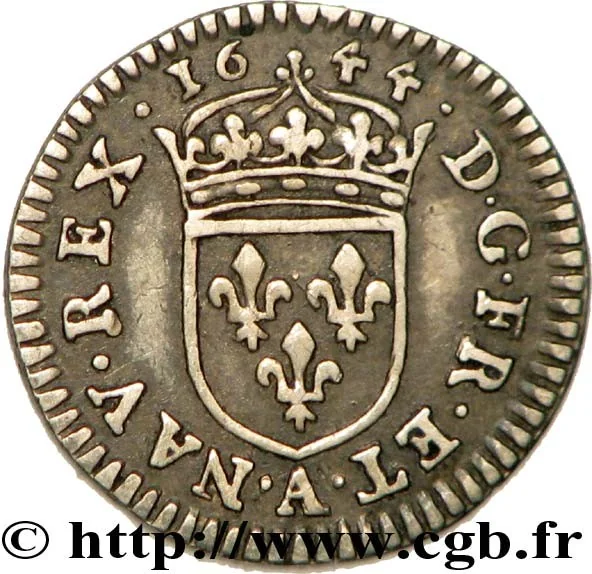
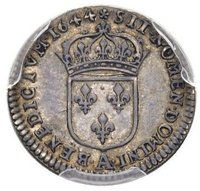
Reverse
Description:
French royal arms.
Inscription:
D. G. FR. ET. .NAV. REX. 1644.
Script: Latin
Engraver: Jean Warin
Edge
Plain
Mints
| Name | Mark |
|---|---|
| Monnaie de Paris | A |
Mintings
| Year | Mint Mark | Mintage | Quality | Collection |
|---|---|---|---|---|
| 1644 | A | — |
Historical background
In 1644, France was in the midst of the long and costly Thirty Years' War (1618-1648), a conflict that placed immense fiscal strain on the monarchy of Louis XIII and his chief minister, Cardinal Richelieu (until his death in 1642). The primary currency issue was not one of a single, stable national coinage, but rather the chaotic coexistence of multiple systems. The realm operated on a bimetallic standard of gold (louis d'or) and silver (écus), but their official values in terms of the accounting unit, the livre tournois, were constantly being manipulated by royal edicts to generate short-term revenue for the war effort.
This period was characterized by severe monetary instability, including repeated devaluations and revaluations. The Crown would officially raise the montant (the value in livres) of its coins, effectively debasing the currency to create more money from existing bullion and to draw older, undervalued coins back to the mints for recoinage at a profit (seigniorage). Conversely, sudden revaluations (augmentations) could be decreed to attract precious metal. These erratic policies created confusion in commerce, fostered speculation, and eroded public trust, as the real value of coins fluctuated independently of their face value.
Furthermore, alongside royal coinage, a plethora of older foreign coins, particularly Spanish silver reales from New World mines, circulated widely due to international war financing and trade. The monetary landscape was thus fragmented and unpredictable, with exchange rates between different physical coins and the notional livre in constant flux. This instability would be a key factor leading to the more systematic, but initially disastrous, reforms undertaken by Louis XIV's minister, Jean-Baptiste Colbert, in the 1660s.
This period was characterized by severe monetary instability, including repeated devaluations and revaluations. The Crown would officially raise the montant (the value in livres) of its coins, effectively debasing the currency to create more money from existing bullion and to draw older, undervalued coins back to the mints for recoinage at a profit (seigniorage). Conversely, sudden revaluations (augmentations) could be decreed to attract precious metal. These erratic policies created confusion in commerce, fostered speculation, and eroded public trust, as the real value of coins fluctuated independently of their face value.
Furthermore, alongside royal coinage, a plethora of older foreign coins, particularly Spanish silver reales from New World mines, circulated widely due to international war financing and trade. The monetary landscape was thus fragmented and unpredictable, with exchange rates between different physical coins and the notional livre in constant flux. This instability would be a key factor leading to the more systematic, but initially disastrous, reforms undertaken by Louis XIV's minister, Jean-Baptiste Colbert, in the 1660s.
✨ Legendary