

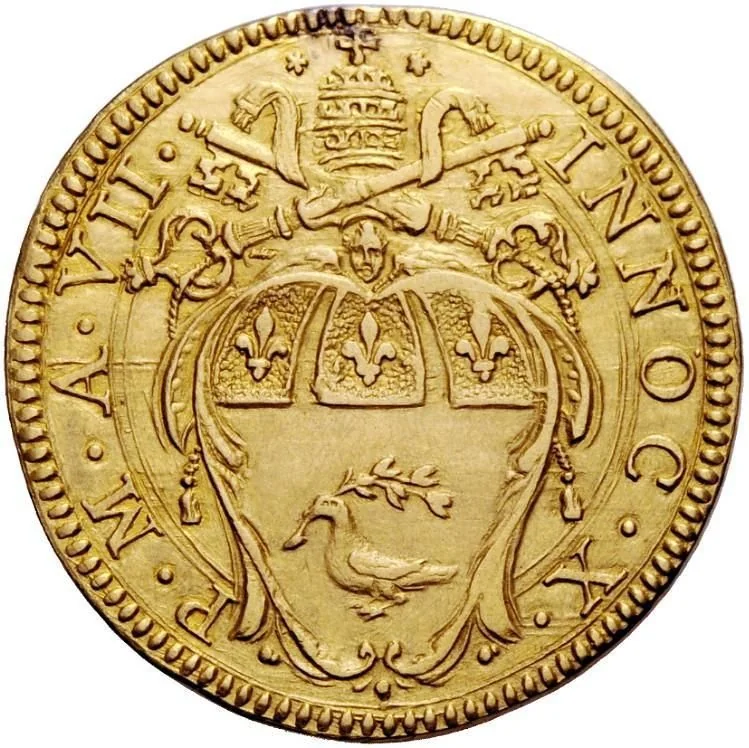
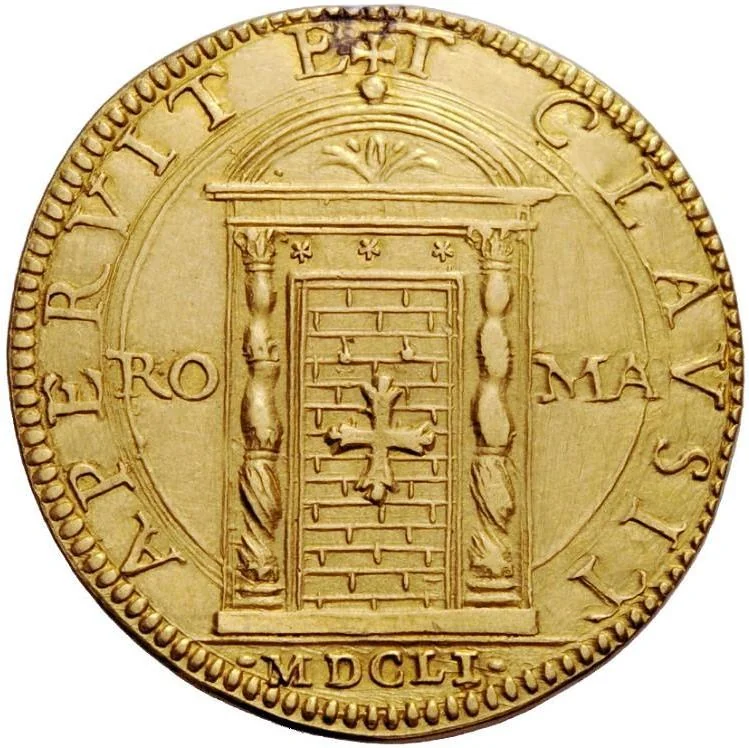
1 Doppia – Papal States
Circulating commemorative coins
Commemoration: Jubilee 1650
Vatican City
Context
Year: 1651
Country: Vatican City 
Issuer: Papal States
Ruler: Innocent X
Currency:
(1534—1835)
Demonetized: Yes
Material
References
KM: #Click to copy to clipboard256
Numista: #376462
Value
Bullion value: $1166.42
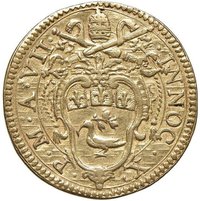
Obverse
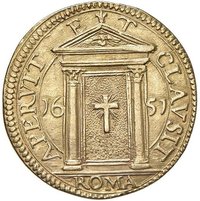
Reverse
Edge
Mints
| Name | Mark |
|---|---|
| Rome | — |
Mintings
| Year | Mint Mark | Mintage | Quality | Collection |
|---|---|---|---|---|
| 1651 | — | — |
Historical background
In 1651, the Papal States under Pope Innocent X faced a significant monetary crisis rooted in decades of fiscal strain. The ongoing Thirty Years' War (1618-1648), though largely fought in northern Europe, had severely disrupted trade and drained papal resources through subsidies to Catholic allies. Furthermore, the ambitious urban and artistic projects of previous popes, funded by heavy borrowing and taxation, left the treasury depleted. To meet its obligations, the Apostolic Chamber had increasingly resorted to debasing the coinage, particularly the low-denomination baiocco and quattrino, by reducing their silver content. This practice, while providing short-term liquidity, eroded public trust and sparked inflation, harming the daily economy of Rome and its territories.
The specific currency situation was characterized by a chaotic circulation of vastly overvalued copper coins alongside underweight silver coins. The value of the standard silver giulio had become unstable, and the proliferation of poor-quality copper currency led to Gresham's Law in action: "bad money drove out good." People hoarded older, purer coins, further complicating transactions. This debasement was not merely an economic tool but also a hidden tax, as the state profited from the seigniorage of minting cheap coins and demanding payments in sound money. The situation caused widespread grievance among the populace, who saw their purchasing power diminish, and created difficulties for merchants engaged in regional trade.
Pope Innocent X's administration recognized the need for reform. In the early 1650s, efforts were made to recall and melt down the debased copper currency and issue new coins of proper weight and alloy. However, these measures were only partially successful due to the immense cost of a full recoinage and the entrenched fiscal pressures. The monetary instability of 1651 was thus a symptom of the broader challenges facing the Papal States as a temporal power: maintaining political influence, funding its grandeur, and managing an economy increasingly strained by external conflicts and internal financial practices that prioritized immediate fiscal survival over long-term monetary stability.
The specific currency situation was characterized by a chaotic circulation of vastly overvalued copper coins alongside underweight silver coins. The value of the standard silver giulio had become unstable, and the proliferation of poor-quality copper currency led to Gresham's Law in action: "bad money drove out good." People hoarded older, purer coins, further complicating transactions. This debasement was not merely an economic tool but also a hidden tax, as the state profited from the seigniorage of minting cheap coins and demanding payments in sound money. The situation caused widespread grievance among the populace, who saw their purchasing power diminish, and created difficulties for merchants engaged in regional trade.
Pope Innocent X's administration recognized the need for reform. In the early 1650s, efforts were made to recall and melt down the debased copper currency and issue new coins of proper weight and alloy. However, these measures were only partially successful due to the immense cost of a full recoinage and the entrenched fiscal pressures. The monetary instability of 1651 was thus a symptom of the broader challenges facing the Papal States as a temporal power: maintaining political influence, funding its grandeur, and managing an economy increasingly strained by external conflicts and internal financial practices that prioritized immediate fiscal survival over long-term monetary stability.
✨ Legendary