

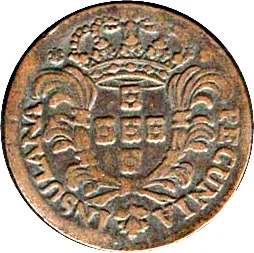
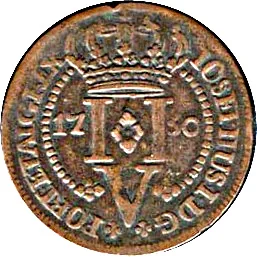
5 Réis – Madeira Islands
Portugal
Context
Years: 1750–1751
Country: Portugal 
Issuer: Madeira Islands
Ruler: Joseph I
Currency:
(1750—1830)
Demonetized: Yes
Material
References
KM: #Click to copy to clipboard1
Numista: #37451
Obverse
Reverse
Description:
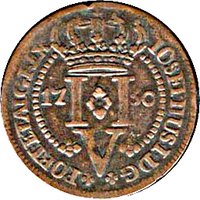
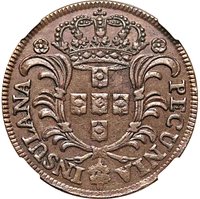
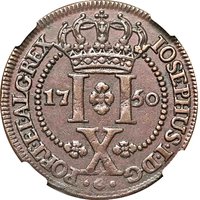
Crowned "IHS" monogram above Roman numeral value. Latin text encircles the bottom.
Inscription:
IOSEPHUS·I·D G·P·ET·ALG·REX
17 50
V
17 50
V
Script: Latin
Edge
Plain
Categories
| Symbols> Coat of Arms |
| Symbol> Crown |
Mintings
| Year | Mint Mark | Mintage | Quality | Collection |
|---|---|---|---|---|
| 1750 | — | — | ||
| 1751 | — | — |
Historical background
In 1750, the currency situation in the Madeira Islands was complex and largely dictated by its colonial status within the Portuguese Empire. The official currency was the Portuguese real (plural: réis), with larger transactions often calculated in milréis (1,000 réis). However, the practical reality in Funchal's bustling port was one of significant foreign coin circulation. Due to Madeira's pivotal role in Atlantic trade routes, coins from Spain, England, France, and Brazil were commonly used in daily commerce, especially in the wine trade that connected the island to Britain and the Americas. This created a de facto multi-currency system where merchants and officials had to constantly negotiate exchange rates and values.
This monetary diversity was symptomatic of a chronic shortage of official Portuguese specie on the island. The problem was systemic: as a small, trade-dependent archipelago with limited natural resources, Madeira imported far more than it exported, causing a constant outflow of coin to pay for essential goods like grain. The local economy, while prosperous from wine and sugar, was thus perpetually starved of convenient small-denomination coinage for everyday transactions. This often led to the use of cut or clipped coins and prompted authorities to periodically assign official values to specific foreign coins, like Spanish pesos or Brazilian gold moedas, to try and stabilize local trade.
The Portuguese crown’s broader imperial financial policies further complicated the situation. Efforts to centralize control over colonial economies and direct bullion to Lisbon often left peripheral territories like Madeira underserved. While no major currency reform was enacted specifically for Madeira in the mid-18th century, the local administration had to pragmatically manage this heterogeneous system. The currency landscape of 1750 Madeira, therefore, reflected its identity as a commercial crossroads—formally under Portuguese rule but economically integrated into a much wider Atlantic world, where the coins in one's pocket were as likely to be foreign as they were domestic.
This monetary diversity was symptomatic of a chronic shortage of official Portuguese specie on the island. The problem was systemic: as a small, trade-dependent archipelago with limited natural resources, Madeira imported far more than it exported, causing a constant outflow of coin to pay for essential goods like grain. The local economy, while prosperous from wine and sugar, was thus perpetually starved of convenient small-denomination coinage for everyday transactions. This often led to the use of cut or clipped coins and prompted authorities to periodically assign official values to specific foreign coins, like Spanish pesos or Brazilian gold moedas, to try and stabilize local trade.
The Portuguese crown’s broader imperial financial policies further complicated the situation. Efforts to centralize control over colonial economies and direct bullion to Lisbon often left peripheral territories like Madeira underserved. While no major currency reform was enacted specifically for Madeira in the mid-18th century, the local administration had to pragmatically manage this heterogeneous system. The currency landscape of 1750 Madeira, therefore, reflected its identity as a commercial crossroads—formally under Portuguese rule but economically integrated into a much wider Atlantic world, where the coins in one's pocket were as likely to be foreign as they were domestic.
⭐ Rare