

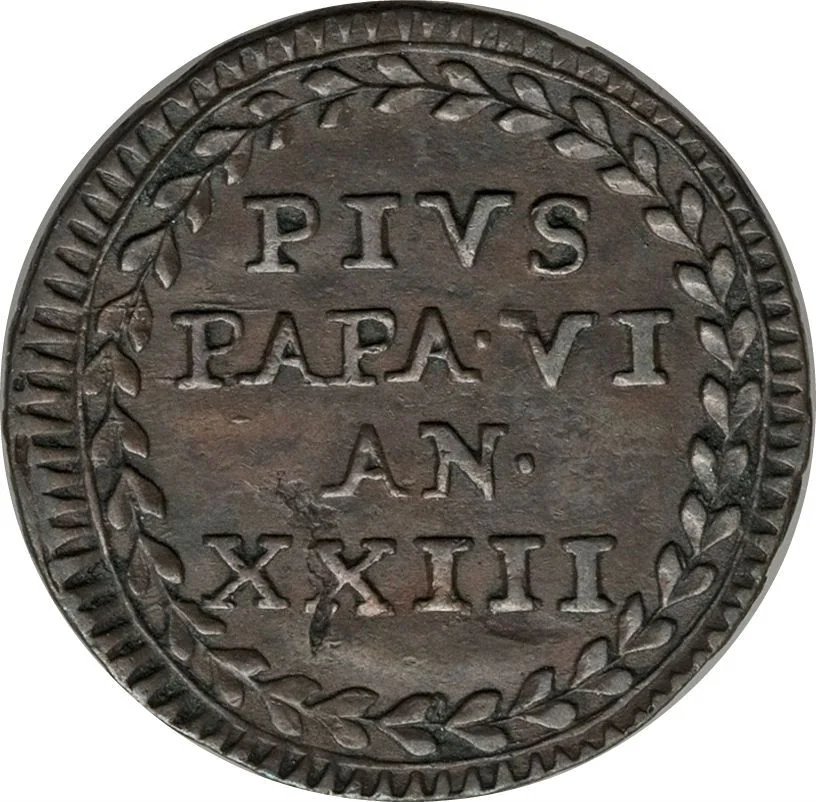
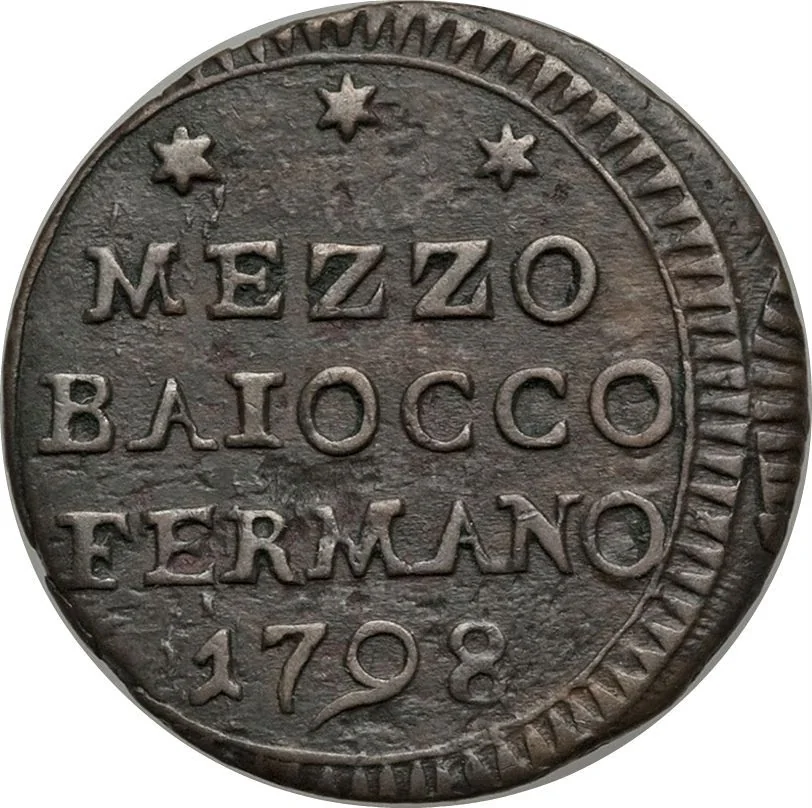
½ baiocco – Fermo
Add to wishlist
Italy
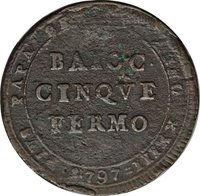
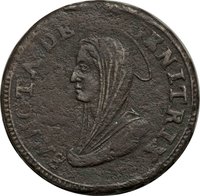
Obverse
Reverse
Edge
Mints
| Name | Mark |
|---|---|
| Fermo | — |
Mintings
| Year | Mint Mark | Mintage | Quality | Collection |
|---|---|---|---|---|
| 1798 | — | — |
Historical background
In 1798, Fermo, a city in the Marche region of Italy, found itself at the turbulent intersection of war, revolution, and monetary chaos. The previous year, French Republican forces under Napoleon Bonaparte had swept through the Italian Peninsula, toppling the ancient Papal States to which Fermo belonged. In its place, they established the short-lived Roman Republic, a French client state. This abrupt political shift immediately destabilized the existing monetary system, as the new revolutionary authorities sought to impose their own financial order while old currencies remained in circulation.
The currency situation became a complex and problematic mosaic. The official currency decreed by the Roman Republic was the scudo romano, divided into 100 baiocchi. However, the sudden change lacked both public trust and sufficient time for implementation. Consequently, a multitude of older coins continued to circulate at fluctuating values, including Papal States scudi and giulii, as well as coins from neighboring states and even older, debased issues. This created a climate of confusion and opportunistic speculation, where merchants and citizens struggled to ascertain real values, hampering daily trade and the local economy.
Furthermore, the French authorities, needing to fund their military campaign and the new administration, imposed heavy financial demands on Fermo and other cities. This often took the form of forced loans, requisitions of goods and precious metals, and the issuance of mandats (assignats), which were paper notes backed by seized church properties. These notes rapidly depreciated, adding a layer of inflationary pressure to the already chaotic multi-currency environment. Thus, by 1798, Fermo's currency was not a single system but a contested and unstable blend of old and new monies, reflecting the profound dislocation and economic strain of revolutionary occupation.
The currency situation became a complex and problematic mosaic. The official currency decreed by the Roman Republic was the scudo romano, divided into 100 baiocchi. However, the sudden change lacked both public trust and sufficient time for implementation. Consequently, a multitude of older coins continued to circulate at fluctuating values, including Papal States scudi and giulii, as well as coins from neighboring states and even older, debased issues. This created a climate of confusion and opportunistic speculation, where merchants and citizens struggled to ascertain real values, hampering daily trade and the local economy.
Furthermore, the French authorities, needing to fund their military campaign and the new administration, imposed heavy financial demands on Fermo and other cities. This often took the form of forced loans, requisitions of goods and precious metals, and the issuance of mandats (assignats), which were paper notes backed by seized church properties. These notes rapidly depreciated, adding a layer of inflationary pressure to the already chaotic multi-currency environment. Thus, by 1798, Fermo's currency was not a single system but a contested and unstable blend of old and new monies, reflecting the profound dislocation and economic strain of revolutionary occupation.
✨ Legendary