

¼ Gold Louis – France
France
Context

Material
Weight: 3.06 g
Gold weight: 2.81 g
Shape: Round
Composition: 91.7% Gold
Standard: Gold tenth ounce
Magnetic: No
Technique: Milled
References
KM: #Click to copy to clipboard429
Numista: #370046
Value
Bullion value: $468.80
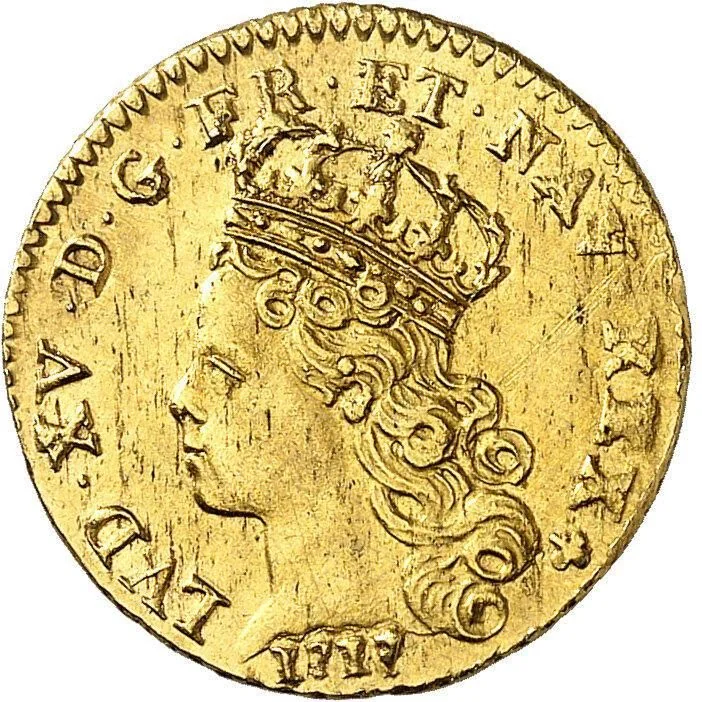
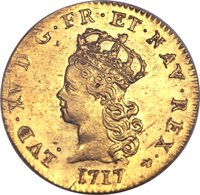
Obverse
Description:
Crowned child facing left.
Inscription:
LVD. XV. D. G. FR. ET. NAV. REX.
1717
1717
Script: Latin
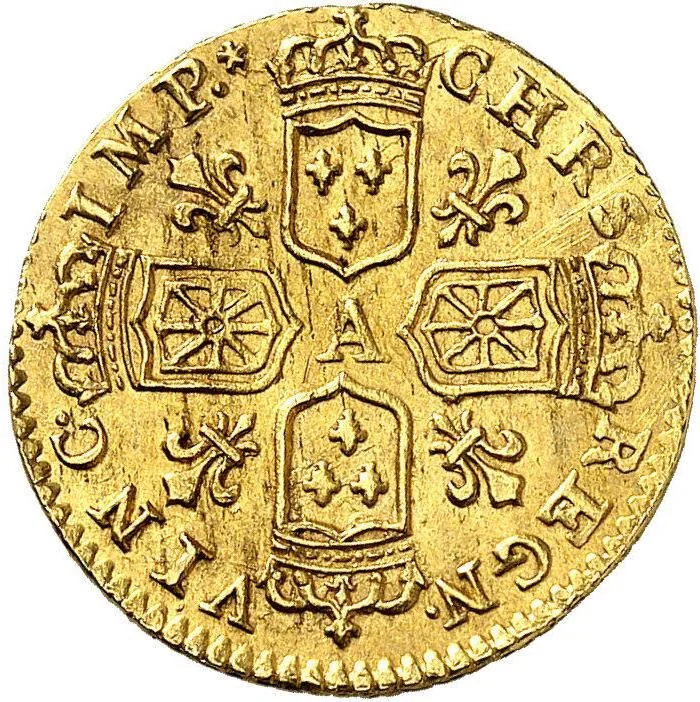
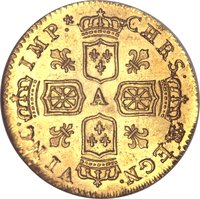
Reverse
Description:
Four shields cross, fleur-de-lis in corners.
Inscription:
CHRS. REGN. VINC. IMP.
A
A
Script: Latin
Edge
Categories
| Symbol> Crown |
| Person> Monarch |
| Symbols> Coat of Arms |
| Symbol> Fleur-de-lis |
Mints
| Name | Mark |
|---|---|
| Monnaie de Paris | A |
| Rouen | B |
Historical background
In 1717, France was mired in a profound financial crisis, the legacy of the extravagant spending and costly wars of Louis XIV. The state was burdened with a colossal debt, and the currency system was chaotic and debased. The livre tournois, the unit of account, had no stable value, as the government had repeatedly manipulated the metal content of coins and issued paper bills (billets de monnaie) that were rapidly losing public confidence. This environment of monetary instability and near-bankruptcy created a desperate need for radical financial reform.
It was into this volatile situation that the Scottish economist John Law arrived, having gained the favor of the Regent, Philippe d’Orléans, who ruled for the young Louis XV. In 1716, Law had successfully established the Banque Générale Privée, a private bank that issued paper notes backed by deposits of specie (coin). By 1717, this bank was gaining traction, as its notes held their value better than the state's metal currency, which was subject to arbitrary devaluations. Law's system promised to replace the chaotic metallic currency with a uniform, reliable paper money, theoretically stimulating commerce and providing the state with a mechanism to manage its debt.
Thus, 1717 stands as a pivotal year, marking the calm before a dramatic financial experiment. It was the year Law secured royal approval for his next, more ambitious venture: the founding of the Compagnie d’Occident (later the Mississippi Company), granted a monopoly on trade with France's Louisiana territory. This move set the stage for the intertwining of his banking system with speculative colonial enterprise, laying the groundwork for the infamous "Mississippi Bubble" that would engulf France in the following years. The currency situation was therefore in a state of tense transition, from the old regime of debasement to a new, untested regime of credit and paper money.
It was into this volatile situation that the Scottish economist John Law arrived, having gained the favor of the Regent, Philippe d’Orléans, who ruled for the young Louis XV. In 1716, Law had successfully established the Banque Générale Privée, a private bank that issued paper notes backed by deposits of specie (coin). By 1717, this bank was gaining traction, as its notes held their value better than the state's metal currency, which was subject to arbitrary devaluations. Law's system promised to replace the chaotic metallic currency with a uniform, reliable paper money, theoretically stimulating commerce and providing the state with a mechanism to manage its debt.
Thus, 1717 stands as a pivotal year, marking the calm before a dramatic financial experiment. It was the year Law secured royal approval for his next, more ambitious venture: the founding of the Compagnie d’Occident (later the Mississippi Company), granted a monopoly on trade with France's Louisiana territory. This move set the stage for the intertwining of his banking system with speculative colonial enterprise, laying the groundwork for the infamous "Mississippi Bubble" that would engulf France in the following years. The currency situation was therefore in a state of tense transition, from the old regime of debasement to a new, untested regime of credit and paper money.
✨ Legendary