

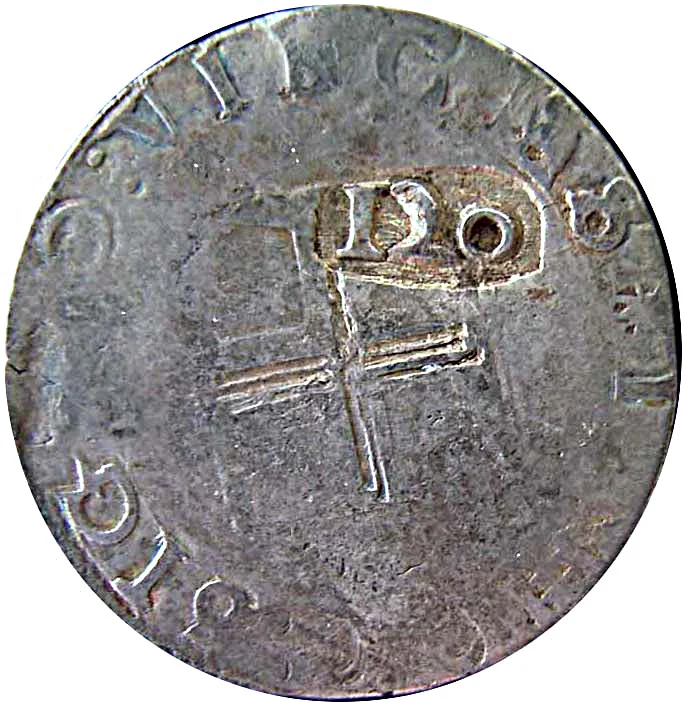
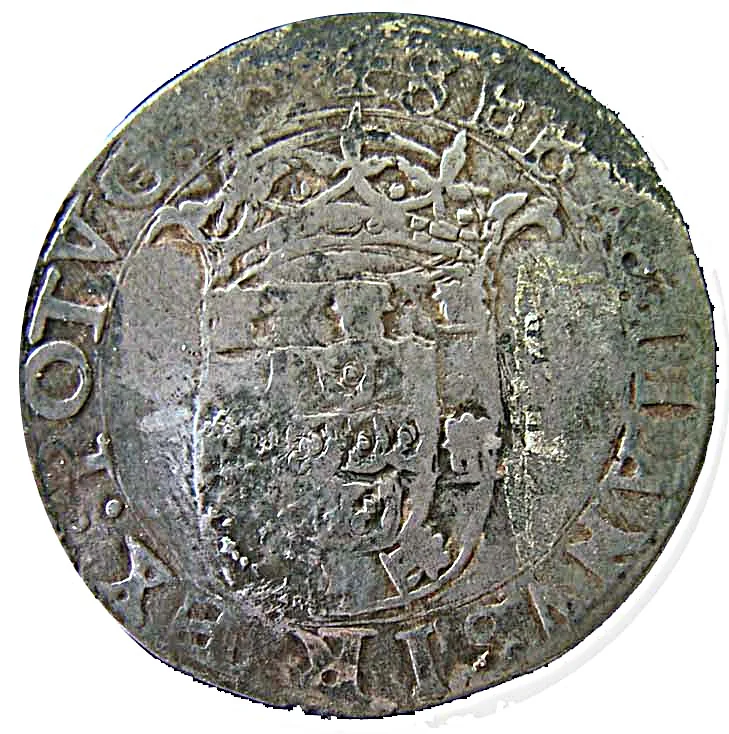
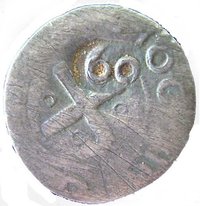
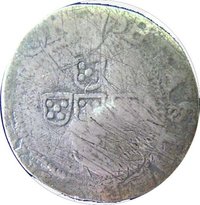
120 Réis – Portugal
Portugal

Material
Diameter: 30 mm
Weight: 8.8 g
Silver weight: 8.07 g
Shape: Irregular round
Composition: 91.67% Silver
Magnetic: No
Techniques: Hammered, Countermarked
References
KM: #Click to copy to clipboard429.2
Numista: #36688
Value
Bullion value: $22.91
Mintings
| Year | Mint Mark | Mintage | Quality | Collection |
|---|---|---|---|---|
| 1642 | — | — |
Historical background
In 1642, Portugal was in the midst of the Restoration War (1640-1668), fighting to secure its independence from the Spanish Habsburg crown. This costly conflict placed immense fiscal strain on the newly reinstated monarchy of King John IV. The war effort demanded vast expenditures for armies, fortifications, and diplomacy, while trade disruptions, particularly with key colonies, hampered revenue. To meet these urgent financial needs, the crown resorted to aggressive monetary debasement, significantly reducing the silver content in the kingdom's primary coin, the real.
The currency situation was therefore one of severe instability and inflation. The government issued coins of inferior alloy while officially maintaining their old face value, a practice that rapidly eroded public trust. This led to the phenomenon of "good money" (older, higher-silver coins) being hoarded or exported, while "bad money" (the new, debased coins) flooded circulation, in accordance with Gresham's Law. Prices soared as the real purchasing power of the currency collapsed, causing hardship for the population and complicating the state's own procurement and payment of troops.
Facing this crisis, the Portuguese crown took a significant step in 1642 by establishing the Casa da Moeda (the Mint) in Lisbon, centralizing coin production which had been scattered across several cities. This move was aimed at asserting royal control over the monetary system, standardizing the debased coinage, and theoretically improving efficiency to fund the war. However, the fundamental pressures remained; the currency would continue to deteriorate for decades, with the financial burdens of sovereignty only being stabilized later in the century with the influx of Brazilian gold.
The currency situation was therefore one of severe instability and inflation. The government issued coins of inferior alloy while officially maintaining their old face value, a practice that rapidly eroded public trust. This led to the phenomenon of "good money" (older, higher-silver coins) being hoarded or exported, while "bad money" (the new, debased coins) flooded circulation, in accordance with Gresham's Law. Prices soared as the real purchasing power of the currency collapsed, causing hardship for the population and complicating the state's own procurement and payment of troops.
Facing this crisis, the Portuguese crown took a significant step in 1642 by establishing the Casa da Moeda (the Mint) in Lisbon, centralizing coin production which had been scattered across several cities. This move was aimed at asserting royal control over the monetary system, standardizing the debased coinage, and theoretically improving efficiency to fund the war. However, the fundamental pressures remained; the currency would continue to deteriorate for decades, with the financial burdens of sovereignty only being stabilized later in the century with the influx of Brazilian gold.
✨ Legendary