

1⁄12 Ecu – Monaco
Monaco

Obverse
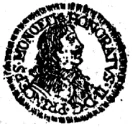
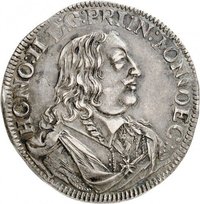
Description:
Honoré II, right-facing bust.
Inscription:
✿HONORATVS II. D.G. PRIN. MONOECI
Script: Latin
Engraver: Jean Solignac
Reverse
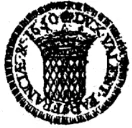
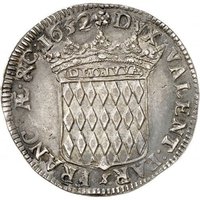
Description:
Arms crowned, date upper left.
Inscription:
✿DVX. VALENT. PAR Ꞩ FRANCIAE. & c. .1650
Script: Latin
Engraver: Jean Solignac
Edge
Plain.
Mints
| Name | Mark |
|---|---|
| Monaco | — |
Mintings
| Year | Mint Mark | Mintage | Quality | Collection |
|---|---|---|---|---|
| 1650 | — | — | ||
| 1651 | — | — |
Historical background
In 1650, Monaco, under the sovereignty of the Grimaldi family, did not mint its own independent currency. Its monetary system was intrinsically tied to that of its much larger neighbors, particularly France and the various Italian states. The Principality operated within a complex Mediterranean zone of concurrent currencies, where coins from multiple issuing authorities circulated simultaneously and were valued by their weight in precious metal. The most commonly accepted tender for larger transactions was the French livre tournois and its subsidiary coins, but Spanish reales, Italian scudi, and even Genoese and Savoyard issues would have been present in commerce, reflecting Monaco's position on a busy trade route.
The local economy, while modest in scale, was strategically significant due to the Rock's fortress and port. Revenue for the ruling Prince came primarily from tariffs on goods passing through this port, taxes on local production (like the famous lemon groves), and the milling of grain. All such transactions required a reliable medium of exchange, leading to the practical acceptance of foreign specie. The stability of Monaco's currency situation, therefore, depended entirely on the monetary policies and fiscal health of the major regional powers, leaving the Principality vulnerable to debasements or shortages occurring beyond its borders.
This period preceded the formal monetary agreements that would later bind Monaco to France. The lack of a sovereign mint meant that the Grimaldi princes had limited direct control over their monetary supply, a common reality for small states of the era. Consequently, the "currency situation" was one of pragmatic adaptation, where merchants and officials in Monaco’s markets and customs house became adept at assessing and exchanging a heterogeneous mix of coins, ensuring the Principality’s commercial life functioned smoothly within the wider European economic landscape.
The local economy, while modest in scale, was strategically significant due to the Rock's fortress and port. Revenue for the ruling Prince came primarily from tariffs on goods passing through this port, taxes on local production (like the famous lemon groves), and the milling of grain. All such transactions required a reliable medium of exchange, leading to the practical acceptance of foreign specie. The stability of Monaco's currency situation, therefore, depended entirely on the monetary policies and fiscal health of the major regional powers, leaving the Principality vulnerable to debasements or shortages occurring beyond its borders.
This period preceded the formal monetary agreements that would later bind Monaco to France. The lack of a sovereign mint meant that the Grimaldi princes had limited direct control over their monetary supply, a common reality for small states of the era. Consequently, the "currency situation" was one of pragmatic adaptation, where merchants and officials in Monaco’s markets and customs house became adept at assessing and exchanging a heterogeneous mix of coins, ensuring the Principality’s commercial life functioned smoothly within the wider European economic landscape.

✨ Legendary