

1 Teston – Portugal
Portugal
Context
Material
Diameter: 32 mm
Weight: 8.19 g
Silver weight: 7.51 g
Shape: Irregular round
Composition: 91.67% Silver
Magnetic: No
Technique: Hammered
References
KM: #Click to copy to clipboard6
Numista: #35517
Value
Bullion value: $21.81
Obverse
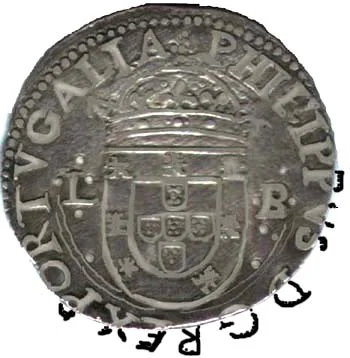
Inscription:
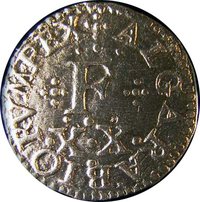
+PHILIPPVS.DG.REX.PORTVGALIA
L B
L B
Script: Latin
Reverse
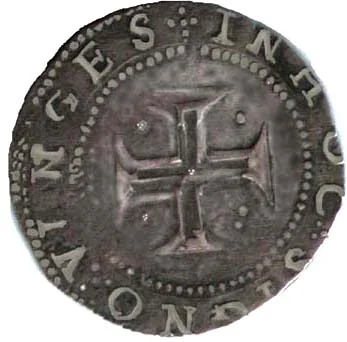
Inscription:
+IN HOC SIGNO VINCES
Script: Latin
Edge
Mints
| Name | Mark |
|---|---|
| Imprensa Nacional - Casa da Moeda | L-B |
Mintings
| Year | Mint Mark | Mintage | Quality | Collection |
|---|---|---|---|---|
| — | L-B | — |
Historical background
In 1598, Portugal's currency situation was deeply intertwined with its political status as part of the Iberian Union under the Spanish Habsburg King Philip III. The Portuguese monetary system was officially separate, with its own unit of account, the real, and its prized gold coin, the cruzado. However, the crown's relentless financial demands to support Spain's costly wars across Europe and the Atlantic, combined with a sprawling colonial administration, led to severe fiscal strain. This pressure resulted in repeated debasements of the copper reis coinage, which fueled inflation and eroded public trust in the currency used in everyday transactions.
The period was marked by a significant "monetary famine"—a severe shortage of sound coinage in circulation. While vast wealth in gold and silver flowed into Seville from the Americas, Portugal saw relatively little of this bullion, as it was often diverted to pay Spain's debts. Consequently, high-value gold and silver coins became scarce within Portugal itself, hindering large-scale commerce. The economy increasingly relied on a chaotic mix of undervalued, worn, and counterfeit copper coins, creating confusion in the markets and discontent among all social classes, from merchants to labourers.
This deteriorating currency environment exacerbated Portugal's broader economic difficulties, including the disruption of its Asian trade by the Dutch and English. The monetary instability undermined Lisbon's commercial vitality and placed a heavy burden on the populace, contributing to a growing sense of grievance against Habsburg rule. These financial woes, symbolic of the costs of the union with Spain, would become one of the factors fuelling the restoration movement that would eventually lead to Portuguese independence in 1640.
The period was marked by a significant "monetary famine"—a severe shortage of sound coinage in circulation. While vast wealth in gold and silver flowed into Seville from the Americas, Portugal saw relatively little of this bullion, as it was often diverted to pay Spain's debts. Consequently, high-value gold and silver coins became scarce within Portugal itself, hindering large-scale commerce. The economy increasingly relied on a chaotic mix of undervalued, worn, and counterfeit copper coins, creating confusion in the markets and discontent among all social classes, from merchants to labourers.
This deteriorating currency environment exacerbated Portugal's broader economic difficulties, including the disruption of its Asian trade by the Dutch and English. The monetary instability undermined Lisbon's commercial vitality and placed a heavy burden on the populace, contributing to a growing sense of grievance against Habsburg rule. These financial woes, symbolic of the costs of the union with Spain, would become one of the factors fuelling the restoration movement that would eventually lead to Portuguese independence in 1640.
✨ Legendary