

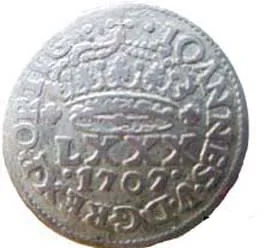

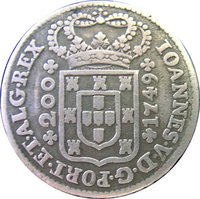
Obverse
Description:
Lxxx above crown. Surrounding text.
Inscription:
LXXX
1707
.IOANNES.V.D.G.REX.PORTVG.
1707
.IOANNES.V.D.G.REX.PORTVG.
Script: Latin
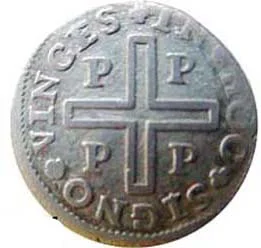
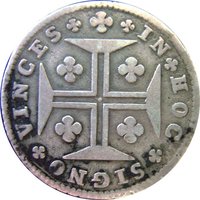
Reverse
Inscription:
IN HOC SIGNO VINCES
PP
PP
PP
PP
Script: Latin
Edge
Rope shaped
Mints
| Name | Mark |
|---|---|
| Porto | PPPP |
Mintings
| Year | Mint Mark | Mintage | Quality | Collection |
|---|---|---|---|---|
| 1707 | PPPP | — |
Historical background
In 1707, Portugal's currency situation was complex and strained, deeply influenced by the ongoing War of the Spanish Succession (1701-1714). As an ally of England and the Grand Alliance against France and Spain, King João V's reign was burdened by immense military expenditures. To finance these costs, the crown repeatedly resorted to debasing the coinage, notably the silver cruzado, by reducing its precious metal content. This practice, while providing short-term revenue, triggered inflation, eroded public trust in the currency, and disrupted both domestic commerce and international trade, upon which the Portuguese economy heavily relied.
The monetary system itself was a patchwork of old and new coins. The standard unit was the real (plural: réis), counted in thousands (milréis). Circulation included a mix of national coins and a flood of foreign currency, particularly gold from Brazil, which was beginning to arrive in significant quantities. However, the sudden influx of Brazilian gold, while a future source of wealth, initially created imbalances. The government struggled to manage and mint this new bullion efficiently, leading to inconsistencies in the value and supply of coins in circulation across the kingdom.
Ultimately, the period was one of transition and fiscal pressure. The wartime debasements undermined the stability of the existing system, while the nascent flow of Brazilian gold promised a profound but not yet fully realized monetary transformation. This set the stage for the major reforms that would follow in the subsequent decades, notably under the Marquis of Pombal, aimed at stabilizing the currency and consolidating the state's control over the burgeoning gold-based economy.
The monetary system itself was a patchwork of old and new coins. The standard unit was the real (plural: réis), counted in thousands (milréis). Circulation included a mix of national coins and a flood of foreign currency, particularly gold from Brazil, which was beginning to arrive in significant quantities. However, the sudden influx of Brazilian gold, while a future source of wealth, initially created imbalances. The government struggled to manage and mint this new bullion efficiently, leading to inconsistencies in the value and supply of coins in circulation across the kingdom.
Ultimately, the period was one of transition and fiscal pressure. The wartime debasements undermined the stability of the existing system, while the nascent flow of Brazilian gold promised a profound but not yet fully realized monetary transformation. This set the stage for the major reforms that would follow in the subsequent decades, notably under the Marquis of Pombal, aimed at stabilizing the currency and consolidating the state's control over the burgeoning gold-based economy.
✨ Legendary