

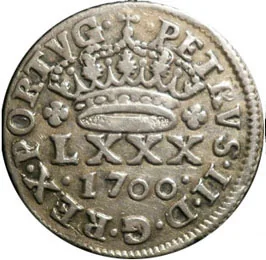

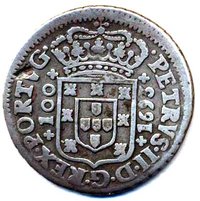
Obverse
Description:
Lxxx above crown. Surrounding text.
Inscription:
LXXX
.1700.
.PETRVS.II.D.G.REX.PORTVG.
.1700.
.PETRVS.II.D.G.REX.PORTVG.
Script: Latin
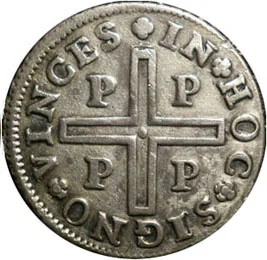
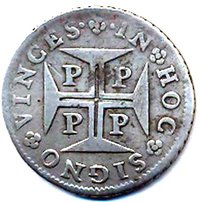
Reverse
Inscription:
IN*HOC*SIGNO*VINCES
PP
PP
PP
PP
Script: Latin
Edge
Rope shaped
Mints
| Name | Mark |
|---|---|
| Porto | PPPP |
Mintings
Historical background
In 1689, Portugal's currency system was in a state of significant strain and transition, a legacy of the preceding decades of conflict and economic policy. The kingdom was still recovering from the Restoration War (1640-1668) against Spain, which had drained the treasury and led to severe debasement of the coinage. To finance the war, the crown had repeatedly reduced the silver content in coins like the cruzado and tostão, leading to inflation, a loss of public confidence in the currency, and complicated exchange rates with stronger foreign currencies, particularly Spanish pieces of eight and Dutch guilders, which circulated widely within Portugal.
The primary monetary concern in 1689 was the chronic shortage of gold and, especially, silver specie in circulation. This was exacerbated by a persistent trade deficit, where imports from England and other nations were paid for with scarce bullion, draining metal from the kingdom. Dom Pedro II, ruling as regent for his incapacitated brother Afonso VI and soon to be king in his own right, faced the urgent need to stabilize the economy. His government had begun to address this through mercantilist policies, promoting Brazilian trade and attempting to curb the export of coin, but the physical scarcity of money hampered domestic commerce and state finances.
Consequently, the monetary landscape was fragmented and unstable. While the official mint issued coins, their value in daily transactions was often negotiated, and a multitude of older, worn, and foreign coins circulated at variable rates. This environment set the stage for the transformative discoveries still to come: the discovery of significant gold deposits in Brazil in the 1690s would soon flood the Portuguese treasury with bullion, enabling a sweeping currency reform under King João V and ultimately shifting Portugal's economic focus and monetary system onto a solid gold standard. Thus, 1689 represents a low point just before a dramatic reversal in Portugal's monetary fortunes.
The primary monetary concern in 1689 was the chronic shortage of gold and, especially, silver specie in circulation. This was exacerbated by a persistent trade deficit, where imports from England and other nations were paid for with scarce bullion, draining metal from the kingdom. Dom Pedro II, ruling as regent for his incapacitated brother Afonso VI and soon to be king in his own right, faced the urgent need to stabilize the economy. His government had begun to address this through mercantilist policies, promoting Brazilian trade and attempting to curb the export of coin, but the physical scarcity of money hampered domestic commerce and state finances.
Consequently, the monetary landscape was fragmented and unstable. While the official mint issued coins, their value in daily transactions was often negotiated, and a multitude of older, worn, and foreign coins circulated at variable rates. This environment set the stage for the transformative discoveries still to come: the discovery of significant gold deposits in Brazil in the 1690s would soon flood the Portuguese treasury with bullion, enabling a sweeping currency reform under King João V and ultimately shifting Portugal's economic focus and monetary system onto a solid gold standard. Thus, 1689 represents a low point just before a dramatic reversal in Portugal's monetary fortunes.
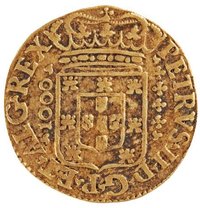
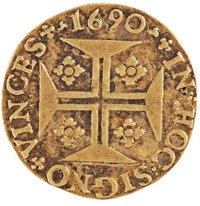
💎 Very Rare