

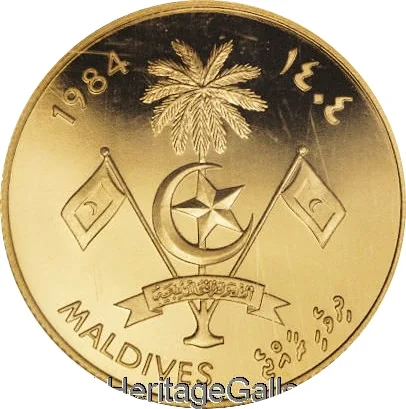

100 Rufiyaa – Maldives
Non-circulating coins
Commemoration: Year of Disabled Persons - Full Participation & Equality
Maldives
Context
Year: 1984
Islamic (Hijri) Year: 1404
Issuer: Maldives 
Period:
(since 1968)
Currency:
(since 1947)
Total mintage: 100
References
KM: #Click to copy to clipboardP3
Numista: #117196
Value
Exchange value: 100 MVR
Obverse
Reverse
Description:
Disabled figures below a halved globe.
Inscription:
FULL PARTICIPATION & EQUALITY
ލާރި
100 RUFIYAA
ލާރި
100 RUFIYAA
Translation:
Full Participation & Equality
Lari
100 Rufiyaa
Lari
100 Rufiyaa
Language: Dhivehi
Edge
Reeded
Mintings
| Year | Mint Mark | Mintage | Quality | Collection |
|---|---|---|---|---|
| 1984 | — | 100 | Proof |
Historical background
In 1984, the currency situation in the Maldives was characterized by a stable but administratively simple system, with the Maldivian Rufiyaa (MVR) pegged to a basket of currencies. The nation's economy was still overwhelmingly dependent on fisheries, which accounted for the vast majority of exports and employment, with tourism only beginning to emerge as a significant sector following the opening of the first resorts in the 1970s. This limited economic diversification meant foreign exchange earnings were relatively modest and concentrated. The Maldives Monetary Authority (MMA), established in 1981, acted as the central bank and was responsible for issuing currency and managing the peg, but the financial system remained underdeveloped with few formal banking services outside the capital, Malé.
The Rufiyaa's peg, which had been historically linked to the British pound and later the IMF's Special Drawing Rights (SDR), provided crucial stability for a small, import-dependent island nation. This fixed exchange rate helped control inflation for essential imported goods and provided predictability for the nascent tourism industry, which required foreign investment. However, the system also reflected a lack of independent monetary policy, with the money supply largely influenced by the balance of payments. Foreign exchange reserves were managed conservatively to defend the peg, and access to foreign currency for citizens and businesses was tightly controlled through the banking system.
Overall, the 1984 currency environment was one of deliberate stability tailored to a small, open economy in the early stages of modernization. The framework successfully avoided the hyperinflation or volatility seen in some developing nations, but it also underscored the Maldives' vulnerability to external shocks, such as fluctuations in fish prices or global economic conditions. This period laid the groundwork for the financial developments that would follow as tourism revenues began to grow, gradually increasing the nation's foreign exchange reserves and economic complexity in the subsequent decades.
The Rufiyaa's peg, which had been historically linked to the British pound and later the IMF's Special Drawing Rights (SDR), provided crucial stability for a small, import-dependent island nation. This fixed exchange rate helped control inflation for essential imported goods and provided predictability for the nascent tourism industry, which required foreign investment. However, the system also reflected a lack of independent monetary policy, with the money supply largely influenced by the balance of payments. Foreign exchange reserves were managed conservatively to defend the peg, and access to foreign currency for citizens and businesses was tightly controlled through the banking system.
Overall, the 1984 currency environment was one of deliberate stability tailored to a small, open economy in the early stages of modernization. The framework successfully avoided the hyperinflation or volatility seen in some developing nations, but it also underscored the Maldives' vulnerability to external shocks, such as fluctuations in fish prices or global economic conditions. This period laid the groundwork for the financial developments that would follow as tourism revenues began to grow, gradually increasing the nation's foreign exchange reserves and economic complexity in the subsequent decades.



✨ Legendary