

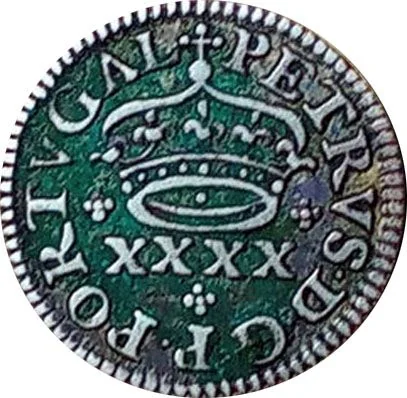
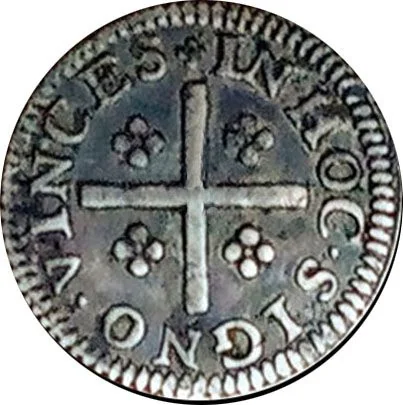
XXXX Réis "2 Vinténs" – Portugal
Portugal

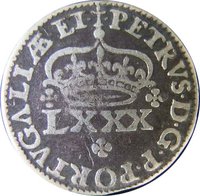
Obverse
Inscription:
PETRVS·D·G.P·PORTVGA
Script: Latin
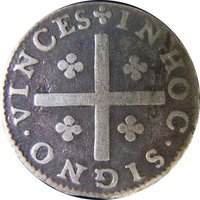
Reverse
Inscription:
IN.HOC.SIGNO.VINCES
Script: Latin
Edge
Mints
| Name | Mark |
|---|---|
| Imprensa Nacional - Casa da Moeda | — |
Mintings
| Year | Mint Mark | Mintage | Quality | Collection |
|---|---|---|---|---|
| — | — | — |
Historical background
In 1676, Portugal's currency system was in a state of profound crisis and transition, a direct consequence of the ambitious but economically draining policies of the preceding decades. The reign of King Afonso VI and the regency of his brother, the future Pedro II, had been marked by the costly effort to secure Portugal's hard-won independence from Spain, finalized in 1668. To finance near-constant warfare and colonial defense, the Crown had resorted to severe currency debasement, particularly of the low-denomination real coins in copper and billon (a base silver alloy). This flooded the economy with intrinsically worthless money, causing rampant inflation, a collapse in public trust, and the effective disappearance of full-weight silver coins like the cruzado from circulation, as they were hoarded or exported.
The situation was further complicated by the influx of gold from Brazil, which was beginning to arrive in significant quantities but was not yet systematically integrated into the domestic coinage system. This Brazilian gold primarily entered as dust or bullion, creating a dual monetary reality: a chaotic and inflated domestic coinage for everyday transactions and a high-value, stable metallic standard for large-scale trade and treasury reserves. The monetary chaos disrupted commerce, made tax collection unpredictable, and undermined both domestic economic activity and Portugal's financial credibility with foreign merchants.
Recognizing the destabilizing effects, the government under the influence of Pedro II (who would become king in 1683) was actively seeking reform. The period around 1676 was one of diagnosis and planning, leading towards the major monetary reform that would be enacted in 1688. This reform would establish a new, stable gold standard based on the moeda, pegged to the Brazilian gold, and systematically recoin the debased currency. Therefore, 1676 represents the turbulent tail end of an era of fiscal desperation, with the foundations for a new, gold-backed currency system being laid as the kingdom shifted from a wartime to a more commercially oriented imperial economy.
The situation was further complicated by the influx of gold from Brazil, which was beginning to arrive in significant quantities but was not yet systematically integrated into the domestic coinage system. This Brazilian gold primarily entered as dust or bullion, creating a dual monetary reality: a chaotic and inflated domestic coinage for everyday transactions and a high-value, stable metallic standard for large-scale trade and treasury reserves. The monetary chaos disrupted commerce, made tax collection unpredictable, and undermined both domestic economic activity and Portugal's financial credibility with foreign merchants.
Recognizing the destabilizing effects, the government under the influence of Pedro II (who would become king in 1683) was actively seeking reform. The period around 1676 was one of diagnosis and planning, leading towards the major monetary reform that would be enacted in 1688. This reform would establish a new, stable gold standard based on the moeda, pegged to the Brazilian gold, and systematically recoin the debased currency. Therefore, 1676 represents the turbulent tail end of an era of fiscal desperation, with the foundations for a new, gold-backed currency system being laid as the kingdom shifted from a wartime to a more commercially oriented imperial economy.
💎 Extremely Rare