

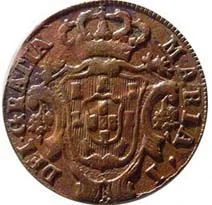
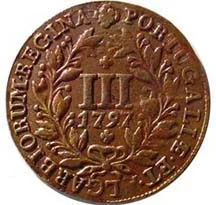
3 Réis – Portugal
Portugal

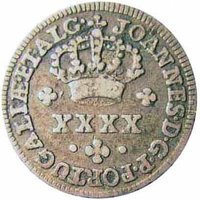
Obverse
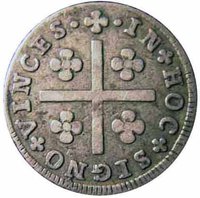
Reverse
Description:
Legend and wreath framing value and date.
Inscription:
PORTVGALIE . ET . ALGARBIOTUM . REGINA
*III*
1797
*III*
1797
Script: Latin
Edge
Plain
Mints
| Name | Mark |
|---|---|
| Imprensa Nacional - Casa da Moeda | — |
Mintings
| Year | Mint Mark | Mintage | Quality | Collection |
|---|---|---|---|---|
| 1797 | — | 9,320 |
Historical background
In 1797, Portugal faced a severe monetary crisis rooted in the pressures of the French Revolutionary Wars and its deep alliance with Great Britain. The Portuguese economy, heavily dependent on Brazilian gold remittances and trade, was strangled by a British naval blockade and the threat of invasion from Spain, which was allied with revolutionary France. This disrupted the vital influx of Brazilian gold, the traditional bedrock of the Portuguese currency, while wartime expenditures soared. The state treasury, already weakened by the 1755 Lisbon earthquake's costs and lavish court spending, was pushed to the brink of insolvency.
The immediate consequence was a dramatic shortage of specie (gold and silver coin) in circulation. To meet its obligations, the government of Prince Regent João (future King João VI) resorted to issuing vast quantities of paper money—the first official paper currency in Portugal's history. These notes, known as "papel-moeda," were initially intended as temporary and were backed by the promise of future payment in metal. However, public confidence in this novel and unbacked paper was extremely low, as Portugal lacked both the financial institutions and the fiscal discipline to support it.
Thus, by the close of 1797, Portugal was experiencing the early stages of currency instability that would worsen in the coming decades. The forced circulation of paper money, combined with a collapsing metallic standard, led to rapid depreciation, inflation, and a loss of trust in the monetary system. This crisis set the stage for further economic turmoil, including the transfer of the Portuguese court to Brazil in 1807, and marked the beginning of a long period of financial difficulty for the Portuguese monarchy.
The immediate consequence was a dramatic shortage of specie (gold and silver coin) in circulation. To meet its obligations, the government of Prince Regent João (future King João VI) resorted to issuing vast quantities of paper money—the first official paper currency in Portugal's history. These notes, known as "papel-moeda," were initially intended as temporary and were backed by the promise of future payment in metal. However, public confidence in this novel and unbacked paper was extremely low, as Portugal lacked both the financial institutions and the fiscal discipline to support it.
Thus, by the close of 1797, Portugal was experiencing the early stages of currency instability that would worsen in the coming decades. The forced circulation of paper money, combined with a collapsing metallic standard, led to rapid depreciation, inflation, and a loss of trust in the monetary system. This crisis set the stage for further economic turmoil, including the transfer of the Portuguese court to Brazil in 1807, and marked the beginning of a long period of financial difficulty for the Portuguese monarchy.
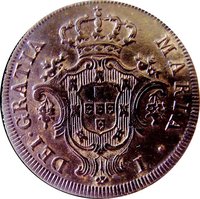
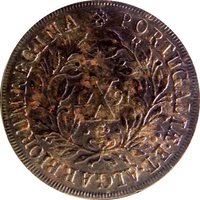
💎 Extremely Rare