

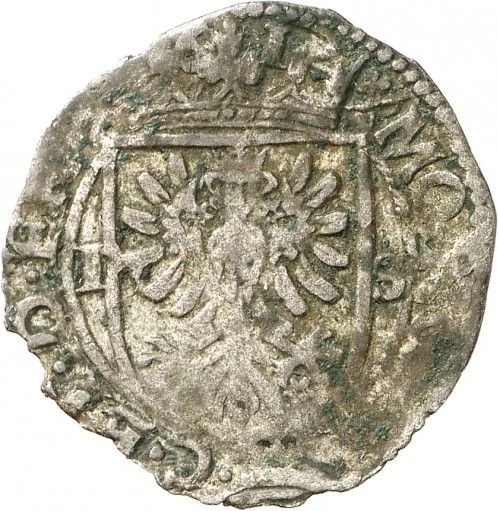
Obverse
Description:
Crowned arms divide I-S, date above.
Script: Latin
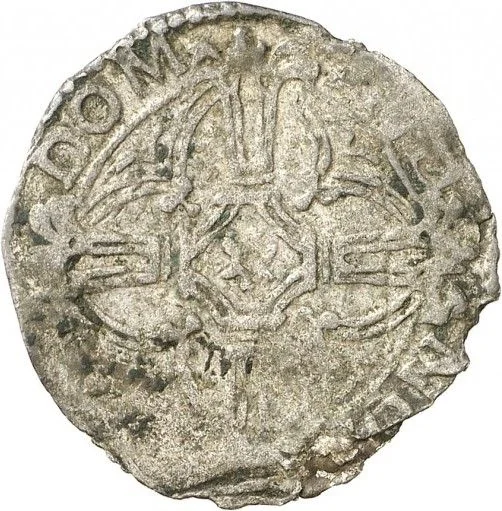
Reverse
Description:
Ornate quatrefoil cross.
Script: Latin
Edge
Mints
| Name | Mark |
|---|---|
| Emden | — |
Mintings
| Year | Mint Mark | Mintage | Quality | Collection |
|---|---|---|---|---|
| 1612 | — | 122,769 |
Historical background
In 1612, the County of East Frisia was entangled in a complex and fragmented monetary landscape, typical of the Holy Roman Empire. The region lacked a unified, sovereign currency, leading to a circulation of numerous foreign and domestic coins. The most important local issue was the East Frisian Rixdollar (Reichstaler), minted under the authority of Count Enno III. However, these competed directly with the Dutch Rijksdaalder and Spanish 8-Reales pieces flowing in from extensive North Sea trade, as well as various German thalers and smaller denominations from neighboring states. This proliferation created constant challenges for commerce and public administration.
The core problem was one of valuation and trust. Different coins, even those with similar face values, contained varying amounts of precious metal. Debasement—reducing the silver content in coins—was a frequent temptation for rulers needing revenue, and foreign coins' true worth was often suspect. Consequently, money changers and merchants had to constantly assess and haggle over the actual intrinsic value of each coin, leading to transactional friction. Official exchange rates, published in periodic "currency ordinances," struggled to keep pace with market realities, creating opportunities for arbitrage and loss.
Count Enno III's attempts to assert monetary control were limited by East Frisia's political constitution. The powerful Estates (representing the towns and nobility) held significant fiscal authority and resisted centralizing measures that might impose costs on them. Therefore, while the Aurich mint produced coins, it could not stem the tide of foreign currency. The situation in 1612 was one of unstable equilibrium, a daily inconvenience for the populace and a persistent headache for the count, reflecting the broader struggle between territorial sovereignty and the decentralized, interconnected economy of early modern Europe.
The core problem was one of valuation and trust. Different coins, even those with similar face values, contained varying amounts of precious metal. Debasement—reducing the silver content in coins—was a frequent temptation for rulers needing revenue, and foreign coins' true worth was often suspect. Consequently, money changers and merchants had to constantly assess and haggle over the actual intrinsic value of each coin, leading to transactional friction. Official exchange rates, published in periodic "currency ordinances," struggled to keep pace with market realities, creating opportunities for arbitrage and loss.
Count Enno III's attempts to assert monetary control were limited by East Frisia's political constitution. The powerful Estates (representing the towns and nobility) held significant fiscal authority and resisted centralizing measures that might impose costs on them. Therefore, while the Aurich mint produced coins, it could not stem the tide of foreign currency. The situation in 1612 was one of unstable equilibrium, a daily inconvenience for the populace and a persistent headache for the count, reflecting the broader struggle between territorial sovereignty and the decentralized, interconnected economy of early modern Europe.
✨ Legendary