

8 Escudos – Chile
Chile
Context
Years: 1772–1789
Issuer: Chile 
Ruler: Charles III
Currency:
(1541—1852)
Demonetized: Yes
Total mintage: 663,000
Material
References
KM: #Click to copy to clipboard27
Numista: #35196
Value
Bullion value: $4067.59
Obverse
Description:
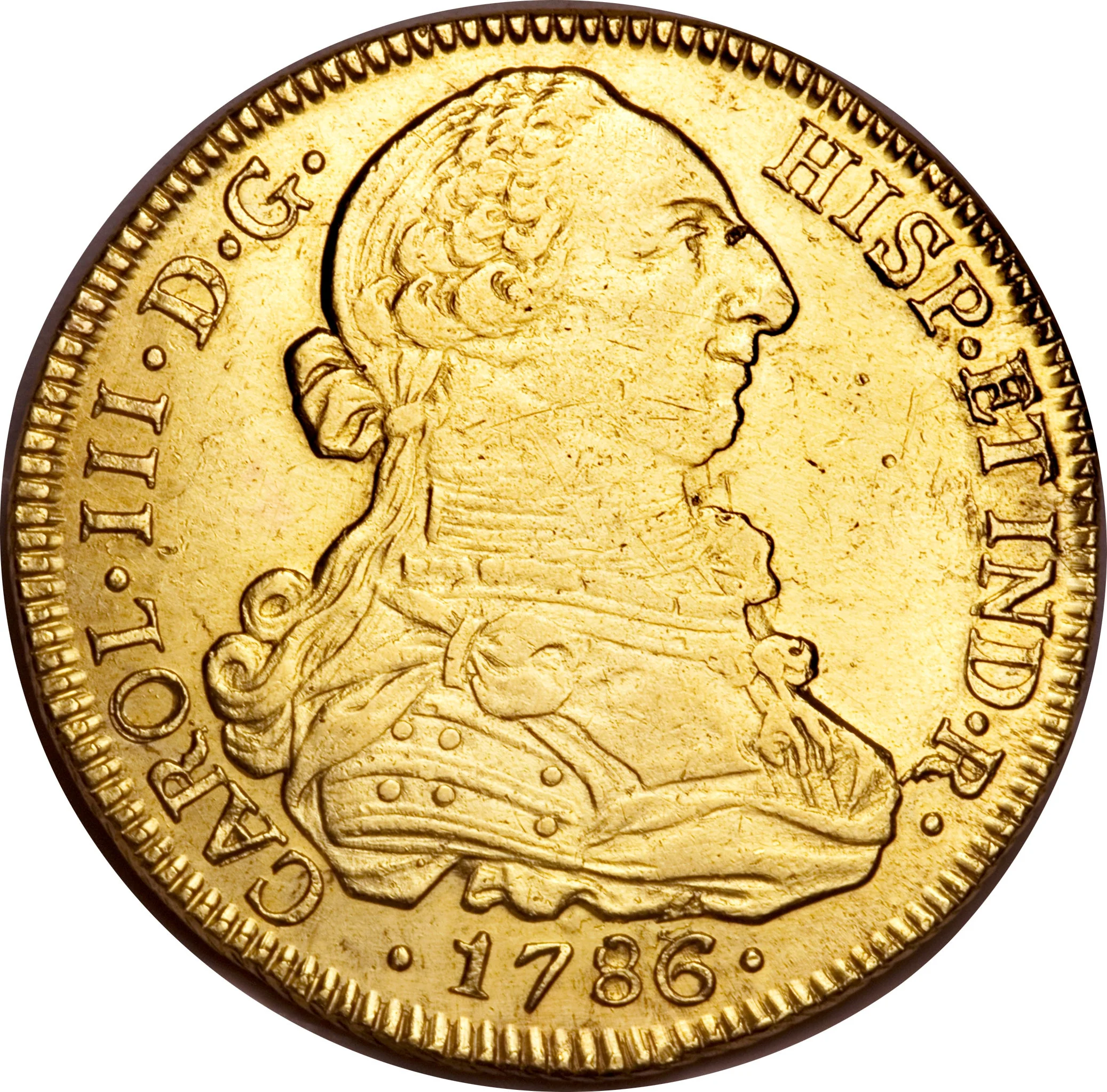
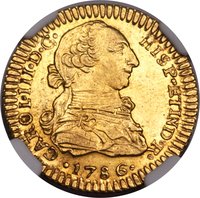
Bust of Charles III with date.
Inscription:
CAROL·III·D·G· HISP·ET IND·R·
·1786·
·1786·
Script: Latin
Reverse
Edge
Mints
| Name | Mark |
|---|---|
| Casa de Moneda de Chile | (So) |
Mintings
| Year | Mint Mark | Mintage | Quality | Collection |
|---|---|---|---|---|
| 1772 | So | — | ||
| 1773 | So | 33,000 | ||
| 1774 | So | 42,000 | ||
| 1775 | So | 36,000 | ||
| 1776 | So | 41,000 | ||
| 1777 | So | 41,000 | ||
| 1778 | So | 42,000 | ||
| 1779 | So | 44,000 | ||
| 1780 | So | 42,000 | ||
| 1781 | So | 43,000 | ||
| 1782 | So | 40,000 | ||
| 1783 | So | 34,000 | ||
| 1784 | So | 37,000 | ||
| 1785 | So | 34,000 | ||
| 1786 | So | 34,000 | ||
| 1787 | So | 37,000 | ||
| 1788 | So | 42,000 | ||
| 1789 | So | 41,000 |
Historical background
In 1772, the currency situation in the Kingdom of Chile, a captaincy general of the Spanish Empire, was characterized by severe scarcity and administrative confusion. The local economy operated primarily on a system of moneda corriente (current money), which was an abstract accounting unit based on the old Spanish real, but physical specie was exceedingly rare. Most transactions, especially large ones like land purchases or tax payments, were conducted through complex credit instruments, barter, or the use of commodity money such as gold dust, silver bars, and even pesos de la tierra (land pesos) tied to agricultural produce. This scarcity stemmed from Chile's remote position within the empire, the limited output of local mints, and the constant drain of silver to Peru for official remittances and trade.
The Spanish crown's monetary policy further complicated the situation. Official coinage from the Potosí mint in Alto Peru (modern Bolivia) circulated, but its value was unstable due to frequent royal decrees altering the fineness and weight of silver coins. Furthermore, a bewildering variety of foreign coins—primarily Peruvian pesos, but also Spanish reales and even contraband French, English, and Portuguese coins from illicit trade—circulated at fluctuating exchange rates. The colonial government in Santiago struggled to enforce royal monetary decrees, leading to a disconnect between the official moneda de plata (silver money) and the moneda de cuenta (money of account) used in daily bookkeeping, which caused widespread commercial disputes and hindered economic growth.
This chaotic environment placed a significant burden on trade and governance. Merchants and hacienda owners maintained elaborate ledgers to track debts and conversions between different monetary units. The colonial treasury faced difficulties in collecting taxes and paying soldiers and officials, often resorting to payment in kind. The year 1772 fell within a period of attempted Bourbon Reforms, but substantive monetary reform for Chile was still decades away; the first permanent mint in Santiago would not be established until 1749, and true standardization of currency would only begin after independence. Thus, the currency situation of 1772 was one of persistent fragmentation, reflecting both the constraints of a colonial extractive economy and the ingenuity of a local society adapting to a chronic shortage of official circulating medium.
The Spanish crown's monetary policy further complicated the situation. Official coinage from the Potosí mint in Alto Peru (modern Bolivia) circulated, but its value was unstable due to frequent royal decrees altering the fineness and weight of silver coins. Furthermore, a bewildering variety of foreign coins—primarily Peruvian pesos, but also Spanish reales and even contraband French, English, and Portuguese coins from illicit trade—circulated at fluctuating exchange rates. The colonial government in Santiago struggled to enforce royal monetary decrees, leading to a disconnect between the official moneda de plata (silver money) and the moneda de cuenta (money of account) used in daily bookkeeping, which caused widespread commercial disputes and hindered economic growth.
This chaotic environment placed a significant burden on trade and governance. Merchants and hacienda owners maintained elaborate ledgers to track debts and conversions between different monetary units. The colonial treasury faced difficulties in collecting taxes and paying soldiers and officials, often resorting to payment in kind. The year 1772 fell within a period of attempted Bourbon Reforms, but substantive monetary reform for Chile was still decades away; the first permanent mint in Santiago would not be established until 1749, and true standardization of currency would only begin after independence. Thus, the currency situation of 1772 was one of persistent fragmentation, reflecting both the constraints of a colonial extractive economy and the ingenuity of a local society adapting to a chronic shortage of official circulating medium.
💎 Extremely Rare