

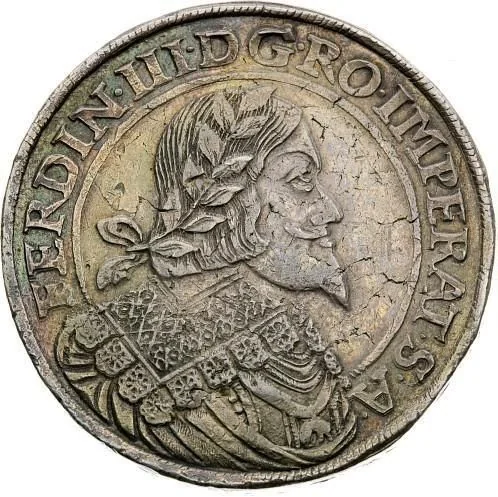
3 Thalers – Kingdom of Bohemia
Context
Year: 1644
Country: Bohemia
Issuer: Kingdom of Bohemia
Ruler: Ferdinand III
Currency:
(1520—1754)
Demonetized: Yes
Material
References
KM: #Click to copy to clipboard472
Numista: #338416
Value
Bullion value: $247.86
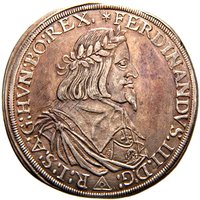
Obverse
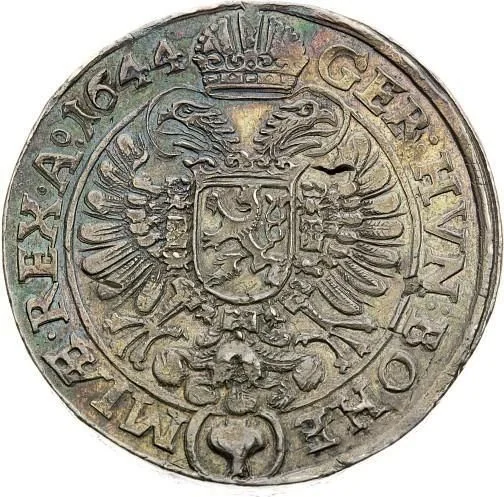
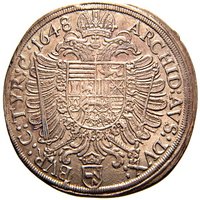
Reverse
Description:
Imperial eagle with crown, date around.
Inscription:
GER: HVN: BOHE MIÆ. REX. Ao. 1644
Script: Latin
Edge
Mints
| Name | Mark |
|---|---|
| Joachimsthal | — |
Mintings
| Year | Mint Mark | Mintage | Quality | Collection |
|---|---|---|---|---|
| 1644 | — | — |
Historical background
In 1644, the Kingdom of Bohemia found itself in a state of severe monetary instability, a direct consequence of both the ongoing Thirty Years' War and long-term Habsburg fiscal policy. The primary currency in circulation was the debased groschen (krejcar), which had been systematically reduced in silver content for decades to finance imperial military campaigns. This practice, accelerated under Emperor Ferdinand II and continued by Ferdinand III, led to a flood of lightweight coins, causing rampant inflation and a loss of public trust in the currency. The situation was exacerbated by the circulation of counterfeit coins and various emergency issues from occupied territories, creating a chaotic and unreliable monetary environment for daily transactions.
The economic foundation of the kingdom, already shattered by the Battle of White Mountain (1620) and the subsequent confiscations and forced re-Catholicization, could not support this financial strain. Agricultural and craft production had declined sharply due to warfare, population loss, and the emigration of Protestant elites, reducing the real wealth backing the currency. While large-scale commerce and state finances attempted to function using heavier silver talers (such as the Reichsthaler), these were scarce for common use. The result was a stark dichotomy: a "small coin" economy of eroded krejcar for the populace suffering from soaring prices, and a "large coin" economy of limited, stable silver for authorities and long-distance trade.
Ultimately, the currency crisis of 1644 was a symptom of deeper turmoil. Bohemia, though nominally a kingdom, had lost much of its political autonomy and economic vitality to the centralized war machine of the Habsburg Monarchy. The deliberate currency debasement was a form of wartime taxation, extracting resources from a ravaged land. Without peace, there could be no meaningful monetary reform, leaving the population to endure the daily hardship of coins whose metallic value was a fraction of their nominal worth, further impoverishing a society struggling to survive the final, devastating years of the conflict.
The economic foundation of the kingdom, already shattered by the Battle of White Mountain (1620) and the subsequent confiscations and forced re-Catholicization, could not support this financial strain. Agricultural and craft production had declined sharply due to warfare, population loss, and the emigration of Protestant elites, reducing the real wealth backing the currency. While large-scale commerce and state finances attempted to function using heavier silver talers (such as the Reichsthaler), these were scarce for common use. The result was a stark dichotomy: a "small coin" economy of eroded krejcar for the populace suffering from soaring prices, and a "large coin" economy of limited, stable silver for authorities and long-distance trade.
Ultimately, the currency crisis of 1644 was a symptom of deeper turmoil. Bohemia, though nominally a kingdom, had lost much of its political autonomy and economic vitality to the centralized war machine of the Habsburg Monarchy. The deliberate currency debasement was a form of wartime taxation, extracting resources from a ravaged land. Without peace, there could be no meaningful monetary reform, leaving the population to endure the daily hardship of coins whose metallic value was a fraction of their nominal worth, further impoverishing a society struggling to survive the final, devastating years of the conflict.
✨ Legendary