

1 Farthing – Ireland
Ireland
Obverse
Description:
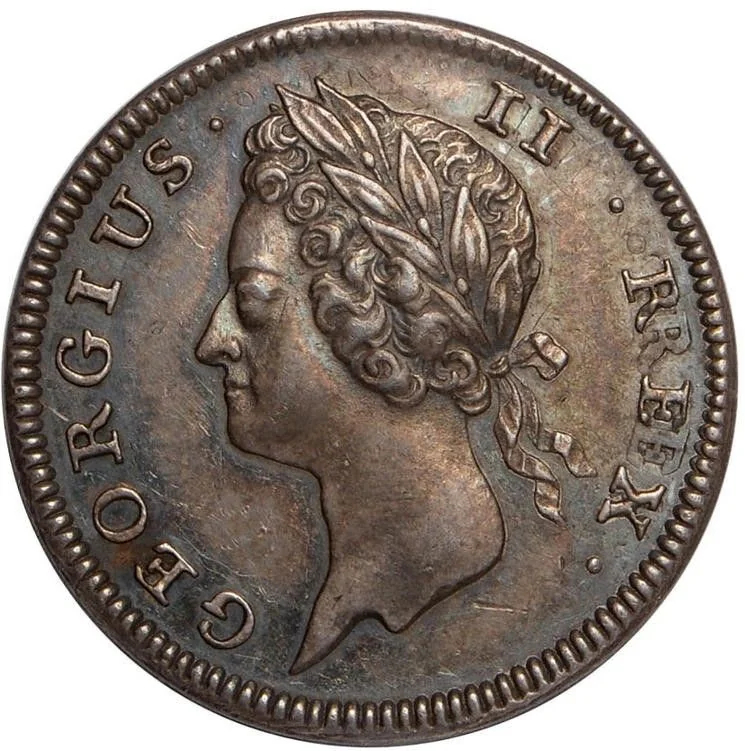
Young laureate bust left, dividing legend.
Inscription:
GEORGIUS · II · REX ·
Script: Latin
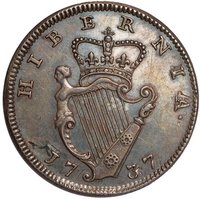
Reverse
Edge
Mintings
| Year | Mint Mark | Mintage | Quality | Collection |
|---|---|---|---|---|
| 1737 | — | — |
Historical background
In 1737, Ireland operated under a complex and strained monetary system, largely dictated by its political and economic subordination to Britain. The official currency was nominally tied to sterling, with Irish pounds, shillings, and pence minted to a lower silver standard than their English counterparts. This created a fixed exchange rate where an Irish pound was valued at approximately 13 Irish shillings to 12 British shillings. However, the chronic shortage of official coinage was the era's defining problem, as Britain prohibited Ireland from minting its own gold or full-weight silver coins, severely restricting the medium for everyday trade and larger commerce.
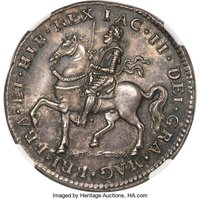
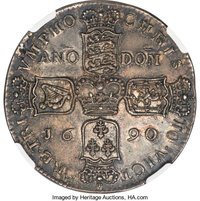
This scarcity led to a reliance on a confusing patchwork of substitute currencies. Foreign coins, particularly Spanish dollars (pieces of eight) and Portuguese moidores, circulated widely but at fluctuating values. To facilitate smaller transactions, a significant portion of the economy depended on primitive credit and "token" money, such as promissory notes from city corporations and private bankers, as well as physically mutilated coinage. The most infamous solution was the widespread use of "gunmoney" – emergency coins minted from melted-down metal, including old cannon, during the war of 1689-91 – which remained in circulation decades later, further eroding trust in the monetary base.
Consequently, the Irish economy in the 1730s suffered from monetary instability, uncertainty in valuation, and a lack of confidence that hindered both internal trade and external investment. This precarious situation was a direct result of mercantilist British policy, which sought to keep Ireland economically dependent. The currency woes of this period, part of a broader "Irish grievance," fueled growing resentment among the Protestant Ascendancy and merchant classes, contributing to the economic arguments that would later fuel movements for legislative independence in the latter half of the 18th century.
This scarcity led to a reliance on a confusing patchwork of substitute currencies. Foreign coins, particularly Spanish dollars (pieces of eight) and Portuguese moidores, circulated widely but at fluctuating values. To facilitate smaller transactions, a significant portion of the economy depended on primitive credit and "token" money, such as promissory notes from city corporations and private bankers, as well as physically mutilated coinage. The most infamous solution was the widespread use of "gunmoney" – emergency coins minted from melted-down metal, including old cannon, during the war of 1689-91 – which remained in circulation decades later, further eroding trust in the monetary base.
Consequently, the Irish economy in the 1730s suffered from monetary instability, uncertainty in valuation, and a lack of confidence that hindered both internal trade and external investment. This precarious situation was a direct result of mercantilist British policy, which sought to keep Ireland economically dependent. The currency woes of this period, part of a broader "Irish grievance," fueled growing resentment among the Protestant Ascendancy and merchant classes, contributing to the economic arguments that would later fuel movements for legislative independence in the latter half of the 18th century.
✨ Legendary