

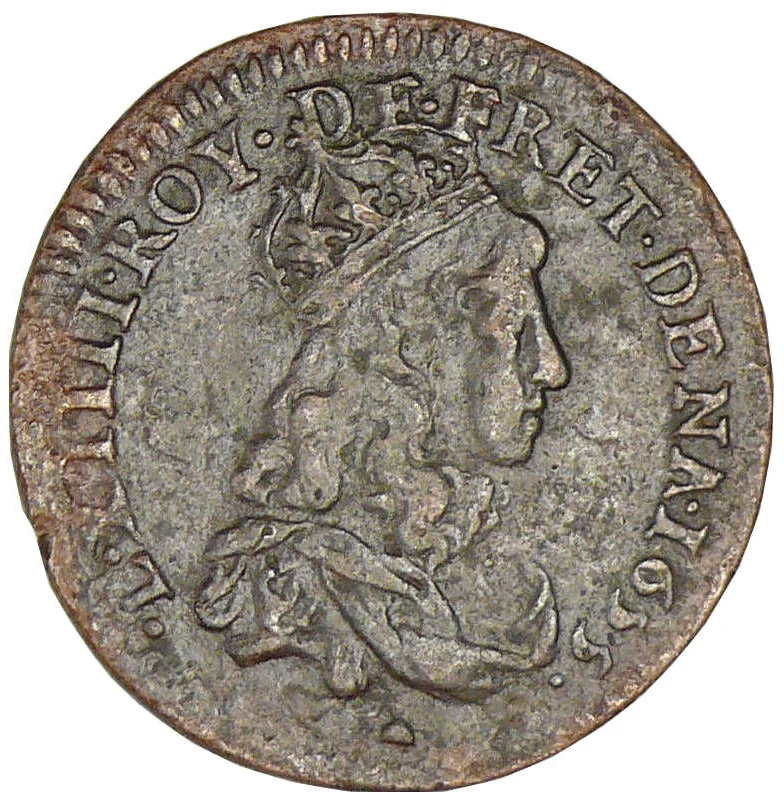
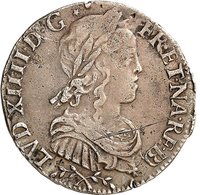
Obverse
Description:
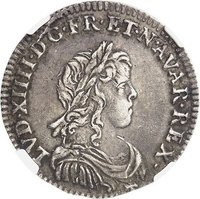
Bust of Louis XIV, crowned and armored, facing right.
Inscription:
•L• XIIII• ROY• DE• FR• ET• DE• NA• 1655•
Script: Latin
Engraver: Jean Warin
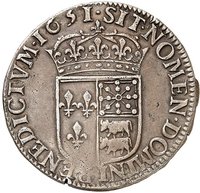
Reverse
Description:
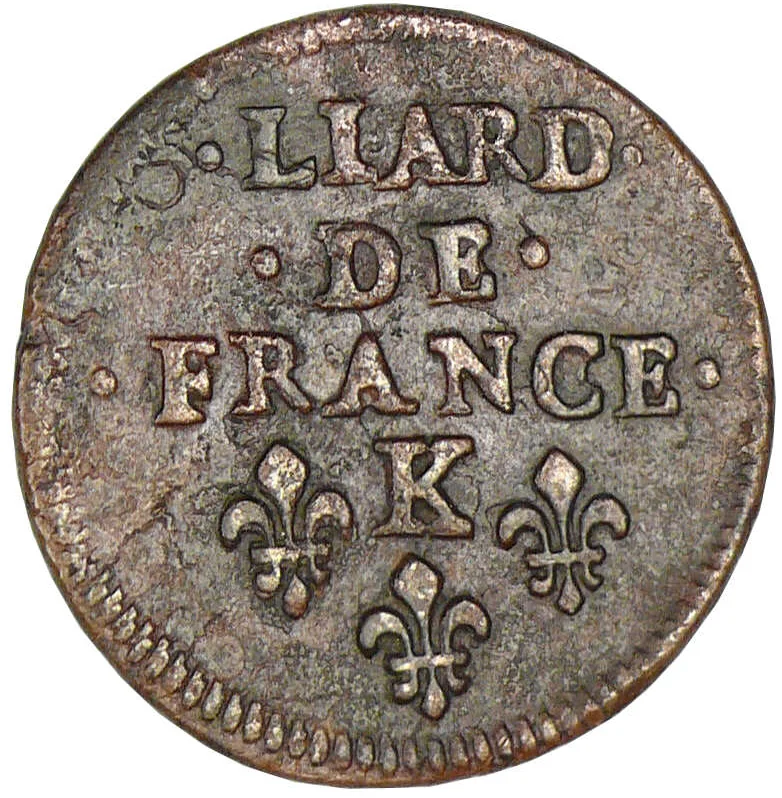
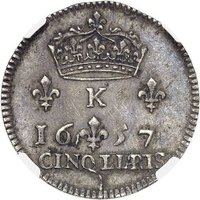
Script: three lines, three lilies (2+1), workshop letter.
Inscription:
•LIARD•
•DE•
•FRANCE•
•DE•
•FRANCE•
Script: Latin
Engraver: Jean Warin
Edge
Plain
Mints
| Name | Mark |
|---|---|
| Corbeil | A |
| Acquigny | B |
| Pont de l'Arche | B★ |
| Caen | C |
| Vimy | D |
| Meung-sur-Loire | E |
| Angers | F |
| Lusignan | G |
| Montreuil-Bonnin | G |
| Châtellerault | G: |
| Limoges | I |
| Bordeaux | K |
| Nîmes | R |
Mintings
| Year | Mint Mark | Mintage | Quality | Collection |
|---|---|---|---|---|
| — | — | — | ||
| 1655 | A | 33,118,425 | ||
| 1655 | — | — | BU | |
| 1655 | B | 10,483,000 | ||
| 1655 | B★ | 13,880,000 | ||
| 1655 | C | 3,486,960 | ||
| 1655 | D | 19,458,142 | ||
| 1655 | E | 34,625,498 | ||
| 1655 | G | — | ||
| 1655 | I | — | ||
| 1655 | K | 3,117,600 | ||
| 1655 | R | — | ||
| 1656 | F | — | ||
| 1656 | G | 118,300 | ||
| 1656 | I | 3,170,160 | ||
| 1656 | K | 25,981,568 | ||
| 1656 | R | 10,983,000 | ||
| 1656 | — | — | ||
| 1656 | — | — | BU | |
| 1656 | A | 66,177,065 | ||
| 1656 | B | 39,650,000 | ||
| 1656 | B★ | 13,880,000 | ||
| 1656 | C | 1,871,995 | ||
| 1656 | D | 11,675,256 | ||
| 1656 | E | 47,287,186 | ||
| 1657 | B★ | — | ||
| 1657 | — | — | BU | |
| 1657 | A | 86,453,500 | ||
| 1657 | B | 1,550,160 | ||
| 1657 | C | 31,322,145 | ||
| 1657 | D | 11,869,050 | ||
| 1657 | E | 32,734,577 | ||
| 1657 | G | — | ||
| 1657 | G: | — | ||
| 1657 | I | — | ||
| 1657 | K | 1,618,352 | ||
| 1657 | R | 12,436,000 | ||
| 1658 | G: | — | ||
| 1658 | I | 973,440 | ||
| 1658 | B★ | — | ||
| 1658 | E | — | ||
| 1658 | — | — | BU |
Historical background
In 1655, France was in the midst of a profound monetary crisis, a direct consequence of the immense financial strain of the ongoing Franco-Spanish War (1635-1659). The conflict, part of the larger Thirty Years' War, had drained the royal treasury, forcing the Crown under the young Louis XIV and his First Minister, Cardinal Mazarin, to resort to desperate fiscal measures. The primary tool was the repeated manipulation of the coinage, a practice known as augmentation and diminution, whereby the government would officially alter the face value of existing coins or reduce their precious metal content while demanding taxes be paid at the old, higher rates.
This period saw a chaotic circulation of both domestic and foreign coins, including Spanish reales and various Italian and German currencies, each with fluctuating values. The royal edicts devaluing the livre tournois (the accounting unit) and the actual silver écu caused widespread confusion, crippled trade, and eroded public trust. Merchants hoarded good, full-weight coins, while only debased currency remained in active circulation, following Gresham's Law that "bad money drives out good." The situation was exacerbated by tax farmers and financiers who profited from the instability, deepening public resentment.
The monetary turmoil of 1655 was therefore not merely a technical financial issue but a symptom of a deeper crisis of state authority and credit. It contributed to the period of civil unrest known as the Fronde (which had largely, but not entirely, subsided by 1655), as the nobility and commoners alike rebelled against the Crown's financial exactions. The instability would ultimately underscore the need for the radical fiscal and monetary reforms later implemented by Louis XIV's finance minister, Jean-Baptiste Colbert, who sought to standardize and stabilize the French currency as a cornerstone of absolutist power.
This period saw a chaotic circulation of both domestic and foreign coins, including Spanish reales and various Italian and German currencies, each with fluctuating values. The royal edicts devaluing the livre tournois (the accounting unit) and the actual silver écu caused widespread confusion, crippled trade, and eroded public trust. Merchants hoarded good, full-weight coins, while only debased currency remained in active circulation, following Gresham's Law that "bad money drives out good." The situation was exacerbated by tax farmers and financiers who profited from the instability, deepening public resentment.
The monetary turmoil of 1655 was therefore not merely a technical financial issue but a symptom of a deeper crisis of state authority and credit. It contributed to the period of civil unrest known as the Fronde (which had largely, but not entirely, subsided by 1655), as the nobility and commoners alike rebelled against the Crown's financial exactions. The instability would ultimately underscore the need for the radical fiscal and monetary reforms later implemented by Louis XIV's finance minister, Jean-Baptiste Colbert, who sought to standardize and stabilize the French currency as a cornerstone of absolutist power.
🌱 Very Common