

5 Ducats – Royal Mint of Silesia
Context
Years: 1721–1722
Country: Bohemia
Issuer: Royal Mint of Silesia
Ruler: Charles VI
Currency:
Demonetized: Yes
References
KM: #Click to copy to clipboard831
Numista: #325982
Value
Bullion value: $2884.09
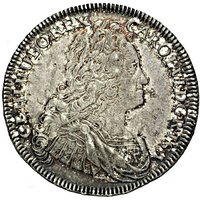
Obverse
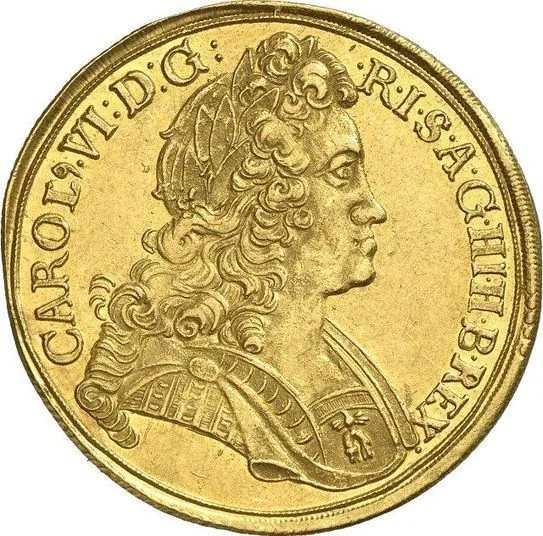
Description:
Laureate head right
Inscription:
CAROL: VI: D: G •• R • I • S • A • G • HI • H • B • REX •
Script: Latin
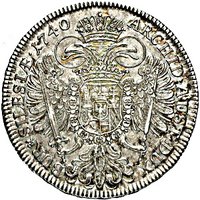
Reverse
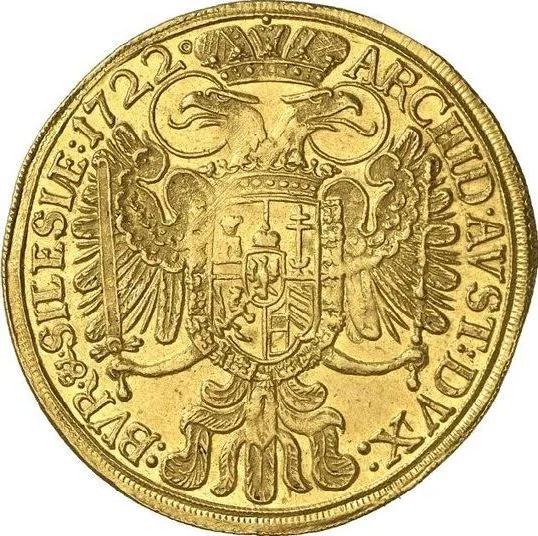
Description:
Imperial eagle crowned within circle.
Inscription:
ARCHID • AVST • DVX: :BVR •&• SILESIÆ: 1722
Script: Latin
Edge
Mints
| Name | Mark |
|---|---|
| Wrocław | — |
Mintings
| Year | Mint Mark | Mintage | Quality | Collection |
|---|---|---|---|---|
| 1721 | — | — | ||
| 1722 | — | — |
Historical background
The Royal Mint of Silesia, established in 1702 in Wrocław (Breslau), operated in a period of immense monetary complexity. By 1721, Silesia was a province of the Habsburg monarchy, but its economy was deeply intertwined with neighboring Poland and the German states, leading to a circulation of diverse and often debased coins. The primary challenge was the proliferation of low-quality Polish and Saxon coins, which drove better Austrian currency out of circulation (Gresham's Law), disrupting local trade and state revenue. The mint's role was therefore not just to produce coinage but to actively stabilize the regional monetary system in the Habsburg interest.
In 1721, the mint was likely engaged in producing silver convention coins, adhering to the 1690 Leipzig monetary standard which set a unified fineness for the Reichsthaler across several German regions. This was part of a broader Habsburg effort to impose order and assert economic control. The mint's output served to pay troops, facilitate crown transactions, and provide a reliable currency to compete with the flood of inferior money. Its operations were a tool of state policy, aiming to anchor Silesia's economy to Vienna and away from the monetary influence of the Polish-Lithuanian Commonwealth.
The situation remained precarious, however. Despite the mint's efforts, controlling the currency in a commercially vibrant borderland proved extremely difficult. The underlying economic pressures and the constant inflow of neighboring coinage meant that stability was temporary. The work of the Royal Mint in 1721 thus represents a specific point in the ongoing struggle between state-mandated monetary order and the chaotic reality of early modern European currency circulation, a struggle that would continue until the more comprehensive reforms of Empress Maria Theresa decades later.
In 1721, the mint was likely engaged in producing silver convention coins, adhering to the 1690 Leipzig monetary standard which set a unified fineness for the Reichsthaler across several German regions. This was part of a broader Habsburg effort to impose order and assert economic control. The mint's output served to pay troops, facilitate crown transactions, and provide a reliable currency to compete with the flood of inferior money. Its operations were a tool of state policy, aiming to anchor Silesia's economy to Vienna and away from the monetary influence of the Polish-Lithuanian Commonwealth.
The situation remained precarious, however. Despite the mint's efforts, controlling the currency in a commercially vibrant borderland proved extremely difficult. The underlying economic pressures and the constant inflow of neighboring coinage meant that stability was temporary. The work of the Royal Mint in 1721 thus represents a specific point in the ongoing struggle between state-mandated monetary order and the chaotic reality of early modern European currency circulation, a struggle that would continue until the more comprehensive reforms of Empress Maria Theresa decades later.
✨ Legendary