

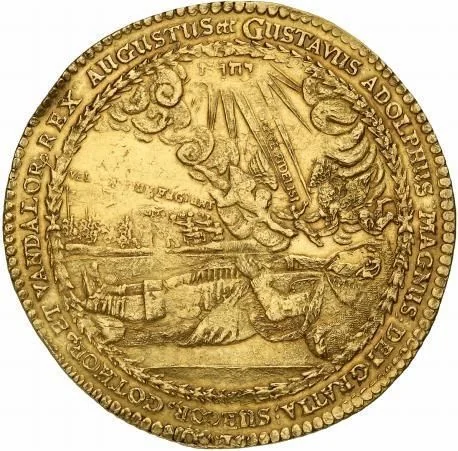
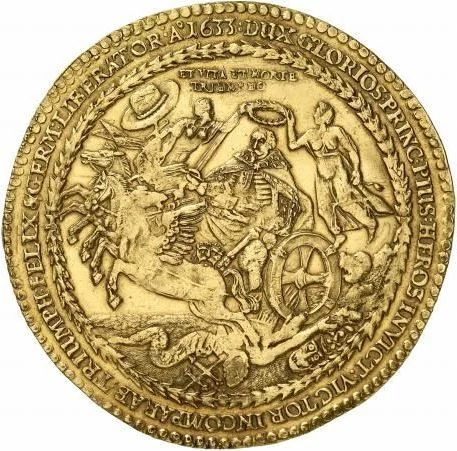
20 ducats – Swedish dominion of Pomerania
Add to wishlist
Circulating commemorative coins
Commemoration: Minted by order of the Swedish government to commemorate the return of the King’s body to Stockholm
Sweden
Context
Year: 1633
Country: Sweden
Issuer: Swedish dominion of Pomerania
Ruler: Gustavus II Adolphus
Currency:
(1630—1815)
Demonetized: Yes
References
KM: #
Numista: #325545
Value
Bullion value: $10680.25
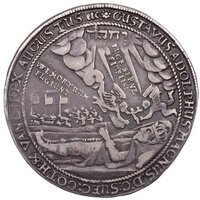
Obverse
Description:
King Gustav II Adolf's soul is borne to heaven by angels.
Inscription:
GUSTAVUS ADOLPHUS MAGNUS D:G:SUEC:GOTH:&VAND:REX AUGUSTUS
VEL MORTUUM FUGIUNT
EUGE SERVE FIDELIS
VEL MORTUUM FUGIUNT
EUGE SERVE FIDELIS
Script: Latin
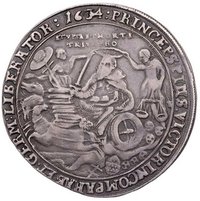
Reverse
Description:
Gustavus, armored and holding a Bible and sword, rides a chariot drawn by three winged horses over the Hydra of Discord. Faith (with a Bible and flaming heart) and Courage (with a column) crown him with laurel; the scene is on a chariot wheel.
Inscription:
DUX GLORIOS : PRINC : PIUS : HEROS INVICT : VICTOR INCOMPARAB : TRIUMPH : FELIX & GERM : LIBERATOR : Ao 1633 :
ET VITA ET MORTE
TRIUMPHO
ET VITA ET MORTE
TRIUMPHO
Script: Latin
Edge
Mintings
| Year | Mint Mark | Mintage | Quality | Collection |
|---|---|---|---|---|
| 1633 | — | — |
Historical background
In 1633, the currency situation in Swedish-occupied Pomerania was one of severe crisis and complexity, deeply entangled in the broader devastation of the Thirty Years' War. The region’s monetary system had been shattered by decades of conflict, with competing currencies circulating from various German states, the Holy Roman Empire, and the Swedish war effort itself. The primary means of exchange for everyday transactions were often debased Kipper und Wipper coins from the 1620s, which had been intentionally minted with lower precious metal content to fund the war, leading to rampant inflation and a profound loss of public trust in coinage.
Sweden’s administration, primarily focused on extracting resources to sustain its military campaigns, exacerbated the problem. While collecting taxes and requisitions in Pomerania, the Swedish army often paid for supplies and garrison costs with hastily minted copper Plattenmünzen (plate money) or low-quality Klippe coins, effectively forcing this unstable currency into local circulation. This created a dual system where official accounting might use a nominal Reichsthaler value, but actual commerce relied on a chaotic mix of physically degraded and suspect coins, making trade difficult and prices volatile.
Furthermore, the legal and sovereign status of Pomerania was in flux, as Sweden held the territory under military occupation while negotiating its formal acquisition. This political uncertainty prevented the implementation of a coherent, long-term monetary policy. Consequently, the currency situation remained a patchwork of emergency measures, characterized by scarcity of good coin, widespread counterfeiting, and an economy heavily reliant on barter. The monetary disorder reflected the broader reality of a war-ravaged land where Swedish priorities were logistical survival, not economic stability for the local population.
Sweden’s administration, primarily focused on extracting resources to sustain its military campaigns, exacerbated the problem. While collecting taxes and requisitions in Pomerania, the Swedish army often paid for supplies and garrison costs with hastily minted copper Plattenmünzen (plate money) or low-quality Klippe coins, effectively forcing this unstable currency into local circulation. This created a dual system where official accounting might use a nominal Reichsthaler value, but actual commerce relied on a chaotic mix of physically degraded and suspect coins, making trade difficult and prices volatile.
Furthermore, the legal and sovereign status of Pomerania was in flux, as Sweden held the territory under military occupation while negotiating its formal acquisition. This political uncertainty prevented the implementation of a coherent, long-term monetary policy. Consequently, the currency situation remained a patchwork of emergency measures, characterized by scarcity of good coin, widespread counterfeiting, and an economy heavily reliant on barter. The monetary disorder reflected the broader reality of a war-ravaged land where Swedish priorities were logistical survival, not economic stability for the local population.
✨ Legendary