

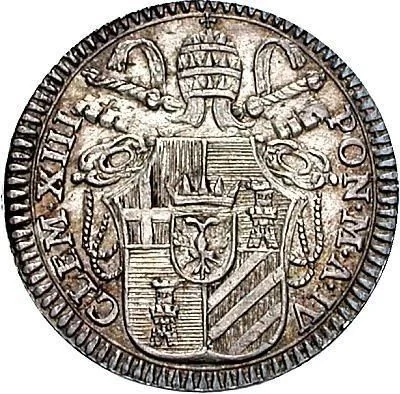
1 Grosso – Papal States
Vatican City
Context
Year: 1762
Country: Vatican City 
Issuer: Papal States
Ruler: Clement XIII
Currency:
(1534—1835)
Demonetized: Yes
Material
References
KM: #Click to copy to clipboard1002
Numista: #325527
Value
Bullion value: $3.51
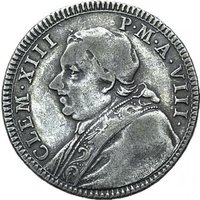
Obverse
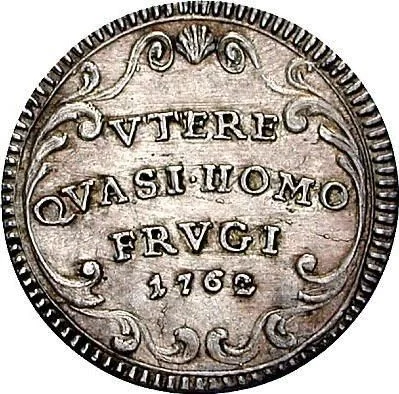
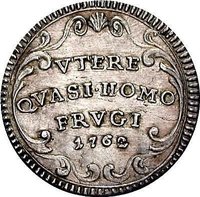
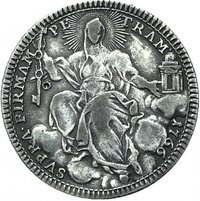
Reverse
Description:
Cartouche with four lines of text.
Inscription:
VTERE
QVASI·HOMO
FRVGI
1762
QVASI·HOMO
FRVGI
1762
Script: Latin
Edge
Plain
Mints
| Name | Mark |
|---|---|
| Rome | — |
Mintings
| Year | Mint Mark | Mintage | Quality | Collection |
|---|---|---|---|---|
| 1762 | — | — |
Historical background
In 1762, the Papal States' currency system reflected the complex and fragmented political reality of the peninsula. The primary unit was the Papal Scudo, a silver coin, which was divided into 100 Baiocchi. However, the monetary landscape was far from unified. Alongside the official papal coinage, numerous local currencies from other Italian states, such as the Tuscan fiorino and the Bolognese lira, circulated freely, creating a chaotic environment for commerce. Furthermore, the value of coins was heavily influenced by their physical silver content, leading to frequent clipping and counterfeiting, which eroded public trust and complicated trade.
The financial situation of the Papacy itself was strained. Years of deficit spending, costly infrastructure projects, and the administrative burdens of governing the central Italian territories had depleted the treasury. Pope Clement XIII (reigned 1758-1769) faced these fiscal challenges while navigating the pressures of the European Enlightenment and secular powers. To raise revenue, the papal government often resorted to manipulating the currency, such as issuing coins with reduced precious metal content or altering exchange rates. These practices, while providing short-term relief, fueled inflation and further destabilized the monetary system, harming the local economy and the populace.
Consequently, the year 1762 fell within a period of monetary instability and transition. The Papal States lacked a strong, centralized banking authority to regulate value, and the coexistence of multiple coinages made everyday transactions cumbersome. This environment highlighted the broader economic weaknesses of the Papal States, which struggled to modernize its financial structures amidst the changing political and intellectual currents of the 18th century. The situation would eventually contribute to calls for reform, though significant overhaul would not come until the following century.
The financial situation of the Papacy itself was strained. Years of deficit spending, costly infrastructure projects, and the administrative burdens of governing the central Italian territories had depleted the treasury. Pope Clement XIII (reigned 1758-1769) faced these fiscal challenges while navigating the pressures of the European Enlightenment and secular powers. To raise revenue, the papal government often resorted to manipulating the currency, such as issuing coins with reduced precious metal content or altering exchange rates. These practices, while providing short-term relief, fueled inflation and further destabilized the monetary system, harming the local economy and the populace.
Consequently, the year 1762 fell within a period of monetary instability and transition. The Papal States lacked a strong, centralized banking authority to regulate value, and the coexistence of multiple coinages made everyday transactions cumbersome. This environment highlighted the broader economic weaknesses of the Papal States, which struggled to modernize its financial structures amidst the changing political and intellectual currents of the 18th century. The situation would eventually contribute to calls for reform, though significant overhaul would not come until the following century.
✨ Legendary