

500 markkaa – Finland
Add to wishlist
Circulating commemorative coins
Commemoration: Olympic Games 1952
Finland
Obverse
Description:
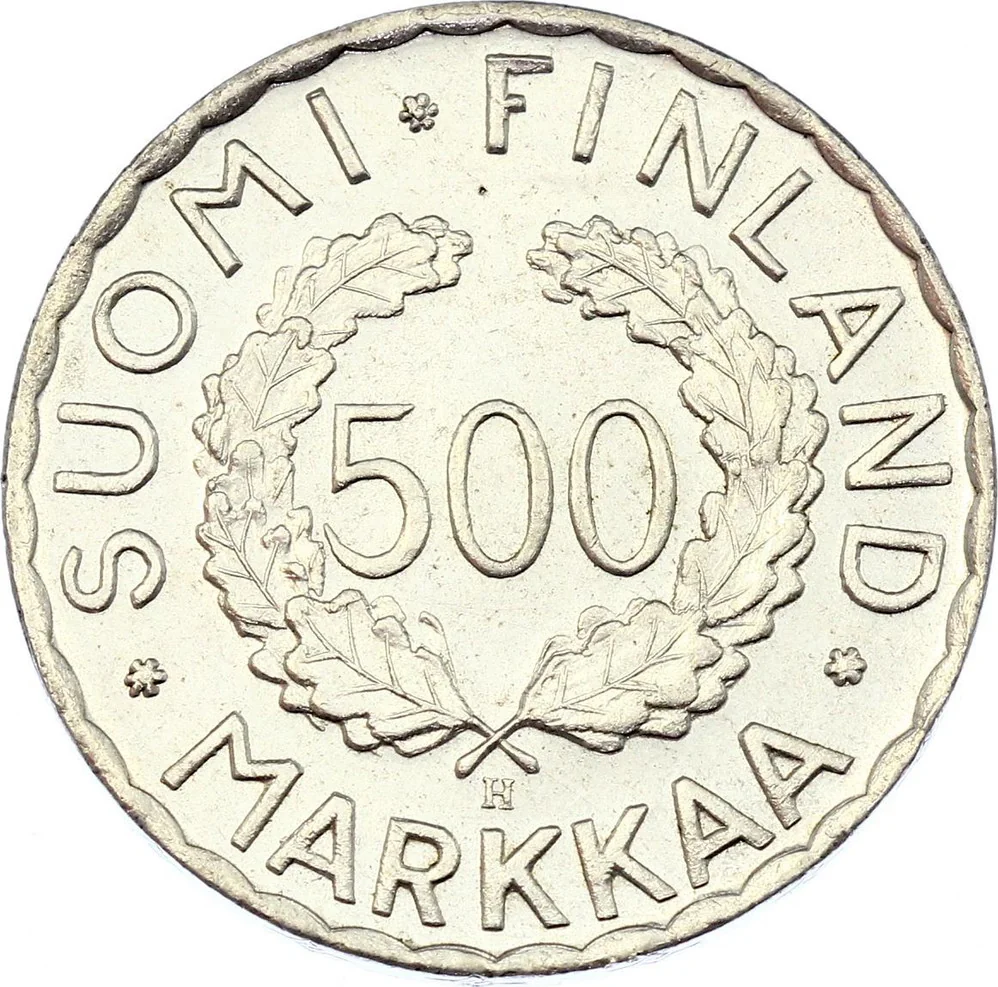
Denomination within wreath, legend around.
Inscription:
SUOMI FINLAND
500
H
MARKKAA
500
H
MARKKAA
Script: Latin
Engravers: Aarre Aaltonen, Matti Visanti
Reverse
Description:
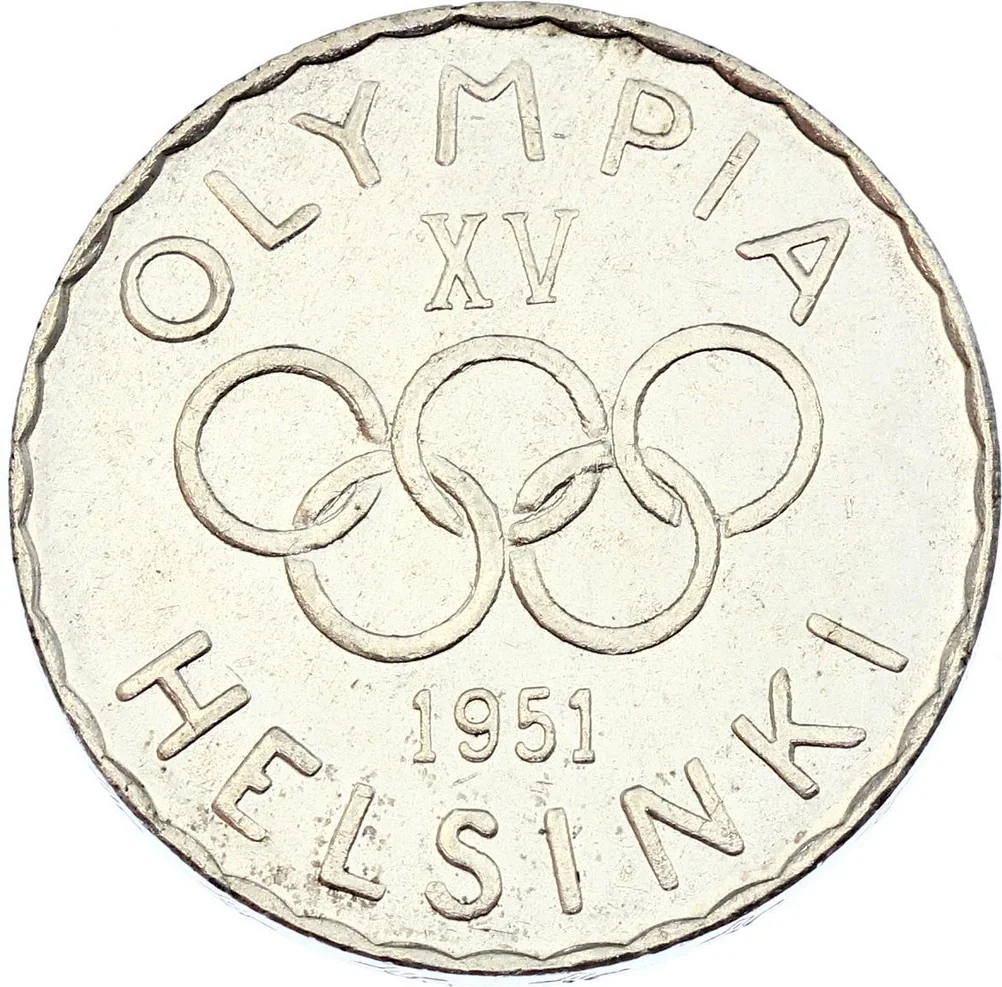
Olympic logo over date.
Inscription:
OLYMPIA
XV
1952
HELSINKI
XV
1952
HELSINKI
Script: Latin
Engravers: Aarre Aaltonen, Matti Visanti
Edge
Interlocking pattern inscription on otherwise smooth edge.
Categories
| Sport> Summer Olympic Games |
Mints
| Name | Mark |
|---|---|
| Mint of Finland | — |
Mintings
| Year | Mint Mark | Mintage | Quality | Collection |
|---|---|---|---|---|
| 1951 | — | 18,500 | ||
| 1952 | — | 586,000 |
Historical background
In 1951, Finland's currency situation was defined by the aftermath of World War II and the ongoing process of post-war reconstruction. The country was operating under a strict system of foreign exchange controls and a fixed exchange rate, managed by the Bank of Finland. The Finnish markka (FIM) was not freely convertible, and its value was set by the authorities rather than market forces. This controlled environment was essential for prioritizing the import of crucial raw materials, machinery, and goods needed to rebuild the industrial base and stabilize the economy, while conserving scarce foreign currency reserves.
Economically, the period was one of stabilization following the severe devaluation of 1949, when the markka was devalued by nearly 30% to boost exports. By 1951, this devaluation, combined with the global demand generated by the Korean War boom, had significantly improved Finland's trade balance. Exports of forestry products, the nation's economic backbone, were strong, providing vital foreign currency earnings. However, this export-led growth also fueled domestic inflation, creating a persistent challenge for monetary policy and living standards.
Overall, the currency regime in 1951 was a tool of directed economic policy, characteristic of the era. It reflected a balance between the need for economic stability, the demands of war reparations to the Soviet Union (which were paid in kind and thus heavily influenced industrial output), and the pressures of a recovering but still vulnerable economy. The system aimed to shield the rebuilding nation from external financial shocks and direct resources toward strategic recovery goals, setting the stage for the more liberalized economic policies that would follow in the coming decades.
Economically, the period was one of stabilization following the severe devaluation of 1949, when the markka was devalued by nearly 30% to boost exports. By 1951, this devaluation, combined with the global demand generated by the Korean War boom, had significantly improved Finland's trade balance. Exports of forestry products, the nation's economic backbone, were strong, providing vital foreign currency earnings. However, this export-led growth also fueled domestic inflation, creating a persistent challenge for monetary policy and living standards.
Overall, the currency regime in 1951 was a tool of directed economic policy, characteristic of the era. It reflected a balance between the need for economic stability, the demands of war reparations to the Soviet Union (which were paid in kind and thus heavily influenced industrial output), and the pressures of a recovering but still vulnerable economy. The system aimed to shield the rebuilding nation from external financial shocks and direct resources toward strategic recovery goals, setting the stage for the more liberalized economic policies that would follow in the coming decades.
🌱 Common