Logo Title
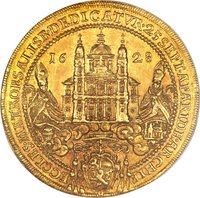
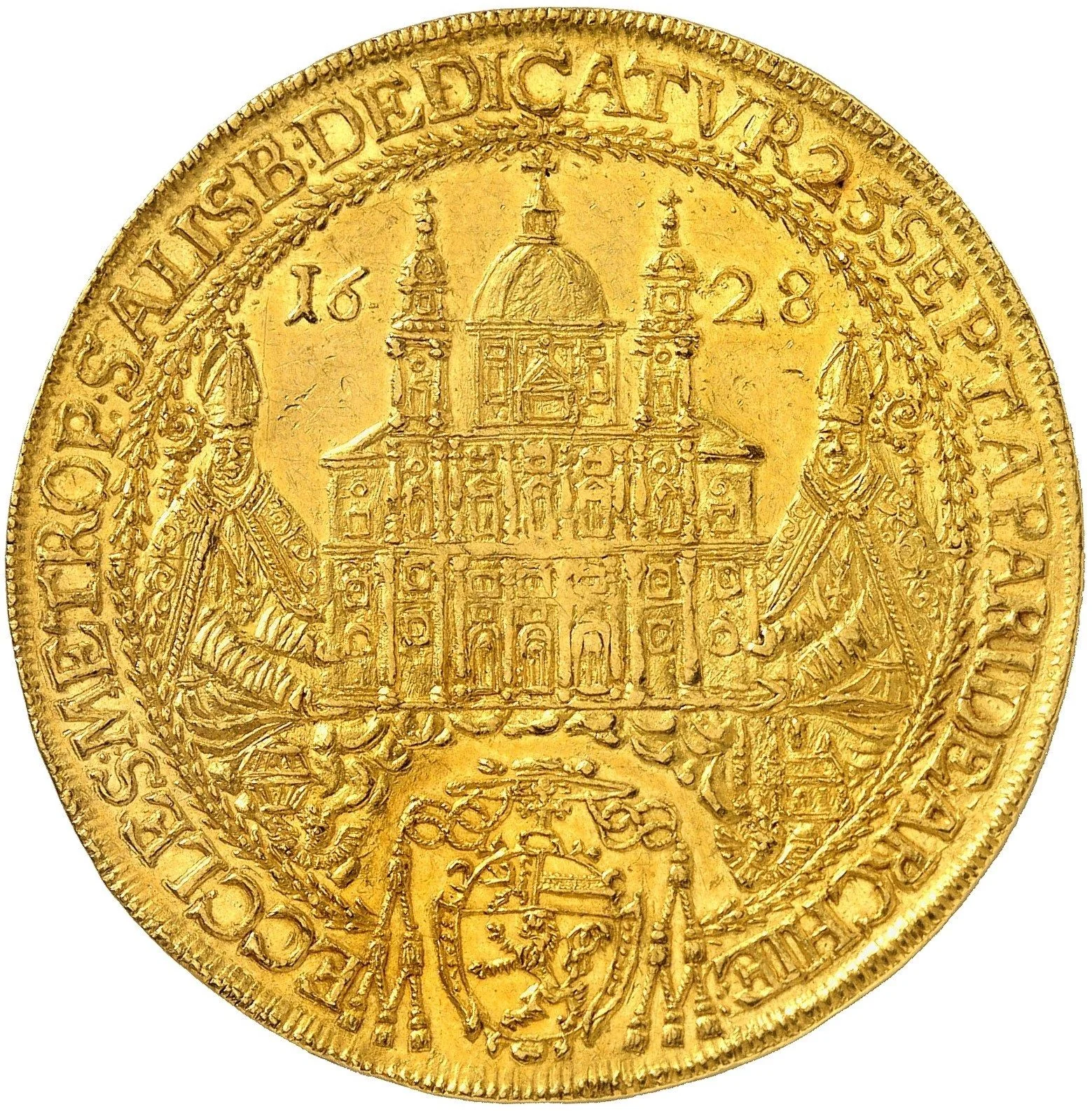
obverse
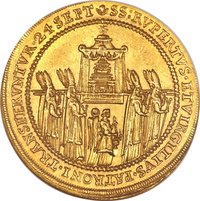
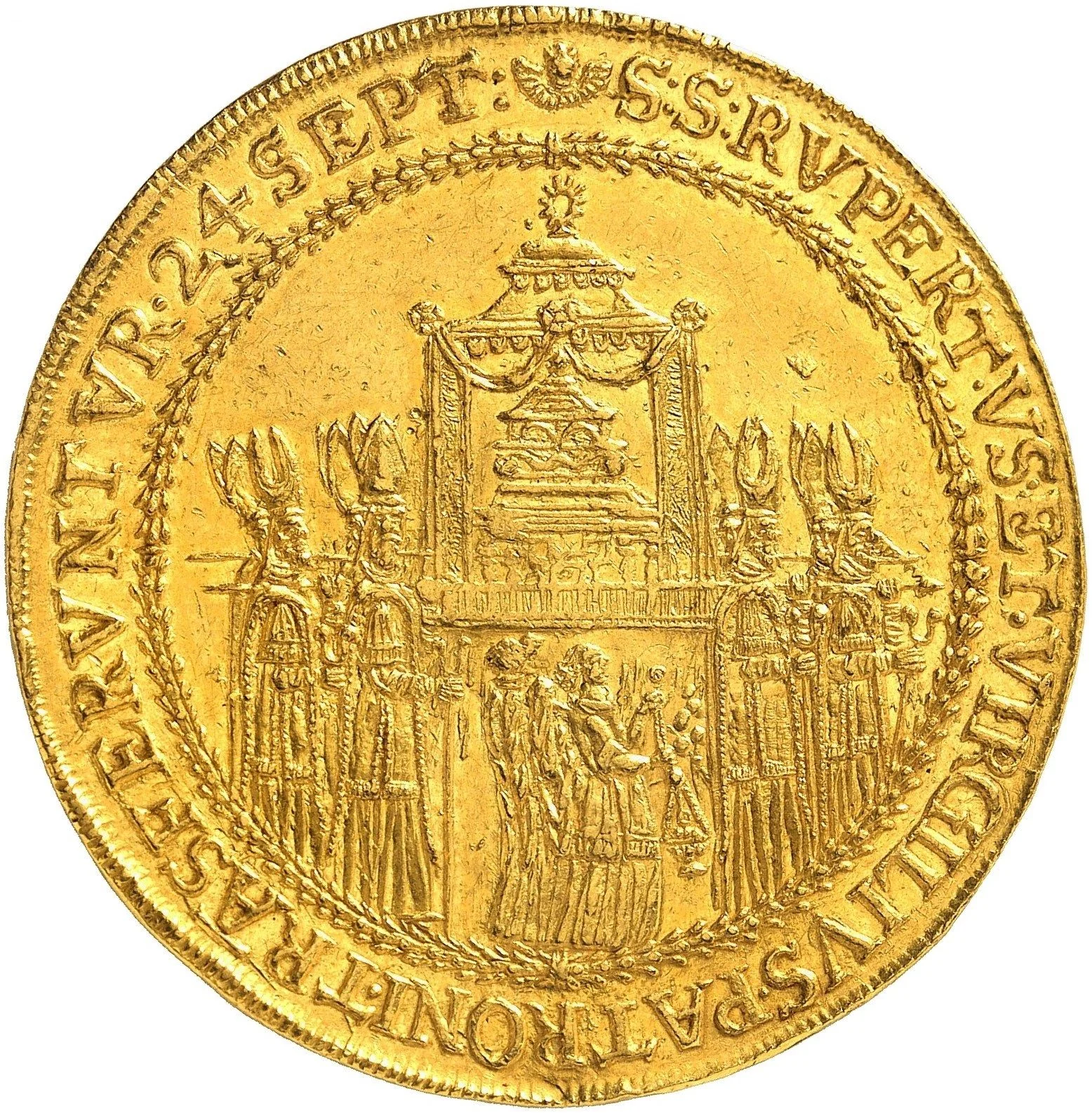
reverse
Fritz Rudolf Künker GmbH & Co. KG, Osnabrück and Lübke & Wiedemann KG, Leonberg

8 Ducats – Bishopric of Salzburg

Circulating commemorative coins
Commemoration: Consecration of St Rupert Cathedral of Salzburg
Context
Year: 1628
Currency:
Demonetized: Yes
Material
Diameter: 46 mm
Weight: 28 g
Gold weight: 27.61 g
Shape: Round
Composition: 98.6% Gold
Magnetic: No
References
KM: #Click to copy to clipboard130
Numista: #320754
Value
Bullion value: $4595.73

Obverse

Description:
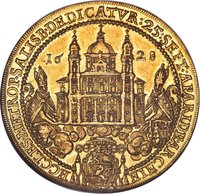
Salzburg Cathedral divides the date between St. Rupert (left) and St. Virgilius (right). The city's arms below split the surrounding legend, which begins at 7 o'clock.
Inscription:
ECCLES METROP SALISB DEDICATVR 25 SEPT APARIDE ARCHIE

1628
Script: Latin

Reverse

Description:
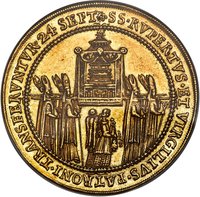
Bishops carrying a reliquary within a beaded circle, transferring the relics of St. Rupert and St. Virgil on 24 September 1628, with a surrounding legend.
Inscription:
SS RVPERTVS ET VIRGILIUVS PATRONI TRANSFERVNTVR 24 SEPT
Script: Latin

Edge

Mintings

YearMint MarkMintageQualityCollection
1628

Historical background

In 1628, the currency situation within the Prince-Archbishopric of Salzburg was characterized by the pervasive economic instability sweeping the Holy Roman Empire during the Thirty Years' War. The region, like much of Central Europe, suffered from severe currency debasement and inflation, often referred to as Kipper- und Wipperzeit. This crisis saw ruling authorities, including prince-archbishops, systematically recall coins, melt them down, and reissue them with reduced precious metal content, thereby generating short-term profit at the expense of long-term monetary trust. The resulting flood of unstable, low-intrinsic-value coins disrupted trade, eroded savings, and created widespread economic hardship for the population.

Prince-Archbishop Paris von Lodron, ruling from 1619 to 1653, faced these challenges directly. His primary focus was on Salzburg's political and military defense, famously keeping the territory largely neutral and spared from direct warfare. However, the monetary chaos from neighboring regions inevitably spilled across Salzburg's borders. While he is not recorded as a primary instigator of debasement, his administration had to navigate an economic environment where the value of coinage was highly volatile and the integrity of the monetary system was under constant pressure from both external currencies and internal economic strain.

Consequently, the currency situation in 1628 Salzburg was one of fragile dependency and market-driven uncertainty. The bishopric's economy relied on a mix of its own issued coinage and the influx of debased coins from other German states, making prices unstable. This monetary confusion compounded the difficulties of a period already marked by harvest failures, rising costs for defense, and the general upheaval of the war. The stability of Salzburg's currency, therefore, was less a function of isolated policy and more a reflection of its struggle to maintain economic order within a disintegrating imperial monetary system.
Legendary