

1 Scudo – Papal States
Vatican City
Context
Year: 1723
Country: Vatican City 
Issuer: Papal States
Ruler: Innocent XIII
Currency:
(1534—1835)
Demonetized: Yes
Material
References
KM: #Click to copy to clipboard792
Numista: #317426
Value
Bullion value: $574.89
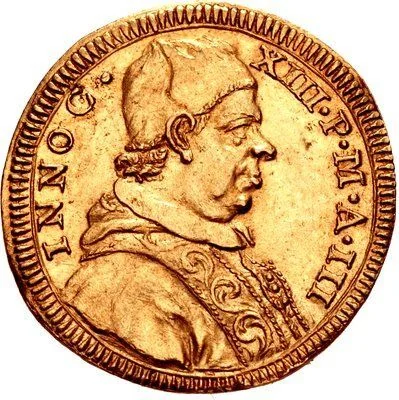
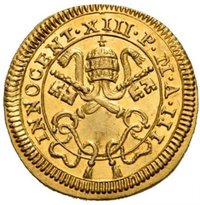
Obverse
Description:
Pope, in camauro, mozzetta, and pallium, facing right.
Inscription:
INNOC. XIII. P. M. A. III
Script: Latin
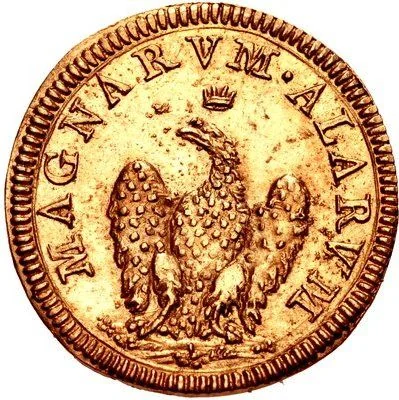
Reverse
Edge
Mints
| Name | Mark |
|---|---|
| Rome | — |
Mintings
| Year | Mint Mark | Mintage | Quality | Collection |
|---|---|---|---|---|
| 1723 | — | — |
Historical background
In 1723, the Papal States under Pope Innocent XIII faced a complex and deteriorating monetary situation, a legacy of the costly wars and expansive building projects of his predecessors. The state's finances were strained, and its currency system was fragmented and debased. The primary unit, the papal scudo, existed alongside a plethora of regional coinages from cities like Bologna and Ravenna, as well as a flood of foreign silver coins, particularly from Spain and the Italian states, which circulated at varying and unstable exchange rates. This lack of uniformity created confusion for commerce and facilitated fraud.
The core of the problem was a severe shortage of high-value silver coinage due to decades of debasement—reducing the precious metal content in coins to stretch state revenues. While this provided short-term liquidity, it drove "good" full-weight coins out of circulation, as they were hoarded or exported (Gresham's Law). Consequently, daily transactions relied heavily on a chaotic mix of low-quality copper and billon (base metal) coinage, known as moneta nera (black money). This inflationary environment eroded public trust, harmed the poor whose wages were paid in this degraded coinage, and disrupted the broader economy of central Italy.
Pope Innocent XIII’s pontificate (1721-1724) was marked by fiscal austerity and attempts at reform, but the monetary crisis proved intractable within his short reign. His government sought to curb expenditure and reduce debt, yet it lacked the resources or perhaps the political will to undertake a comprehensive recoinage or impose monetary unity. Therefore, the situation in 1723 was one of acknowledged crisis and attempted retrenchment, but with no decisive resolution. The fundamental instability would persist, posing a continuous administrative and economic challenge for the Papal States throughout much of the 18th century.
The core of the problem was a severe shortage of high-value silver coinage due to decades of debasement—reducing the precious metal content in coins to stretch state revenues. While this provided short-term liquidity, it drove "good" full-weight coins out of circulation, as they were hoarded or exported (Gresham's Law). Consequently, daily transactions relied heavily on a chaotic mix of low-quality copper and billon (base metal) coinage, known as moneta nera (black money). This inflationary environment eroded public trust, harmed the poor whose wages were paid in this degraded coinage, and disrupted the broader economy of central Italy.
Pope Innocent XIII’s pontificate (1721-1724) was marked by fiscal austerity and attempts at reform, but the monetary crisis proved intractable within his short reign. His government sought to curb expenditure and reduce debt, yet it lacked the resources or perhaps the political will to undertake a comprehensive recoinage or impose monetary unity. Therefore, the situation in 1723 was one of acknowledged crisis and attempted retrenchment, but with no decisive resolution. The fundamental instability would persist, posing a continuous administrative and economic challenge for the Papal States throughout much of the 18th century.
✨ Legendary